Russia is undertaking a large-scale effort to digitize vast archives of Soviet scientific and technical documentation — accumulated over decades and never before available in digital form — with the goal of using them to train domestic AI models. The initiative addresses a widely recognized challenge in the AI industry: the growing scarcity of high-quality training data. By tapping into what was once a paper-only repository of over two billion information units, Russian authorities hope to create specialized AI systems grounded in verified experimental data rather than the open web content that most large language models rely on today.
What you need to know
- The Soviet-era State System of Scientific and Technical Information (GSNTI) had accumulated more than two billion units of data by 1980, spanning physics, biology, mathematics, and engineering.
- As of mid-August, 483 million units of scientific and technical information have been confirmed for digitization and preparation for AI training.
- Russian Deputy Prime Minister Dmitry Chernyshenko has called for updating the GSNTI regulations to give AI algorithms legal access to these archives, according to TASS.
- The digitization process is complicated by the presence of complex mathematical formulas, hand-written annotations, multi-layered technical drawings, and deteriorating paper documents.
Why scientific data matters for AI training
Most popular AI models are trained on publicly available internet content — Wikipedia articles, news sites, blogs, and entertainment portals. While this produces capable general-purpose chatbots, it leaves them poorly equipped for rigorous scientific work. One well-documented consequence is “hallucination”: when an AI model lacks precise knowledge, it generates plausible-sounding but fabricated answers. In casual conversation this may go unnoticed, but in science, engineering, and medicine, even small inaccuracies can have serious consequences.
Feeding AI models millions of pages of real experimental results, formulas, and technical reports could enable them to identify hidden patterns across large bodies of research — patterns that would be impossible for any individual researcher to detect manually. The source suggests, for example, that analysis of thousands of archived chemical experiments could potentially help suggest formulations for new high-strength alloys, though such outcomes remain speculative at this stage.
The scale of the Soviet scientific archive
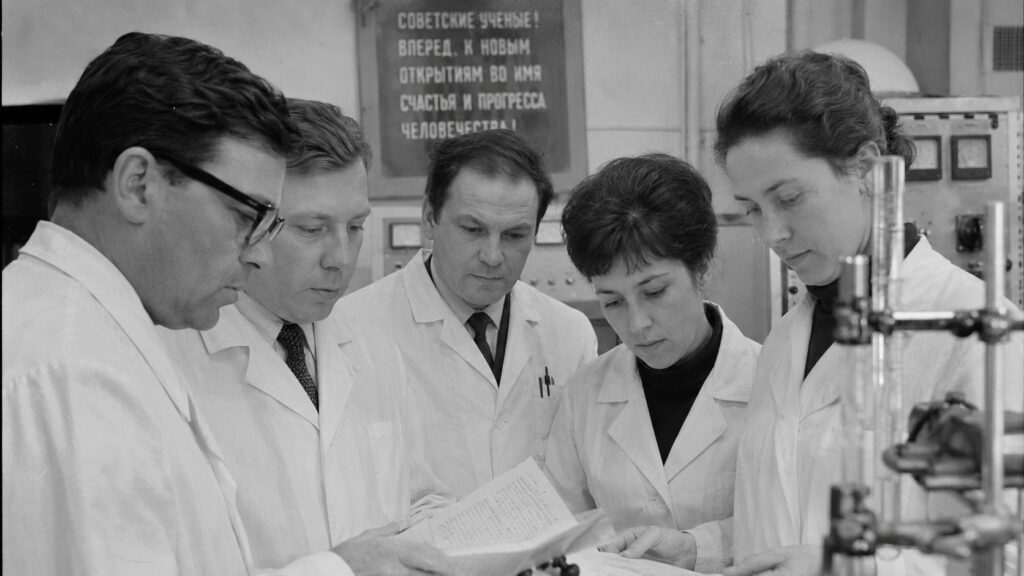
Soviet science was generously funded by the state, and every technical achievement — from space programs to geological surveys — was meticulously documented. The State System of Scientific and Technical Information (GSNTI) was created to store this knowledge. By 1980, its holdings exceeded two billion units of data, including detailed technical drawings, materials testing reports, graphs, and textual documents.
All of this was stored exclusively on paper or microfilm. Scientific documents from that era were typically black-and-white, which simplified mass copying but now presents challenges for digitization. For decades, this enormous archive sat largely unused. Finding a specific reference in a paper catalog was extremely difficult, and analyzing the full volume was physically impossible. Until now, no global AI model has had access to these materials simply because they did not exist in digital form.
What the digitization effort involves
As of mid-August, 483 million units of scientific and technical information have been confirmed and are currently being digitized and prepared for ingestion by AI systems. Beyond the Soviet-era material, the training dataset is expected to include modern research as well. The Russian government platform “GosTech” has already aggregated extensive data on Russian scientific research and development dating from 1998 onward. Federal projects are also updating scientific and technical libraries across the country.
Several anticipated benefits of combining Soviet-era and modern data for AI training have been outlined:
- Researchers could quickly locate results from past experiments, potentially avoiding costly repetition of previously documented failures.
- AI systems might identify unexpected connections between disparate scientific disciplines — for instance, between microbiology and polymer development.
- Domestic AI models could become narrow-domain experts capable of advising engineers based on verified experimental evidence.
These outcomes remain aspirational, and it is not yet clear how effectively the digitized data will translate into improved AI performance.
Why digitizing scientific archives is harder than scanning books
Converting a novel to digital text is a well-established process: scan the pages and run optical character recognition. Scientific and technical documents are far more complex. Archival reports contain intricate mathematical formulas, handwritten margin notes, multi-layered engineering drawings, and non-standard tables. A single misrecognized subscript in a chemical formula could turn a safe polymer into a nonsensical entry in the model’s memory. The process therefore requires specialized algorithms capable of understanding the context of technical drawings and correctly transferring variables.
Physical deterioration adds another layer of difficulty. Many documents have degraded over time, and specialists must painstakingly restore them to create the cleanest possible dataset for AI training.
The push for sovereign AI models
Popular global AI models are trained predominantly on English-language internet content. While they excel at text generation and programming, their scientific knowledge base is limited to what is publicly available in Western countries. The Russian government frames the creation of national AI models as a matter of technological independence: if a domestic algorithm draws on internal archives unavailable to the rest of the world, it could gain a significant advantage in specific scientific and technical domains.
At a recent meeting of the Council on Science and Education in Novosibirsk, Russian Deputy Prime Minister Dmitry Chernyshenko stated that the government’s goal is to unify all available scientific information. According to TASS, the deputy prime minister called for support in updating the GSNTI regulations to provide AI algorithms with legal access to these knowledge repositories. The long-term vision is to transform millions of forgotten archival folders into a driver of future technological breakthroughs — though the practical results of this ambitious undertaking remain to be seen.