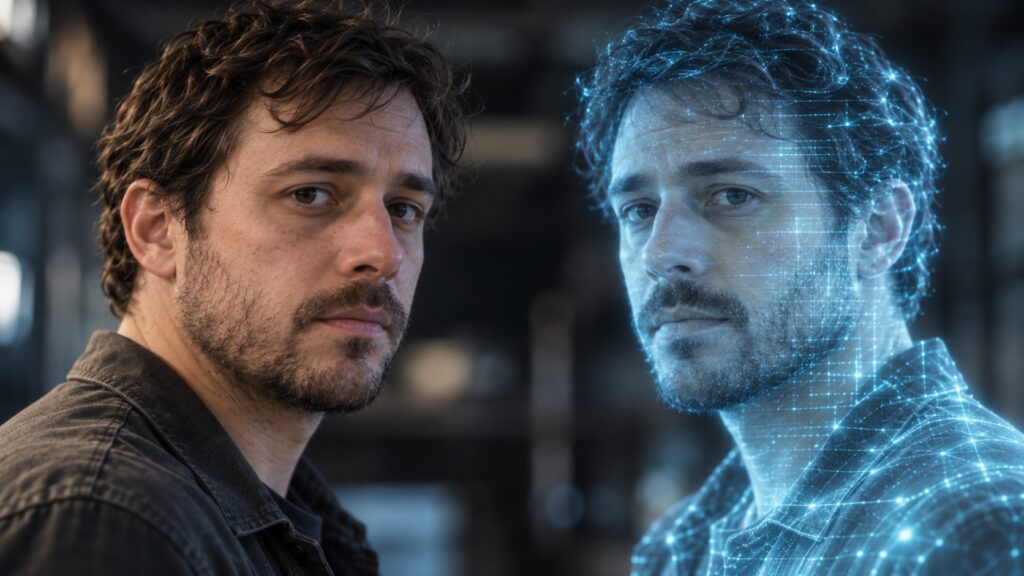
A man and his digital copy
Most debate about AI focuses on jobs, especially the idea that copywriters, accountants and call-centre operators are about to be replaced. Some of the most significant changes, however, may happen elsewhere: in everyday life, medicine, science and the internet itself. The biggest shift could come when AI becomes an intermediary between people and the world around them. Here are five such scenarios. None has fully materialised yet, but each already has a real foundation in existing technology or research.
What you need to know
- AI agents that can operate a web browser, click buttons and fill in forms already exist, and could take on paperwork and disputes with companies.
- A 2026 review in Nature Reviews Bioengineering examined digital models of the human circulatory system, part of research into patient-specific "digital twins".
- In May 2026, Nature described Robin, an AI system that helped identify drug candidates for dry age-related macular degeneration; they have so far been tested only on cells.
- On October 5, 2026, Italian Prime Minister Giorgia Meloni applied to register her voice as an EU trademark amid deepfake concerns; the application is still under review.
AI agents could handle bureaucracy and disputes with companies
A standard chatbot only answers questions. An AI agent is a program that carries out actions itself: it can click buttons, fill in forms and use websites much as a person would. Agents capable of using a browser already exist.
In one possible scenario, a user might simply say: "My internet bill went up. Find a cheaper plan or negotiate with the provider." The agent would then compare plans, read the contract, contact the provider and come back with a ready-made option. The same approach could apply to insurance, product returns, tax deductions and utility bills.
The most interesting part is the balance of power. Companies have lawyers and automated systems, while individuals often cannot be bothered to argue over a small sum. A personal "digital advocate" never gets tired: it could complete a 17-point service cancellation form in seconds. This remains a forecast, but a grounded one: AI could become a tool for fighting everyday red tape.
Digital twins could let doctors test treatments on a model of your body
A digital twin is a continuously updated computer model of a specific person. It takes into account test results, age, genetics, medical imaging, current medications and data from smartwatches. Researchers are already studying such models for cardiovascular disease, oncology and personalised treatment selection. In 2026, Nature Reviews Bioengineering published a major review of digital models of the human circulatory system.
The idea is that a doctor would first "give" a drug to the model rather than to the patient, exploring questions such as what would happen at a higher dose, how the body would respond to a different medication, which option is safer, and how health indicators might change over five years.
There is an important limitation: a model will never match a living person exactly, so this is an approximate simulation rather than a precise prediction. Even so, it could shift medicine from the principle of "this usually helps patients like you" towards "based on the model of your body, it is better to start with this". It is a bit like continuous car diagnostics, except that the vehicle is you.
Self-driving labs can search for drugs and materials around the clock
Combine AI with laboratory robots and the result is a system that reads scientific papers, forms a hypothesis, runs an experiment, analyses the results and designs the next experiment, repeating the cycle hundreds of times. A 2026 review in Nature Reviews Chemistry describes the move from simple automation towards laboratories where algorithms propose, conduct and analyse experiments themselves, with only limited human involvement.
The Robin system and its limits
In May 2026, Nature described a system called Robin, which generates hypotheses, proposes experiments and analyses their results. It was used to find drug candidates for dry age-related macular degeneration, a retinal disease that is the most common cause of blindness in developed countries. So far, the candidates' effects have been confirmed only in cells in the laboratory, not in patients, and humans still verify the results.
Why machines change the pace of discovery
The main advantage of such systems is that they need neither holidays nor sleep. They can work around the clock testing options for batteries, alloys, drug molecules, plastics, catalysts and solar-cell materials. Within a few decades, the phrase "scientists have developed a new material" might mean that people built the system and set the task, while AI found the winning combination after thousands of experiments. Ordinary users would notice only the outcome, such as a smartphone whose battery lasts three days.
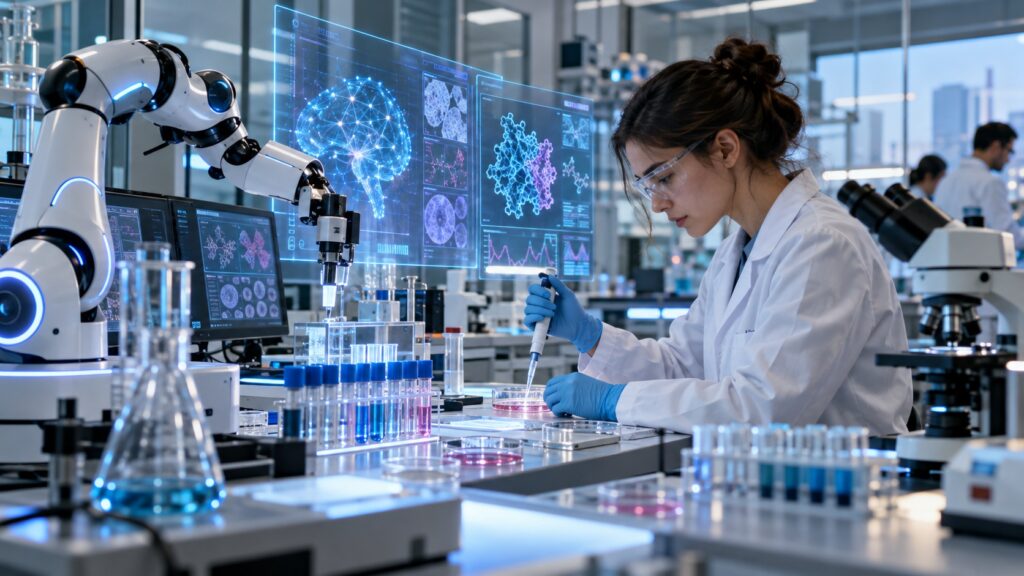
A scientist working in a laboratory with AI
AI agents may start negotiating with each other on our behalf
Today's internet is designed for people: we compare products, read reviews, choose hotels and message each other to arrange meetings. AI agents can already work on a single task across more than one request and use a range of tools. The next step could be your agent negotiating with someone else's.
A user might say: "I want a four-day trip in November, here is my budget, and no early flights." The agent would then contact airline and hotel systems directly. Instead of a long exchange along the lines of "Does Tuesday work for you?", two assistants could compare calendars in a second.
If such systems become widespread, the internet itself could look different. Websites currently compete for human attention with large banners and bright "Buy" buttons. An agent does not care about any of that; it needs prices, specifications and terms. The result is a paradox: a significant part of the familiar web could become invisible to people, with machines communicating with machines.
Proving that photos, video and voices are real
When convincing content is easy to generate, the challenge becomes proving that something is genuine. Photos, video, voices, documents and, in theory, even video calls can be faked.
One recent example: on October 5, 2026, Italian Prime Minister Giorgia Meloni filed an application with the EU's intellectual property office to register her voice as a trademark, accompanied by a four-second recording. The application is still being reviewed. Even if approved, it would not prevent voice cloning; it would simply create more legal problems for those who fake it.
Content provenance as a digital seal
This is why technologies that verify where files come from are being developed. The C2PA standard allows a cryptographically protected record to be attached to a photo or video, showing where the file originated and whether it was edited with AI. It works like a seal: the photo looks normal, but it carries a verifiable history.
In the future, a phone might be able to confirm that a video really came from a bank, or that a photo of an incident was taken by a specific camera and has not been altered. The question "There's a photo, so it must be true?" would give way to another: "Is there proof that the photo is real?"
The real change: less digital busywork
All five scenarios share a common thread. The change is not about humanoid robots but about the disappearance of countless small tasks. Forms, conversations with customer support, comparing plans and scheduling meetings would shift to machines. Outwardly, the future might look much like today; people would simply spend far less time on digital routine.
Fears about jobs are not unfounded, though they are exaggerated. Some professions are likely to be barely affected by AI: those where personal contact, manual work and responsibility for other people's lives are decisive.