Russia has experienced yet another massive disruption of VPN services and Telegram proxies. This time, a record number of MTProto proxies were hit, and many popular VPNs simply stopped connecting. Although the idea of charging for VPN traffic was temporarily shelved, the authorities have taken a different — and much harsher — approach to these services.

Roskomnadzor has once again actively targeted proxies and VPNs
Why VPNs and Proxies Stopped Working in Russia
On May 27, 2026, the publication “Code of Durov” reported an unprecedented wave of blocks. A massive number of MTProto proxy servers in Telegram simultaneously stopped working across the entire country. The problem is independent of the carrier, region, or specific provider — complaints are coming from everywhere.
Alongside the proxy outages, disruptions in numerous VPN services began. Users on specialized forums and in themed communities are writing en masse that their usual VPN services simply stopped working. For some, the VPN disconnected entirely; for others, it slowed down noticeably and became unusable.
We can also confirm this problem from our own experience: proxies from different creators and different regions became unavailable simultaneously. Everything points to a targeted and coordinated blockade, not a random technical failure.
Experts interviewed by “Code of Durov” believe that Roskomnadzor may have discovered a new vulnerability in the MTProto proxy mechanism. This is precisely what led to their mass shutdown. Simply put, the regulator learned to identify and block traffic passing through such proxy servers — whereas previously this traffic could be disguised.
Some users report that using so-called cascade methods through Russian servers helps. But this is more of a temporary measure than a full solution. It doesn’t work for everyone and isn’t always stable.
The situation is further aggravated by the fact that hosting providers have begun detecting blocking of Chrome browser fingerprints by the regulator. A fingerprint is a unique digital signature that can identify which browser is sending a request. Some VPN services disguise their traffic as regular Chrome requests to blend in with normal internet traffic. Now Roskomnadzor has learned to recognize this disguise and block such connections. Additionally, the TCP-RAW protocol has been partially blocked, which is used by a number of VPN services. In essence, Roskomnadzor is striking on multiple fronts simultaneously, shutting down both proxies and VPNs at the same time.
How the New VPN Block Differs from the Previous One
A similar situation occurred just a month and a half ago — in early April 2026. At that time, MTProto proxies also went down en masse, and Telegram users in Russia faced serious problems. However, that episode ended relatively well: Telegram developers, with community support, released an update that quickly patched the vulnerability.
But the current wave of blocks looks more serious. First, it affects not only proxies but also VPNs. Second, the blocking methods have become more sophisticated — Roskomnadzor has started detecting VPN traffic disguised as Chrome and blocking the TCP-RAW protocol, which hadn’t been discussed before. It feels as though the regulator conducted serious preparatory work and struck across the broadest possible front.
Why Using VPN on iPhone Has Become Harder in Russia
Many VPNs simply stopped connecting
A separate problem for iPhone owners is the rapid reduction of VPN apps in the Russian App Store. Apple regularly complies with Roskomnadzor’s demands and removes VPN clients from the store. In March 2026, for example, Apple removed more than 20 VPNs from the App Store, including popular clients Streisand, V2Box, and v2RayTun.
According to the Apple Censorship project, Apple has so far censored 717 apps in the “Utilities” category in Russia, which includes VPN services. And according to Apple’s latest transparency report, in 2025, 1,213 apps were removed from the Russian App Store at the authorities’ request — an absolute world record. For comparison, Vietnam had 335 apps removed during the same period, and China — 196.
The result is a vicious circle. VPNs are blocked at the protocol level through TSPU (technical countermeasure equipment), and at the application level — they’re removed from the App Store. iPhone owners are particularly affected because installing an app on iOS bypassing the App Store is still practically impossible. On Android, you can at least download an APK directly.
Number of Blocked VPN Services in Russia

A huge number of VPN apps have been removed from the App Store
To understand the scale of what’s happening, just look at the numbers. By the end of February 2026, Roskomnadzor reported restricting access to 469 VPN services. For comparison: in October 2025, there were 258 such services, and in October 2023 — only 167. That means over the past six months, the number of blocked VPNs has doubled.
Since December 2025, Roskomnadzor has been actively blocking protocols — SOCKS5, VLESS, and L2TP. Then WireGuard and OpenVPN came under blockade. TSPU equipment (technical threat countermeasure systems) installed at internet providers learned to recognize characteristic VPN traffic patterns and automatically cut them off. Admittedly, the Ministry of Digital Development acknowledged that completely blocking VPNs on iPhones is practically impossible — but that doesn’t stop the regulator from trying.
Meanwhile, the head of the Ministry of Digital Development, Maksut Shadaev, stated back in March 2026 that his department is purposefully working on reducing VPN usage in Russia. However, he called the idea of fining ordinary users for using VPNs unacceptable. For now, using VPNs in Russia is not formally prohibited — restrictions apply to those services that haven’t registered with Roskomnadzor’s registry.
How to Keep a Working VPN on iPhone
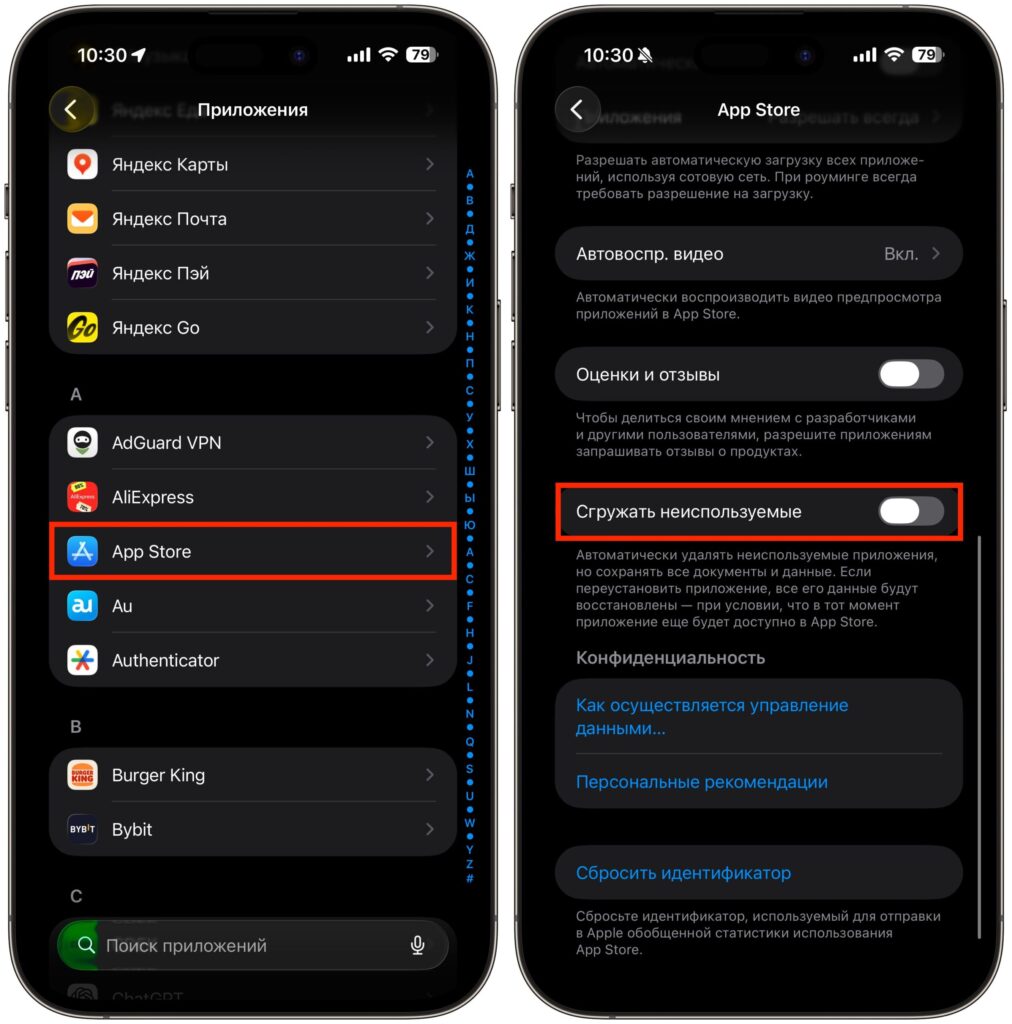
Be sure to turn off this toggle so the VPN doesn’t accidentally get deleted from your iPhone
The situation is challenging, but several options still remain. Already installed VPN apps will continue to work even if they are removed from the App Store — only updates will be lost. So if you currently have a working VPN client installed, don’t rush to delete it. Updates can be obtained through a foreign Apple ID.
As for MTProto proxies in Telegram, it’s worth waiting. In April, developers already dealt with a similar issue, and there’s a chance the community will find a solution again.