A radiator that is hot at the top and cooler at the bottom is usually working exactly as designed, provided the room itself is warm enough. The water entering a radiator gives up heat to the metal and the air as it passes through, so it leaves cooler than it arrived. The situation only becomes a fault when the top is scalding, the lower sections are completely cold, and the room fails to warm up — a pattern that most often points to weak coolant flow rather than trapped air.
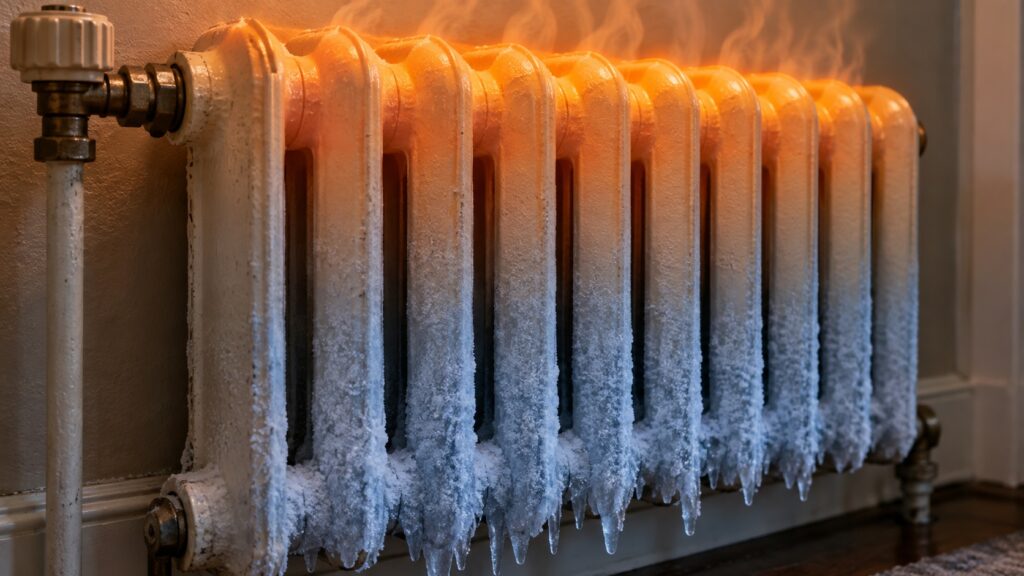
A radiator that is hot on top and cold at the bottom
What you need to know
- Water cools as it passes through a radiator, so a warmer top and cooler bottom is normal if the room reaches a comfortable temperature.
- A thermostatic head controls how much water flows through the radiator, not its temperature; a partly closed valve makes the bottom noticeably cooler.
- Engineering calculations sometimes assume a drop of around 20 degrees between inlet and outlet, but this is a design guideline, not a rule for every room.
- Bleeding air does not fix a cold bottom: air collects at the top, so a bleed valve helps only when the top is cold and the bottom is hot.
Why a cooler bottom is often normal
Hot water — the heat-transfer fluid — enters the radiator through the supply pipe. As it moves through the internal channels, it heats the metal, which in turn heats the air in the room. Because that heat leaves for the room, the water exiting into the return pipe has already cooled. If the top is hot, the bottom is somewhat cooler, and the room is warm enough, this temperature difference is typically normal operation.
Many radiators are fitted with a thermostatic head — the dial with numbers. It does not regulate the water temperature; it regulates the flow rate of water through the radiator. Once the room has warmed up, the valve partially closes and less hot water passes through. Moving more slowly, the water has more time to cool, so the lower part of the radiator can become noticeably cooler than the top. If the room still holds a comfortable temperature, the thermostat is doing its job.
How large a temperature drop is acceptable
There is no strict rule requiring, say, a drop of exactly ten degrees. The difference depends on the supply temperature, the size of the radiator, the connection layout, and how fast the water circulates.
Engineering calculations for heating equipment sometimes assume a difference of about 20 degrees between inlet and outlet. This is a design reference point, however, not a requirement for every living room, as noted on the website of VALTEC.
On long radiators, the temperature difference between sections can be more pronounced. The connection scheme — side, diagonal, or bottom — also strongly affects how heat is distributed across the unit.
Main causes of a completely cold radiator bottom
The picture changes when the top is burning hot, the lower sections are completely cold, and the room does not warm up. Most often the cause is too little flow of heating water.
At very low flow rates, the water moves through the radiator more slowly and cools more before it reaches the outlet, leaving the lower and far sections much colder. Several things can slow the flow:
- the regulating valve is partly closed or broken;
- the strainer (dirt filter) in the system is clogged;
- the riser has become unbalanced, and the water is bypassing the radiator in favour of neighbouring apartments.
In older buildings with cast-iron radiators, accumulated sludge is a common culprit. Rust and sediment build up on the bottom over years and block the lower channels, so water cannot pass downward and circulates only along the top. Such a radiator needs to be flushed.
Why bleeding air won’t help
The popular advice to “bleed the air” does not work for a cold bottom. Air is lighter than water, so inside a radiator it usually collects at the top. The bleed valve (known in Russia as a Mayevsky valve) is the right fix only in the opposite case — when the lower half is hot and the upper corner is ice-cold.
What to do if the room is actually cold
In Russia, the source notes, utility-quality standards regulate the air temperature in the room rather than the temperature of the radiator itself: a living room must be kept at no lower than +18 °C, and a corner room at no lower than +20 °C. Where the air temperature meets the standard, a cool radiator bottom by itself does not indicate a poorly delivered heating service. Standards may differ elsewhere, so readers outside Russia should check their local regulations.
If the room really is cold, the source suggests the following sequence:
- Open the thermostatic head to maximum and wait a couple of hours. If the radiator begins heating evenly, the problem was the setting.
- Compare the temperature of the supply and return pipes. If the inlet is very hot and the outlet only slightly warm, the flow is clearly insufficient.
- Check the other radiators in the home. If only one is cold, the problem is likely local — a valve, a blockage, or disrupted circulation through that unit. If all radiators heat poorly, the fault lies in the shared system of the apartment, riser, or building.
According to the source, you should never unscrew nuts or plugs on a live heating system yourself. In an apartment building the system pressure can turn the smallest leak into a serious flood of scalding water. For flushing or repairs, call a plumber from the building’s management company or an equivalent qualified professional.
Key takeaways
A temperature difference between the top and bottom of a radiator is not in itself a malfunction. The time to worry is when the radiator stops doing its main job — heating the room.
The situation can be assessed without instruments. A warm bottom with a very hot top and a comfortable room means the equipment is working correctly. A cold top with a warm bottom calls for bleeding air. A completely ice-cold lower section combined with a chilly apartment is the signal to check water circulation and call a specialist.