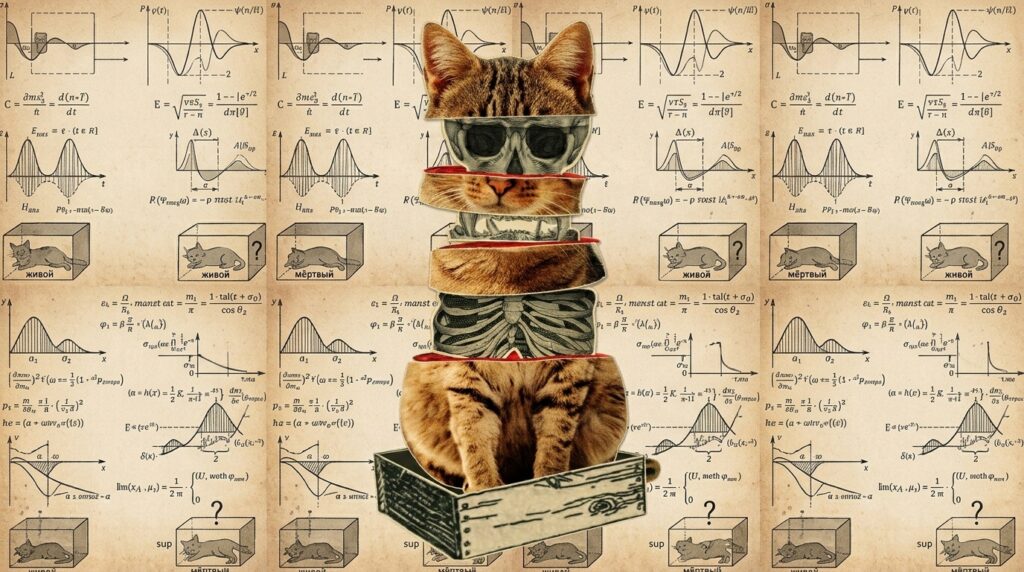
A cat assembled from body parts stands on a wooden box against a background of scientific sketches and graphs
An experiment deep under Italy’s Gran Sasso mountain has found no trace of a faint radiation signal predicted by a 1960s hypothesis. That hypothesis held that tiny random fluctuations in spacetime destroy quantum superposition in large objects. The null result rules out the tested version of the model, proposed by Hungarian physicist Frigyes Károlyházy. It also places strict limits on similar ideas. However, it does not rule out every possible role for gravity in explaining why everyday objects never behave like Schrödinger’s cat.
What you need to know
- In the reformulated Károlyházy model, spacetime jitter should gently shake charged particles. Those particles should then emit extremely weak electromagnetic radiation.
- Researchers monitored an ultra-pure germanium crystal about the size of a coffee mug for 62 days. The crystal was shielded by copper and lead and sat under 1.4 kilometres of rock.
- After the expected natural background was subtracted, the predicted signal was absent from the data.
- Other gravitational mechanisms remain open, as does the idea of a minimum possible length in nature.
Why superposition seems to vanish in the everyday world
In the microscopic world, elementary particles can exist in a superposition, meaning two states at once. Schrödinger’s famous thought experiment illustrates this paradox with a cat in a sealed box that is both alive and dead. In the everyday macroscopic world, however, chairs, cups and pets are always in one definite state. The quantum uncertainty seems to disappear.
Scientists call this transition from quantum possibilities to ordinary classical physics decoherence. It is the breakdown of superposition through interaction with the environment. Catalina Curceanu leads the VIP collaboration at Italy’s National Institute for Nuclear Physics. She notes that the disappearance of strange quantum behaviour at large scales remains one of the deepest questions in modern science.
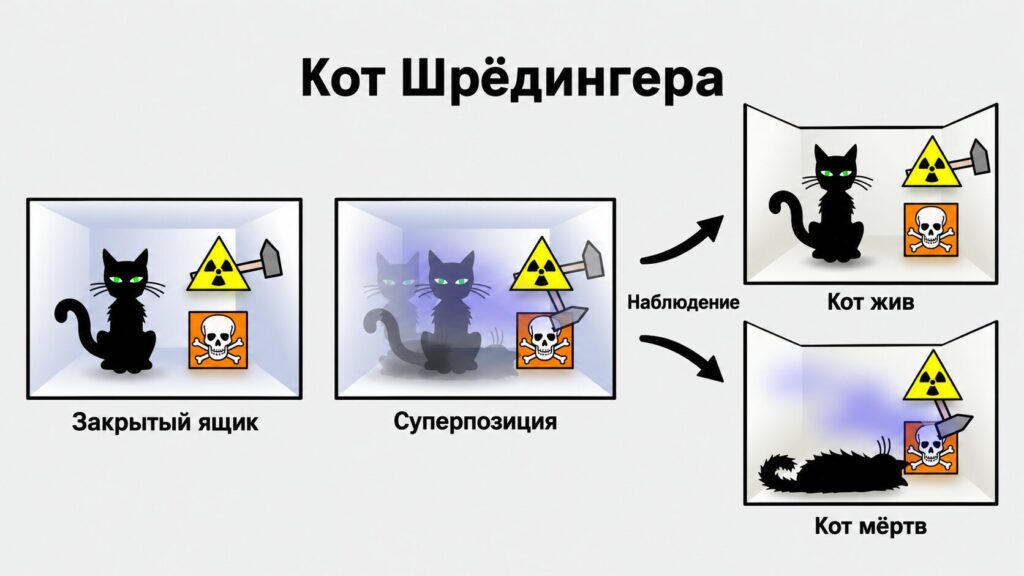
The thought experiment
In the thought experiment itself, poison kills the cat. But why can’t a real cat be alive and dead at the same time? The answer lies in its interaction with the surrounding world, which suppresses quantum effects. Scientists have suggested that gravity might also play a part. That is the idea the new experiment set out to test.
How spacetime jitter was linked to gravity
Károlyházy made his proposal in the 1960s. He suggested that spacetime is not perfectly smooth but constantly undergoes tiny random fluctuations. By his calculations, this imperceptible ripple destroys superposition in large objects and stops them from behaving like Schrödinger’s cat. The idea neatly connected quantum mechanics with Einstein’s general theory of relativity, in which gravity is described as the curvature of spacetime.
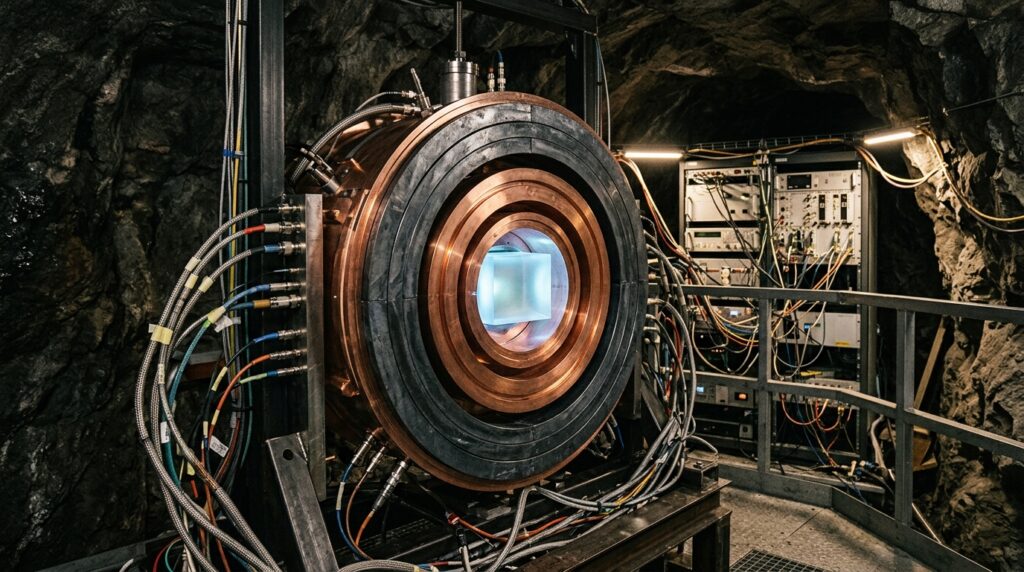
A copper instrument with cables inside a rock cavern
Turning an old idea into a testable prediction
Physicist Angelo Bassi and colleagues recently reformulated Károlyházy’s model so that its predictions could be checked with instruments. The tiny fluctuations in the fabric of the universe cannot be detected directly, but they should leave a measurable trace. If spacetime trembles slightly, it should gently shake electrically charged particles. That shaking would make the particles emit extremely weak electromagnetic radiation.
A germanium crystal beneath Gran Sasso
To hunt for this elusive signal, the researchers worked at Gran Sasso in Italy, the world’s largest underground physics laboratory. At the Earth’s surface, cosmic radiation would instantly swamp the faint emission. But beneath 1.4 kilometres of rock, there is near-perfect radiation silence.
The target was an ultra-pure germanium crystal about the size of a coffee mug, further shielded by layers of pure copper and lead. The setup collected data continuously for 62 days. The physicists then subtracted the predictable natural background and analysed the results. The signal they were looking for was not in the data.
New limits for quantum gravity theories
Here, the absence of radiation is itself an important scientific result. The experiment ruled out the tested version of Károlyházy’s model. It also set strict limits on any hypothesis that blames the loss of quantum behaviour on spacetime ripples.
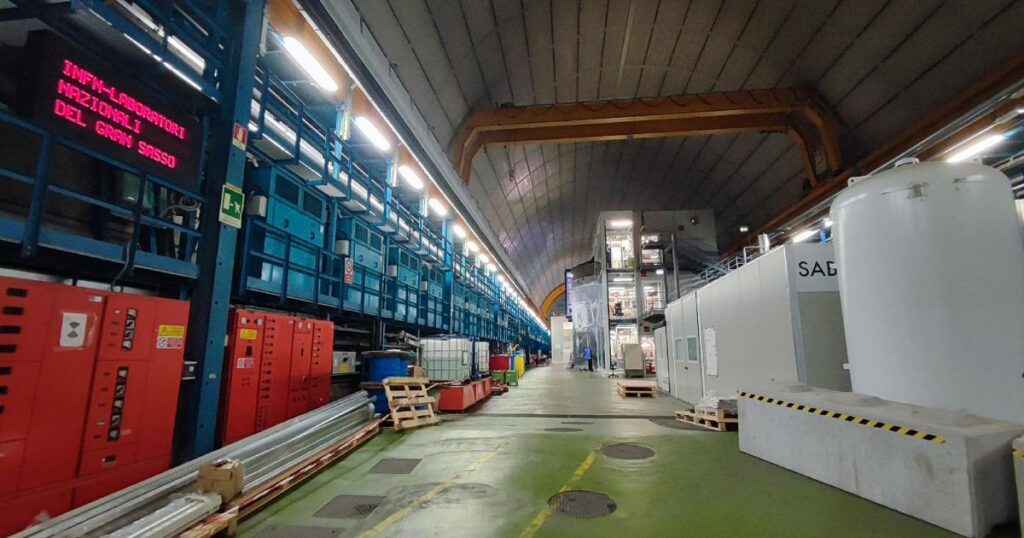
The Gran Sasso underground laboratory
What the result does not show
The Italian team’s work does not prove that gravity plays no part in the “death” of Schrödinger’s cat. Theorists still have other gravitational mechanisms to explore. These work differently and do not require this kind of radiation:
- The tested Károlyházy model is fully excluded by the new data.
- The hypothesis that nature has a minimum possible length remains viable.
- The search for other ways to connect gravity with quantum mechanics continues within new constraints.
Kristian Piscicchia, the lead author of the experiment, points to modern approaches to quantum gravity, including string theory and loop quantum gravity. These predict a fundamental limit on how precisely distance can be measured. The new data do not eliminate that limit. They do eliminate one of the oldest explanations of how it shows up in the real world. Underground detectors have now become sensitive enough to test ideas that existed only on paper for decades.