Every year, the Unicode Consortium gathers to decide which symbols humanity is missing for happiness. This time, the list turned out to be short but telling: eight new emoji and several fixes to old ones. Formally, the standard is called Emoji 18.0, and it has already been approved. All that’s left is to wait for the images to reach your smartphone. Apple last updated its emoji set in iOS 26.4, and the next batch will arrive with iOS 27.
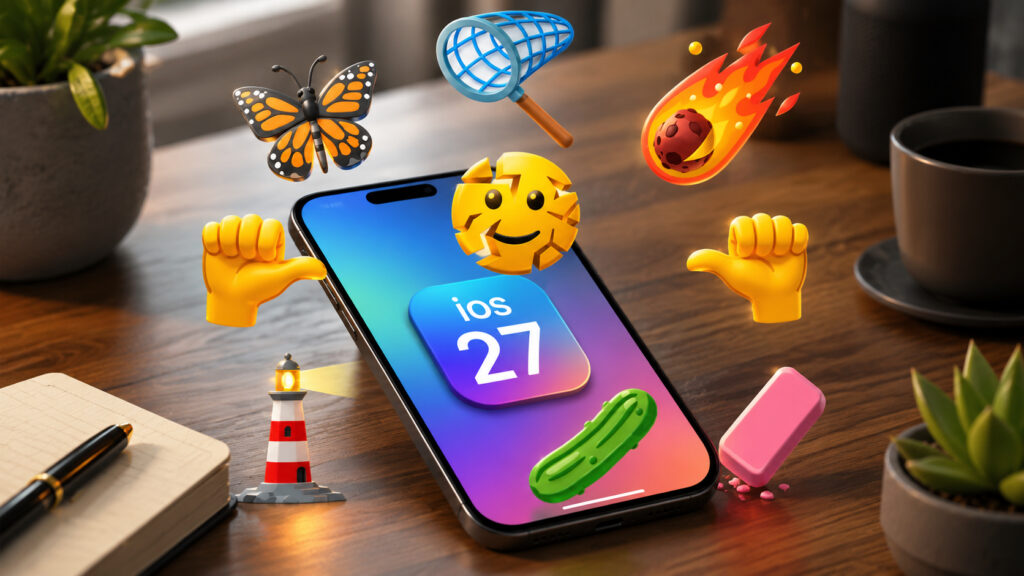
Getting ready for new emoji in iOS 27
All New Emoji Coming to iOS 27
The final Emoji 18.0 list includes eight symbols. Here is the full list of new emoji that Unicode approved this year:
- Cracked Smiling Face — the classic yellow smiley with a crack running through it
- Pickle — a bumpy pickled cucumber, separate from the regular one
- Meteor — a celestial body with a fiery tail, hurtling downward
- Lighthouse — a tower with a light, a coastal landmark
- Eraser — a rubber eraser to pair with the pencil
- Net with Handle — the very same one you used to chase butterflies around the yard as a kid
- Leftward Thumb Gesture — pointing a direction, not giving a rating
- Rightward Thumb Gesture — the mirror pair to the previous one
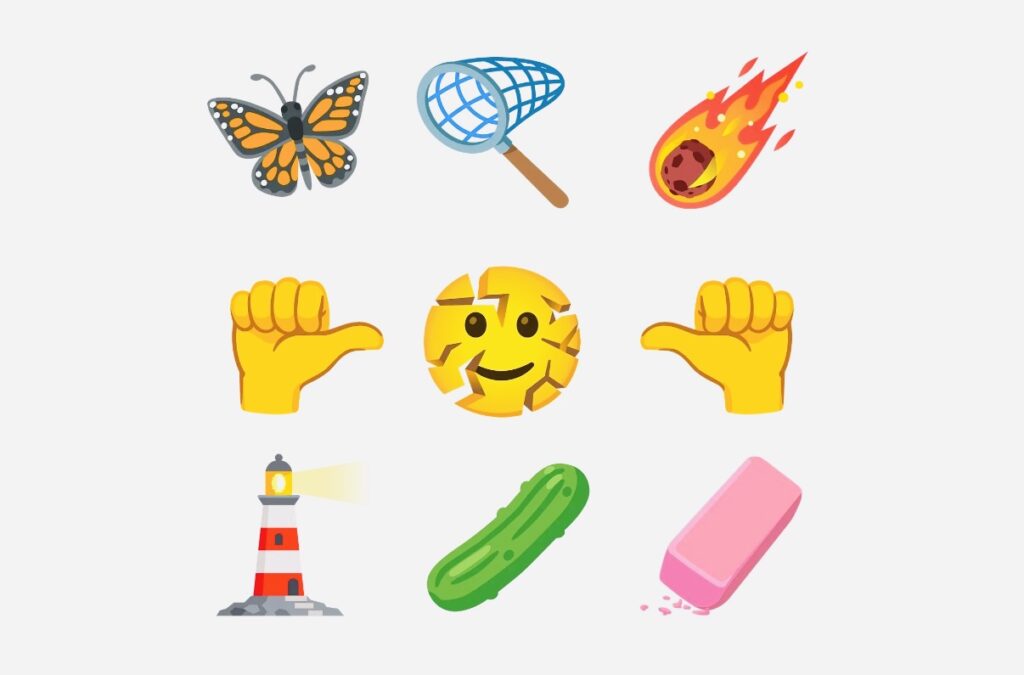
This is roughly what all the new emoji look like
The most talked-about of the eight is the cracked smiley. The meaning is instantly clear without a dictionary: smiling, but falling apart inside. Judging by how quickly the image spread across the internet, it will become the most used one. The cucumber here is not the one that has lived on the keyboard for ten years and gained a dubious reputation. This is specifically about a pickled cucumber, and that’s a separate story we’ll come back to.
The meteor and lighthouse are more straightforward. Previously, the comet partially played the role of a falling fiery object, which caused confusion. Now each object has its own symbol. And the lighthouse will be useful in a figurative sense: a guiding light, a beacon in the dark, a point of reference. The eraser fills a gap in the stationery theme that was long overdue: there’s a pencil, there’s a pen, but nothing to erase what you’ve written. And the leftward and rightward thumb gestures complete the set logically. Thumbs up and down have always been there; now there’s the horizontal axis. Swipe right, swipe left, you know the drill.
Why Old Emoji Now Look Different
New symbols are only half the work. The second half is far more interesting, because Unicode has set out to fix accumulated inconsistencies.
The main problem with emoji is that the standard only defines the meaning of a symbol, while each manufacturer is free to draw it however they want. This is where legendary stories come from, like the pistol that Apple turned into a water gun while everyone else kept it real for several more years. Or the famous burger where Google put the cheese under the patty and sparked a scandal that lasted days.
Something similar happened with the comet. The comet emoji across different platforms looked either like a tailed object in space or like a fireball plummeting to earth. People used it with different meanings and didn’t understand each other. Now the comet will once again mean specifically a comet, while the fiery celestial body moves to the new meteor. To each its own.
The same logic applies to the cucumber. Fresh and pickled cucumbers have finally been separated for good, because previously on some platforms one symbol tried to be both. Additionally, the monarch butterfly got its own separate symbol: before this, the regular butterfly was drawn as a monarch on some devices and as some abstract butterfly on others, with no consistency.
The point of all these fixes is simple. Unicode wants to eliminate discrepancies between platforms so that a symbol sent from an iPhone reads the same way on Android as the sender intended. The task sounds boring, but it’s precisely these small details that turned emoji into a source of miscommunication for years.
When New Emoji Will Appear in iOS 27
You’ll need to be patient here. Approval of the standard and the appearance of images on your smartphone screen are two very different things. First, Unicode finalizes the list, then Apple, Google, Samsung, and others draw their own versions of the symbols, then all of this goes into beta versions of operating systems, and only then does it reach users.
According to the consortium’s plans, new emoji will start appearing in spring 2027. iOS will traditionally get them first: Apple is usually the fastest to adopt the latest standard and distributes symbols along with the next major update. So you should expect them around iOS 27.4 or thereabouts, unless the company changes its usual schedule.
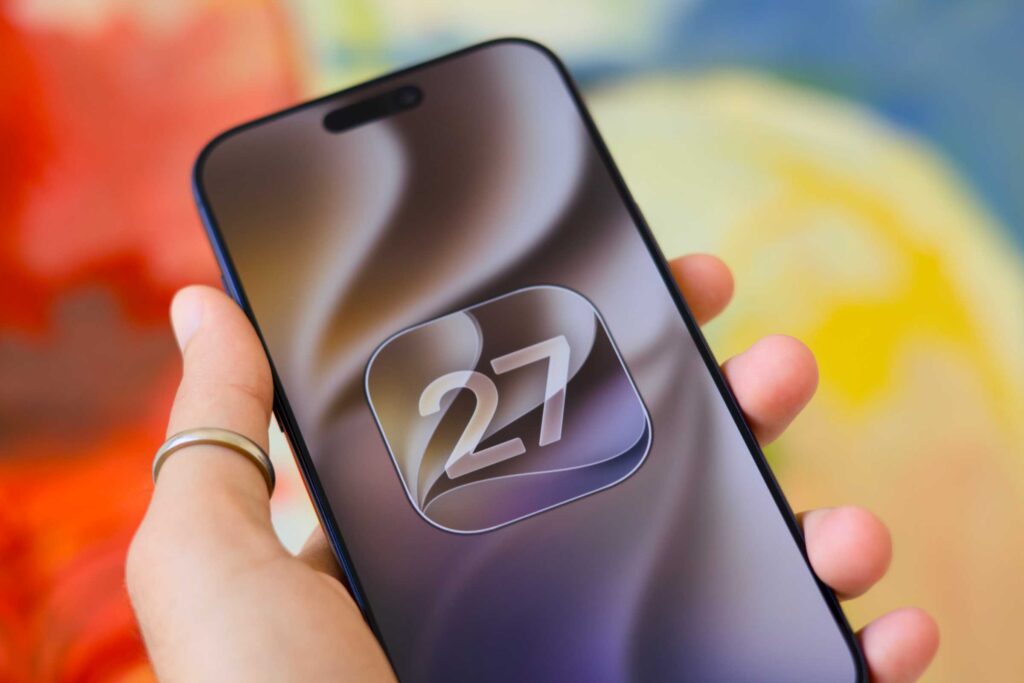
To try the new emoji, you’ll have to wait until iOS 27.4 comes out
An important note: the iOS 27 public beta is already available, but the new emoji aren’t there yet. Don’t waste time searching for the cracked smiley on your keyboard — it hasn’t been added yet. Apple adds fresh symbols as a separate stage, usually closer to the spring updates, once the artists finish their work.
There’s another nuance as well. Even when the emoji appears on your device, a contact with an older system version will see an empty square instead. This has been the case with all previous sets, and it will be the same with this one. You’ll be able to fully use the new symbols roughly a year after release, once the majority of devices have updated.
Why Unicode Is Releasing Fewer and Fewer Emoji
If it seems like eight symbols is a bit sparse, you’re not wrong. Unicode used to add several dozen emoji at a time, while recent updates have consistently been modest. The reason is that basic concepts have been exhausted. All the main emotions, foods, animals, professions, and objects have already been drawn. What’s left are niche things that the consortium debates for years.
Plus, every new symbol means work for all manufacturers at once. Apple draws its own set, Google draws its own, Samsung draws its own, and messaging apps create their own versions. The more symbols there are, the greater the chance that someone draws theirs differently and we get another burger-with-wrong-cheese situation. That’s why Unicode is deliberately slowing down the expansion and is instead fixing what already exists.
In this sense, Emoji 18.0 is telling: half the work went not into new additions but into sorting out old contradictions. The comet, cucumber, butterfly — these are all symbols that formally existed but meant different things on different devices. And that is arguably more useful than eight fresh pictures.