Scientists managed to learn more details about the Lighthouse of Alexandria
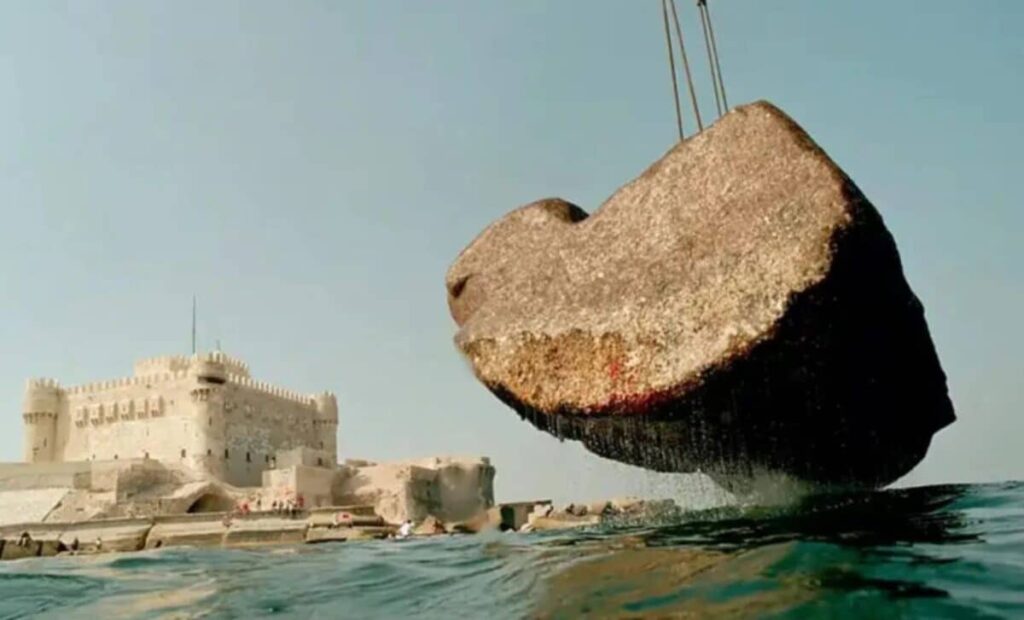
More than 1,600 years ago, the Lighthouse of Alexandria ceased to exist, as earthquakes and time turned one of the Seven Wonders of the World into a pile of stones on the seabed. Now archaeologists have raised 22 monumental stone blocks from the bottom, each weighing between 70 and 80 tons, and these fragments allow for the first time a detailed study of what the entrance to the legendary structure looked like. The PHAROS project is assembling a digital twin of the lighthouse, literally piece by piece.
Scientists Found the Ruins of the Lighthouse of Alexandria
The operation took place in the waters of Alexandria’s eastern harbor, where underwater ruins have been known since 1968. Among the recovered elements were lintels, door jambs, threshold slabs, and massive paving blocks. According to project leader Isabelle Hairy, these details most likely belonged to the monumental entrance to the lighthouse, where Egyptian and Greek architectural styles merged.

This is approximately what the Lighthouse of Alexandria looked like when it was intact
Of particular interest was a previously unknown pylon-like structure with a doorway in Egyptian style. This suggests that the lighthouse was an architecturally complex structure, far more elaborate than previously believed.
It is worth noting that the underwater zone near the Qaitbay Citadel covers about 13,000 square meters. Back in 1994, French archaeologist Jean-Yves Empereur conducted a large-scale survey and cataloged more than 3,300 objects: sphinxes, obelisks, columns, and granite blocks scattered across the seabed.
A Digital Copy of the Lighthouse of Alexandria
The PHAROS project is not limited to raising stones. Each recovered block is scanned using high-precision photogrammetry, a technology that creates a detailed three-dimensional model of an object from a series of photographs. Over the past ten years, more than 100 underwater blocks have already been digitized right on the seabed.
The new models are passed to engineers at the Dassault Systèmes Foundation, who assemble them into a virtual lighthouse, like a giant archaeological puzzle. Each block is analyzed and placed back into its position in the overall structure. In addition to physical fragments, the team uses ancient descriptions and depictions of the lighthouse — from coins of the 4th century BC to texts from the 15th century.
The goal is not a fantasy about “what it might have looked like,” but the most accurate reconstruction possible, based on real data. If the project is completed successfully, anyone will be able to “walk through” the lighthouse in a virtual environment.
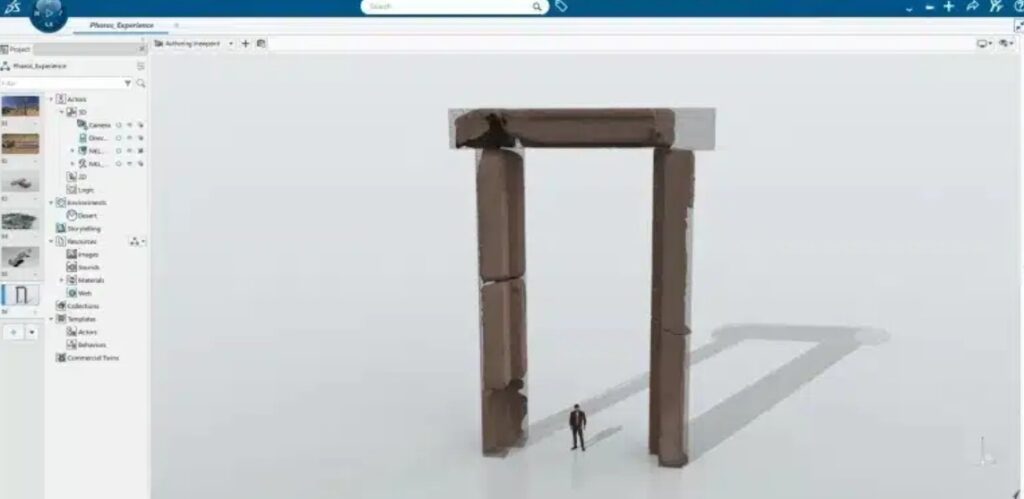
Digital copy of the entrance to the Lighthouse of Alexandria. Image source: dailygalaxy.com
How the Lighthouse of Alexandria Was Built and Why It Was Destroyed
The lighthouse was built in the early 3rd century BC, commissioned by Ptolemy I Soter and designed by Greek architect Sostratus of Cnidus. The structure stood on the island of Pharos at the entrance to Alexandria’s harbor and rose to a height of more than 100 meters, making it the tallest man-made structure in the world after the Egyptian pyramids.
For more than a thousand years, the lighthouse guided ships in the eastern Mediterranean. A fire burned at the top, and a bronze mirror amplified the light, making it visible for tens of kilometers. The word “pharos” itself became a common noun: from it came the words for “lighthouse” in French (phare), Italian (faro), Spanish (faro), and even the Russian word “fara” (headlight).
The destruction was gradual. A series of earthquakes began damaging the structure as early as the 5th century, and a massive tremor in 1303 rendered the lighthouse unusable. By 1477, the remaining stones were used to build the Qaitbay Citadel — a fortification that still stands on the same site today.
Underwater Excavations Near Alexandria
A question might arise: why raise the stones if they can be scanned right underwater? In reality, working on the surface provides a completely different quality of data. Underwater conditions in Alexandria’s harbor are difficult: murky water, strong currents, and concrete breakwater blocks that were dumped near the ruins back in 1993, obstructing access to artifacts.
The PHAROS project unites not only archaeologists and engineers but also historians, numismatists, and architects. Together they gather all available evidence, from physical blocks to descriptions by Arab travelers of the 17th century who saw the lighthouse still standing. Work has been ongoing for nearly 30 years, and the current recovery is the culmination of these efforts.
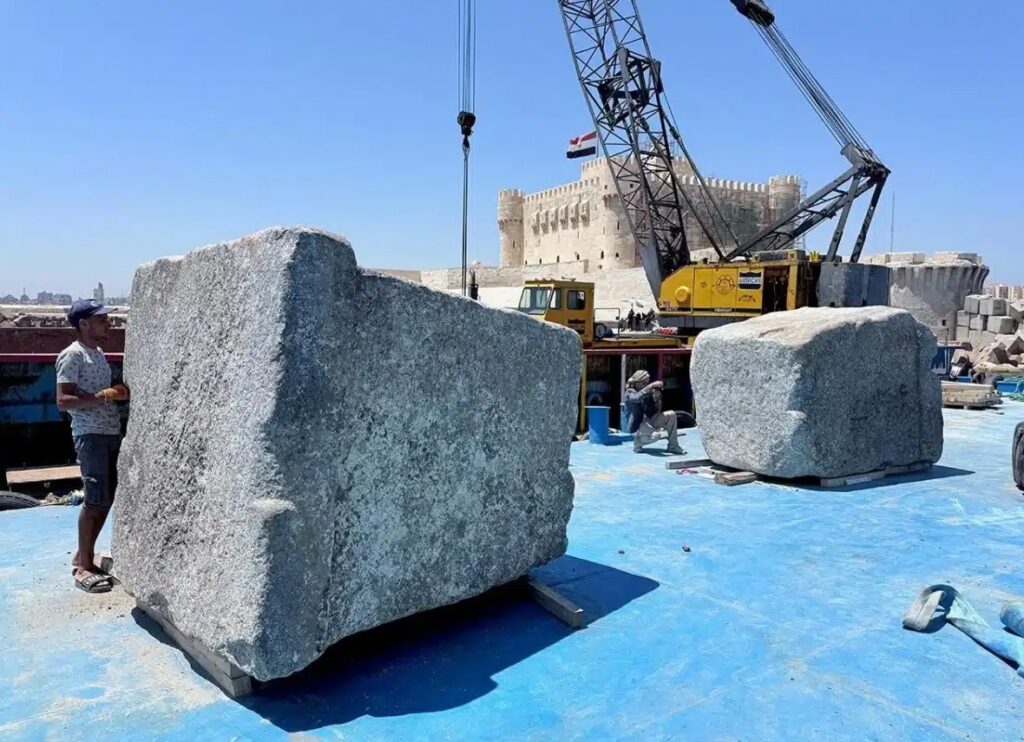
Giant stone blocks raised from the seabed at the site of the Lighthouse of Alexandria. Image source: dailygalaxy.com
The Structure of the Pharos Lighthouse
Until the latest finds, ideas about the lighthouse were based mainly on coins, mosaics, and texts, with few specific architectural details available. Now the recovered entrance elements indicate that the lighthouse combined Egyptian monumentality with Greek construction techniques. The discovered pylon — a structure with sloping walls typical of Egyptian temples — was built using Hellenistic technologies, underscoring the cosmopolitan character of Ptolemaic Alexandria.
This is an important detail for understanding not only the lighthouse itself but also the culture of that era. Alexandria in the 3rd century BC was a city where Greek, Egyptian, and later Roman traditions coexisted, and the lighthouse’s architecture appears to have reflected precisely this fusion.
The virtual model being assembled from scanned blocks is gradually becoming more and more detailed. For now, the lighthouse is “rising” only in digital form, but each new fragment brings scientists closer to the day when we can finally see one of the Seven Wonders of the World as ancient sailors once saw it.