A Geekbench 6 result attributed to the unreleased iPhone 18 Pro suggests Apple’s new A20 Pro chip scores roughly 25 percent higher than last year’s A19 Pro in both single-core and multi-core tests, and that its single-core score edges past Apple’s M4 Max laptop chip. The numbers come from a single leaked benchmark entry, not from Apple or from independent hands-on testing, so they should be treated as preliminary until the phone ships and real-world tests appear.
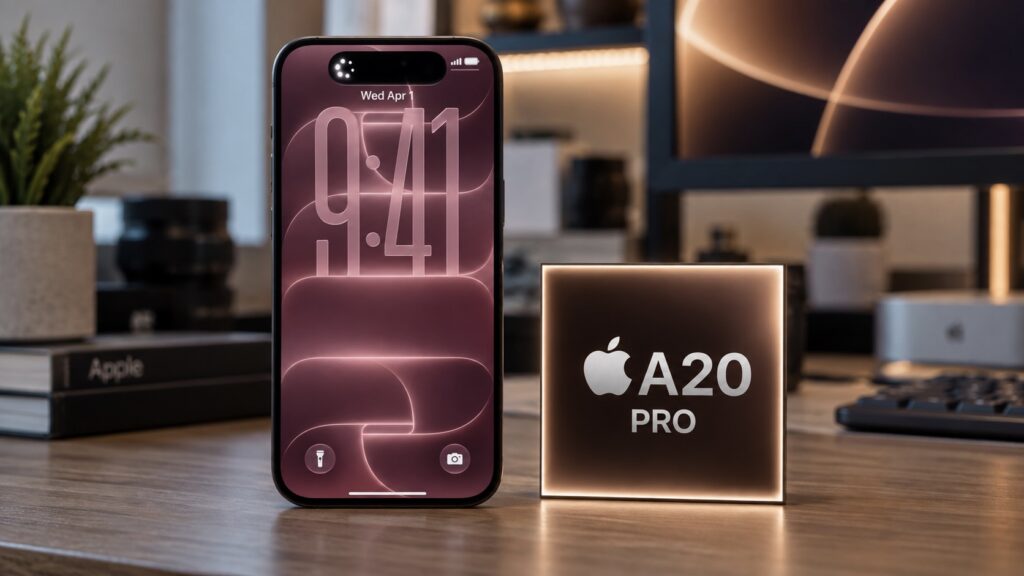
iPhone 18 Pro next to the Apple A20 Pro processor
What you need to know
- The leaked Geekbench 6 entry lists the A20 Pro at 4725 single-core and 12575 multi-core points, versus 3771 and 9955 for the A19 Pro — gains of 25.3 and 26.3 percent.
- The A20 Pro is reported to run at 4.93 GHz, up from 4.26 GHz on the A19 Pro, and the chip is said to be built on a new 2-nanometer process.
- Geekbench also lists 12 GB of RAM for the iPhone 18 Pro — the same amount as the iPhone 17 Pro, so there is no memory increase over last year’s model.
- In multi-core tests the A20 Pro still trails the M4 MacBook Air and the M4 Max MacBook Pro, which have more cores and better cooling.
How much faster the A20 Pro is than its predecessor
According to the Geekbench listing, the A20 Pro in the iPhone 18 Pro scored 4725 points in the single-core test, compared with 3771 for the A19 Pro. In the multi-core test the gap is similar: 12575 points for the new chip against 9955 for last year’s processor.
Expressed as percentages, that works out to a 25.3 percent single-core improvement and a 26.3 percent multi-core improvement. The source author notes that this is a large jump for a single generation, since Apple’s year-over-year gains are typically described as more modest, in the region of 10-15 percent.
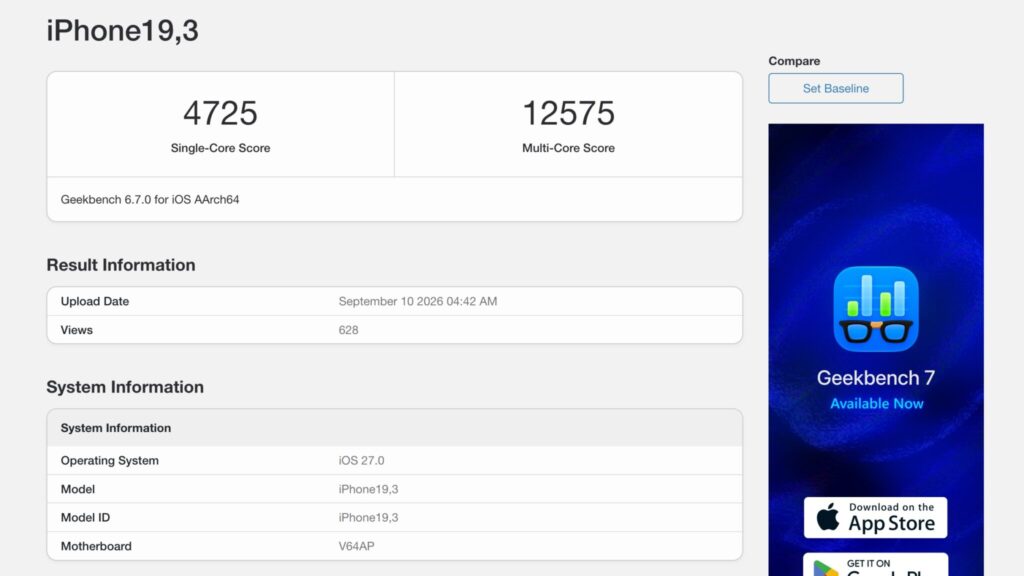
iPhone 18 Pro result in Geekbench
One caveat about the models themselves: the iPhone 18 Pro and iPhone 18 Pro Max reportedly share the same chip, but this particular run was recorded on the Pro, and it should not be presented as a measurement of the Pro Max. Benchmark results depend on the state of the system and the test conditions, so a proper comparison requires results from both devices.
Where the gain comes from
The source attributes the jump to two changes working together. First, Apple is said to have moved the chip to a new 2-nanometer manufacturing process; smaller transistors generally mean better efficiency and more computing power on the same die. Second, the clock speed has gone up.
The A20 Pro is reported to run at 4.93 GHz, whereas the A19 Pro ran at 4.26 GHz. That increase of nearly 700 MHz, combined with the new process node, is credited with most of the performance gain.
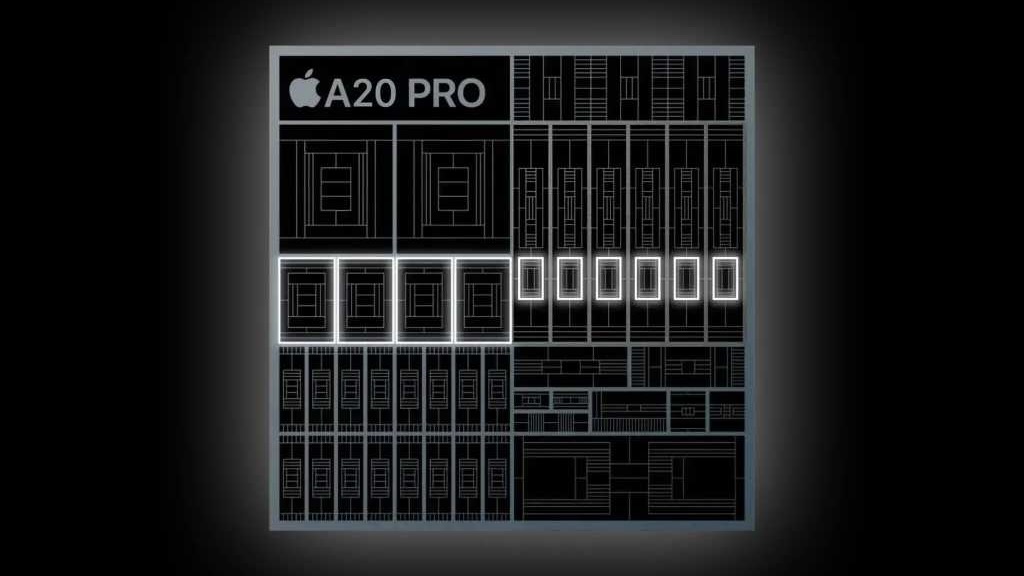
Apple A20 Pro processor
Memory: 12 GB, but no increase over the iPhone 17 Pro
The Geekbench entry also lists 12 GB of RAM for the iPhone 18 Pro, which matters for multitasking and on-device AI features. However, this is not an upgrade compared with the iPhone 17 Pro, which also has 12 GB. Any memory advantage should be judged against the specific model you would be upgrading from.
How the A20 Pro compares with Apple’s Mac chips
The most striking part of the leak is the single-core comparison with Apple’s desktop and laptop silicon. The source author compiled the following table of Geekbench 6 results across several Apple devices.
| Device and chip | Single-core | Multi-core |
|---|---|---|
| iPhone 18 Pro (A20 Pro) | 4725 | 12575 |
| iPhone 17 Pro (A19 Pro) | 3771 | 9955 |
| iPad Pro (M5) | 3531 | 14976 |
| MacBook Air (M4) | 3750 | 15000 |
| MacBook Pro (M4 Max) | 4060 | 26675 |
On these figures, the A20 Pro’s 4725 single-core points exceed even the M4 Max, Apple’s top chip for professional laptops. That is the basis for the online claim that the iPhone 18 Pro performs “like a MacBook” — but only for single-threaded work.
The multi-core picture is very different. With 12575 points, the A20 Pro falls behind the M4 in the MacBook Air and well behind the M4 Max. The reason is straightforward: laptop and desktop chips have more cores and far better heat dissipation, so they pull ahead on heavy multi-threaded workloads. A smartphone cannot match them on core count or thermals.
The fair summary, per the source, is that the A20 Pro is exceptionally strong per core but should not be expected to rival Macs in multi-threaded tasks. For everyday use, games, and video capture, single-core performance tends to matter more, which is why the phone is expected to feel very fast in practice.
Should the chip alone justify an upgrade?
A 26 percent gain looks impressive on paper, but whether you notice it depends on what you are coming from. If you already own an iPhone 17 Pro, the source author expects the difference to be hard to perceive in typical scenarios, since the A19 Pro already handles everything without stutter.
For owners of a two- or three-year-old phone, the source expects a much larger perceived difference. Compared with an A16 or A17 Pro, the new chip is described as tens of percent faster, which would show up in app launch times, photo processing, and on-device AI features. The 12 GB of RAM would also improve multitasking relative to those older models.
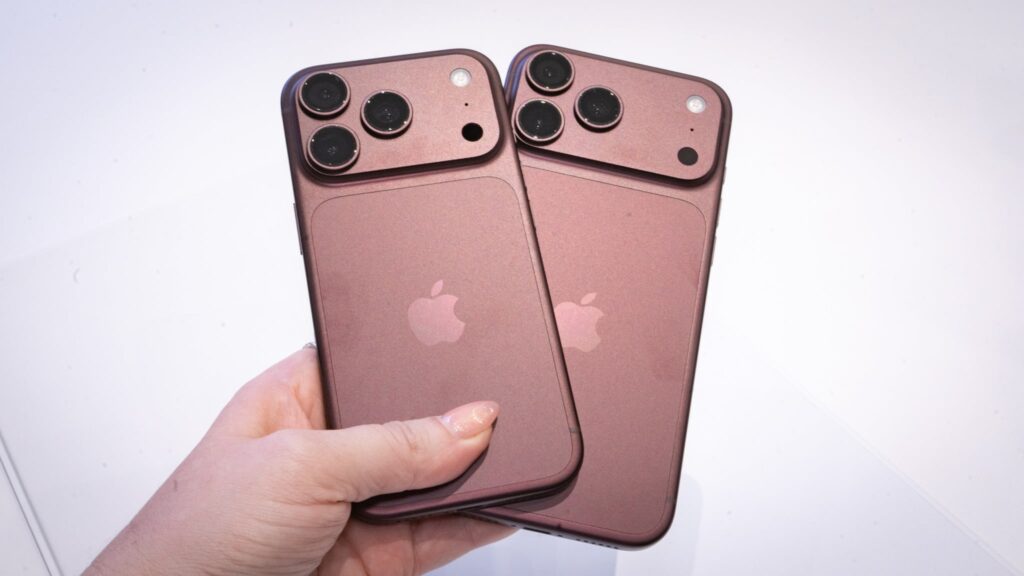
iPhone 18 Pro and iPhone 18 Pro Max, both powered by the Apple A20 Pro
Battery life and what remains unknown
Battery life is another consideration. A chip built on a finer process node is usually more power-efficient, and the source notes that the 2-nanometer process should help the A20 Pro run cooler and sustain its peak clock speed for longer. The source also mentions that Apple has disclosed the battery capacities of the new models, but no battery-life figures are given here, so real-world endurance remains to be tested.
The bottom line, according to the source: the A20 Pro appears to be a substantial step forward, especially for people who do not upgrade every year. But everything above rests on a single synthetic Geekbench run. Meaningful conclusions will have to wait for the phone’s release and for tests in actual games and apps, which will show whether the leaked figures hold up and whether the Pro model’s price is justified by its performance.