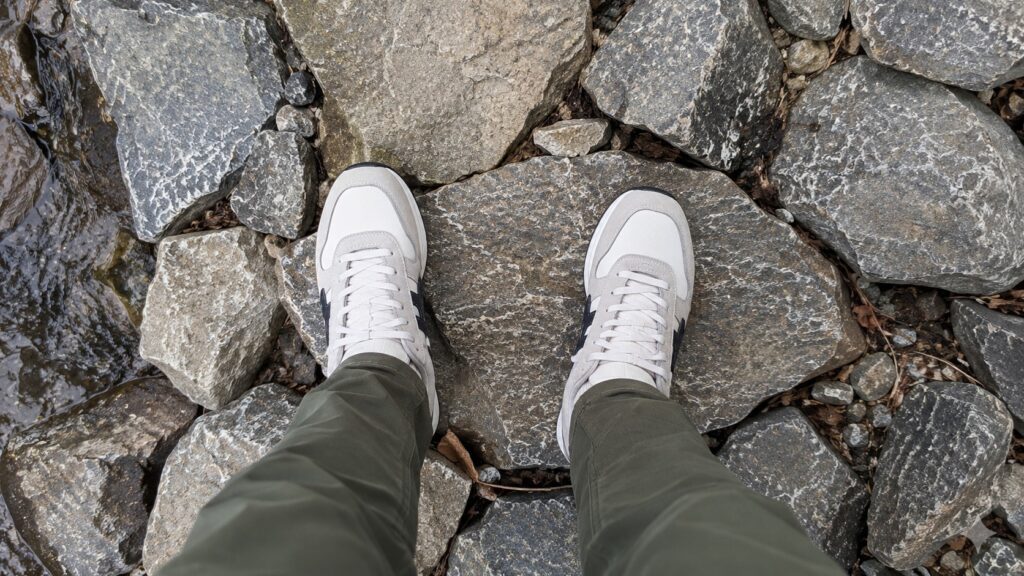
Rocks on Earth are constantly changing, and this process cannot be stopped
As children, each of us held a smooth pebble or a piece of quartz and thought: it must have been lying here forever, right? Rocks seem to us like symbols of permanence — they don’t grow, don’t breathe, don’t die. And when someone says that a particular boulder is several billion years old, a touch of skepticism stirs inside. But imagine that the very stone you squeezed in your palm could have witnessed times when the Earth was unrecognizable.
How Rocks Form on Earth
According to Lumen Learning, all rocks on Earth are divided into three major groups, and each forms in its own way.
Igneous rocks appear when molten rock — magma — rises from the Earth’s interior and solidifies. If it cools slowly, deep underground, you get granite with large crystals that had thousands of years to grow. But if magma erupts onto the surface as lava and cools quickly, basalt or even volcanic glass — obsidian — forms.
Sedimentary rocks are the result of wind, water, and time at work. Rivers, glaciers, and rain break down existing rocks, turning them into sand, clay, and small fragments. These particles accumulate layer by layer, become compressed, and over millions of years turn into sandstone, limestone, or shale.
Metamorphic rocks are stones that already existed but were so intensely compressed and heated deep in the Earth’s crust that they completely changed their structure. The same granite under enormous pressure transforms into gneiss, and limestone becomes marble.
It’s important to understand that rocks are not created once and forever. Authors at ZME Science explain that they are constantly recycled through the geological rock cycle. Granite can break down and become sand, sand can compact into sandstone, and that sandstone can melt into magma and give birth to a new rock. This cycle has no beginning or end — it has been going on for 4.5 billion years.
How Old Are the Rocks on Earth
Most rocks on the Earth’s surface are between a few million and two to three billion years old. Rocks older than that are a great rarity because the Earth’s crust is constantly being renewed.
It comes down to plate tectonics: the Earth’s crust is divided into enormous blocks that slowly move. In some places, new crust is born, while in others, old crust sinks deep down and gets melted. That’s why most rocks don’t survive past 2–3 billion years — the Earth’s “grinder” crushes them before they get the chance.
The youngest rocks on Earth can be literally just a few years old — solidified lava from recent eruptions. And the ocean floor near mid-ocean ridges is forming right now. The oldest sections of the ocean floor, about 200 million years old, are located as far as possible from the ridges, near the shores of the northern Atlantic and the northwestern Pacific Ocean.
So the rock in your backyard could very well be older than the dinosaurs, or it might turn out to be young by geological standards — it all depends on the region and type of rock.
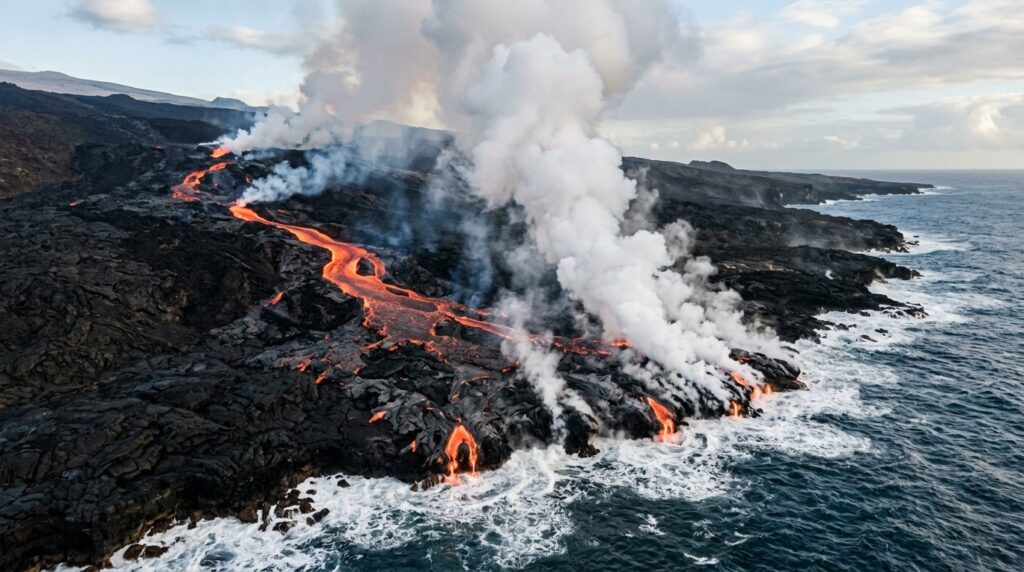
Fresh lava cools at the ocean shore — this is how the youngest rocks on Earth are born
The Most Ancient Rock and Mineral on Earth
The record holder among whole rocks is the Acasta Gneiss — a rock from the Canadian Shield in northwestern Canada. Its age, determined by zircon crystals within the rock, is about 4.03 billion years. This means the rock formed at the dawn of the planet’s existence, when the Earth was only about 500 million years old.
But there is something even older — though not a whole rock, but an individual mineral. According to Elementy.ru, in the Jack Hills of western Australia, a tiny zircon crystal aged 4.374 billion years was found. This is the oldest solid material of terrestrial origin that has been discovered and reliably dated. The rock in which it originally formed was long ago destroyed and recycled by plate tectonics, but the zircon survived because this mineral is incredibly resistant to heat, pressure, and erosion.
By the way, the Earth as a planet is approximately 4.54 billion years old. So that Australian zircon formed when the planet was only about 160 million years old — roughly in the first 3–4% of its existence.
How Scientists Determine the Age of Rocks
Geologists have two fundamentally different approaches: relative and absolute dating. Specialists from Thermo Fisher have described them.
Relative dating is when you determine not the exact age but the order: this layer is older than that one. If one rock layer lies beneath another and both haven’t been overturned, the lower one formed earlier. This approach doesn’t give a number in years but allows you to establish a sequence of geological events.
Absolute dating involves measuring age in years, and here the main role is played by the radiometric method. It is based on a simple but powerful principle: some atoms are unstable and over time transform into other elements. Uranium, for example, gradually decays and becomes lead. The rate of this transformation is known with high precision, and it doesn’t change with temperature or pressure.
Imagine an hourglass where sand flows from the top half to the bottom at an absolutely constant rate. If you know how much sand was there at the start and how much has already accumulated at the bottom, you can precisely calculate how much time has passed. Radiometric dating works on the same principle: scientists measure the ratio of the “parent” element (for example, uranium) to the “daughter” element (lead) inside a mineral and calculate the age.
Different “clocks” are used for different ages:
- Carbon-14 — for relatively young objects (up to 50,000 years), more commonly used in archaeology;
- Potassium-argon — for volcanic rocks aged from 20,000 to 4.5 billion years;
- Uranium-lead — the most precise method for very ancient rocks; this is the method used to date the Acasta Gneiss and the Australian zircons.
The mineral zircon is ideal for these “clocks”: during formation, it captures uranium atoms but completely excludes lead. Therefore, all the lead found inside a zircon definitely formed from uranium decay after crystallization. This makes zircon, in geologists’ words, the most reliable natural chronometer for studying the early history of Earth.

A scientist analyzes a mineral in a laboratory using a mass spectrometer
Why Rocks Exist for Billions of Years
Rocks don’t have a biological age in the usual sense — they don’t age, deteriorate, or break down from having existed too long. A rock that is 3 billion years old is no weaker than a rock that is 3 million years old.
But rocks do break down — not from old age, but from external forces. Water seeps into cracks, freezes, and splits the rock. Wind carries sand grains that wear down the surface. Roots grow into cracks and literally split rocks from the inside. And acid rain gradually eats away at limestone.
The geological rock cycle is designed so that material doesn’t disappear but goes in circles: a rock crumbles, the fragments turn into sediment, the sediment compacts into new rock, and that rock may one day sink back down and melt into magma. That’s why almost no rocks older than 3–4 billion years remain on Earth’s surface. It’s not that they aged — they were simply recycled.
The mineral zircon, however, is a survival champion. It is so resistant to any impact that it can survive several complete cycles of rock destruction and remelting while preserving its crystal structure and its “record” of age. That is why the most ancient evidence of early Earth has been preserved inside tiny zircon crystals rather than in the form of giant boulders.
The rocks around us are material witnesses to the planet’s history, each carrying information about the conditions under which it formed. An ordinary boulder by the road may be older than all civilizations, all animal species, and even entire oceans. And dating methods allow us to read this history — with an accuracy of a few million years, which for a scale of billions is not bad at all.