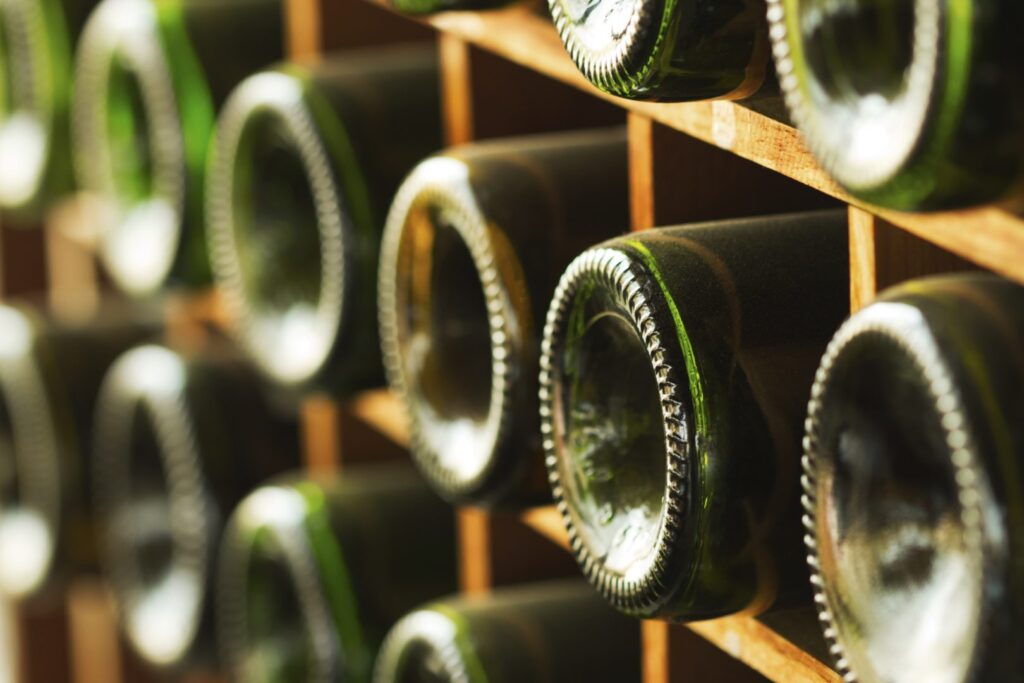
Why wine bottles have these strange indentations on the bottom
You’ve probably also chosen wine based on the indentation on the bottom of the bottle (among other criteria) and believed it indicated the quality of the drink. But the concave indentation, which winemakers and sommeliers call a punt, isn’t there for that reason at all. Behind it lies a history spanning several centuries (but I’ll try to keep it brief), a bit of physics, and a lot of marketing. And no, a deep punt doesn’t guarantee that the wine inside is good.
The Indentation on the Bottom of a Wine Bottle: What It Is and Why It’s There
A punt is a concave indentation on the bottom of a bottle that looks as if someone carefully pushed the glass inward. The name comes from the word “punty” or pontil — the metal rod that glassblowers used when hand-blowing bottles. It’s also sometimes called a “kick-up.”
If you’ve been to a fine restaurant, you’ve probably seen a sommelier elegantly pouring wine with one hand, pressing their thumb right into this indentation. Among sommeliers, this technique is sometimes jokingly called the “proctologist’s grip” — it doesn’t sound as refined as it looks.

Although not all sommeliers pour wine using the punt.
Why Wine Bottles Developed a Concave Bottom
The punt appeared in an era when bottles were blown by hand. Creating a perfectly flat bottom was virtually impossible: as the glass cooled, the center of the base often bulged outward, causing bottles to wobble and stand unsteadily.
The solution was elegant: while the glass was still hot, the craftsman pushed the soft bottom inward. This is how the familiar concave shape appeared — it was a purely practical solution to a side effect of manual production.
There was another detail. Old glassblowing methods left a sharp scar from the pontil on the bottom of the bottle. By pushing the base inward, craftsmen eliminated this dangerous irregularity — making bottles safer.
In other words, the punt wasn’t designed as a design element. It was an engineering workaround that helped crooked bottles stand straight and not injure people.
Why Champagne Bottles Have a Concave Bottom
For still wines, the punt is more of a tradition. But for sparkling wines, the indentation on the bottom serves a real engineering function, and the integrity of the bottle depends on it.
Sparkling wines contain internal pressure from dissolved carbon dioxide. The concave bottom helps distribute this pressure more evenly across the bottle walls, increasing its strength and resistance to breaking. The pressure inside such bottles can reach 5–6 atmospheres — approximately 87 psi.
Imagine a cathedral dome: a concave shape distributes the load more effectively than a flat surface. The punt works on the same principle — the pressure from champagne (up to 90 psi) is redirected from the center to the walls, which are stronger.

Diagram of pressure distribution in a sparkling wine bottle
In earlier times, when glass wasn’t reliably strong, the punt helped compensate for pressure during the secondary fermentation of champagne. According to wine historian Hugh Johnson, 80% of the 1828 champagne harvest was lost due to bottle explosions. So the deep punt in champagne isn’t about showing off — it’s literally protection against explosion.
The Indentation on the Bottom of a Bottle Doesn’t Indicate Wine Quality
One of the most persistent myths: the deeper the punt, the better the wine. Many people are convinced of this, but it’s a misconception. Most experts agree that wine quality cannot be judged by the size of the indentation on the bottom of the bottle.
Sommelier and wine specialist Stéphane Sanchez explains directly: the punt is the producer’s choice, and it has no effect on the quality of the wine inside. It makes sense for wines intended for long aging — for example, Bordeaux. But for a rosé that will be drunk within a year, a deep punt serves no purpose.
If a connection exists, it’s indirect: producing bottles with a punt requires more glass and costs more. On that basis, one might assume that premium wines more often use this design. But it’s not a rule — Riesling bottles, for example, traditionally don’t have a punt, even though there are plenty of expensive and outstanding Rieslings.
There’s also a frankly marketing aspect. Some producers make the punt larger and increase the overall size of the bottle so the wine looks more expensive. The bottle appears bigger, but the volume is still the same — 750 ml.
How the Indentation on the Bottom of a Bottle Relates to Sediment
Another popular theory is that the punt supposedly helps collect sediment during wine aging, preventing it from getting into the glass. In old unfiltered wines, sediment does indeed form over time. The punt may help it settle in a ring around the edge of the bottom, which makes careful decanting easier.
But there’s an important caveat. There are virtually no scientific studies that convincingly prove that the shape of the punt fundamentally improves sediment collection. Many winemakers have believed for centuries that the punt helps sediment form a ring on the bottom. This theory is still debated, but it has certainly influenced bottle design.
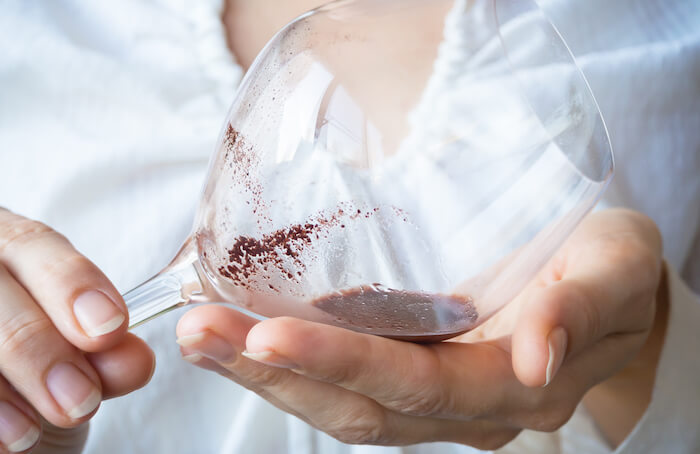
Sediment collected in the remains of wine from a bottle.
Why the Punt in a Wine Bottle Became a Marketing Detail
Modern bottles are made by machines, and glass has become much stronger. Machines long ago replaced glassblowers and easily produce bottles with perfectly flat bottoms without any scars. For still wines, the punt no longer serves a structural function — it remains part of tradition.
In bottles for sparkling wines, the punt is still important due to internal pressure. But for all other wines, it’s a purely aesthetic and marketing decision: a bottle with a punt looks more impressive, feels heavier in the hand, and allows a sommelier to beautifully pour wine with one hand.
The trend toward sustainability and reducing the carbon footprint is already leading winemakers to use punt bottles less frequently — the extra weight of glass increases emissions during transportation. So in the future, the familiar dimple on the bottom of a bottle may become a rarity.