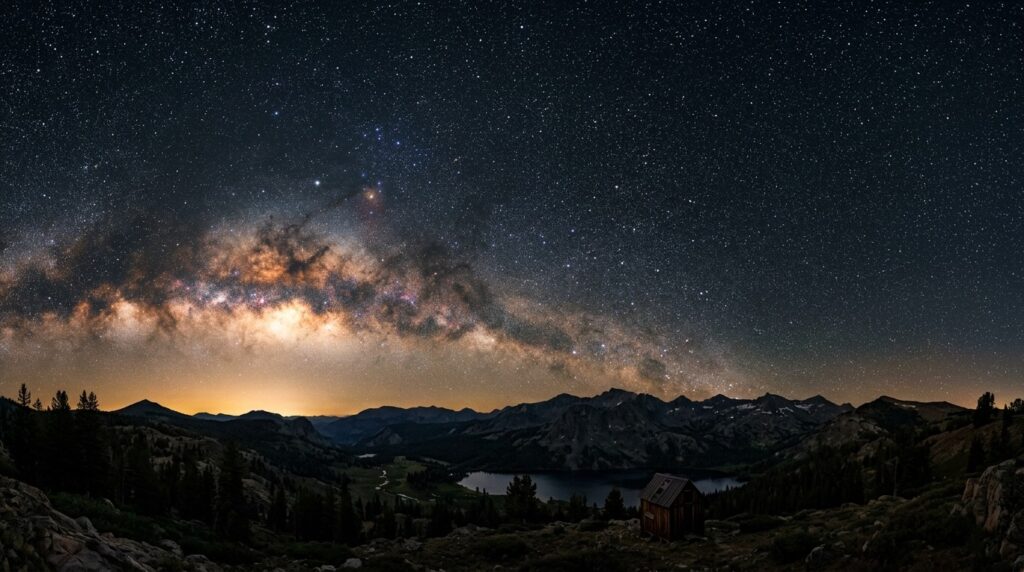
The boundary of our galaxy has finally been found — scientists have solved the main mystery of the Milky Way
An international team of astronomers has for the first time determined the edge of the Milky Way’s star-forming disk — the region where new stars are born. The boundary lies approximately 40,000 light-years from the galactic center. The discovery was made possible by a new approach: the scientists mapped the ages of stars and found a characteristic U-shaped pattern that pointed to the “line” beyond which stars no longer form.
Why the Milky Way Galaxy Has No Clear Boundary
Unlike an island with a coastline, a galaxy is more like a cloud. Its stars, gas, and dust don’t end abruptly but gradually thin out. The farther from the center, the fewer the stars, but some loners continue to appear. Because of this, the question “where does the Milky Way end?” has been called one of the most awkward by astronomers for decades.
Unlike an island with a coastline, a galaxy is more like a cloud. Its stars, gas, and dust don’t end abruptly but gradually thin out. The farther from the center, the fewer the stars, but some loners continue to appear. Because of this, the question “where does the Milky Way end?” has been called one of the most awkward by astronomers for decades. A similar confusion arises when trying to assess the true size of our galaxy.
One could try to draw the boundary at the most distant star — but it keeps shifting, since individual stars fly away from their “birthplace” over enormous distances. It’s far more reliable to find the line beyond which stars stop being born — and that’s exactly what the team led by Dr. Karl Fiteni from the University of Insubria did.
How Scientists Found the Galaxy’s Edge Using Star Ages
Galaxies grow “inside out.” First, stars form in the dense center, where there is the most gas. Over time, star formation spreads to the outskirts. This means that, on average, the farther from the center, the younger the stars — at least within the active disk.
But at some point, this trend must break. Beyond the edge of the disk, there is no longer enough gas for new stars to be born. The luminaries found farther out are “migrants” that were born closer to the center and gradually moved outward. And since they traveled for a long time, they are all old.
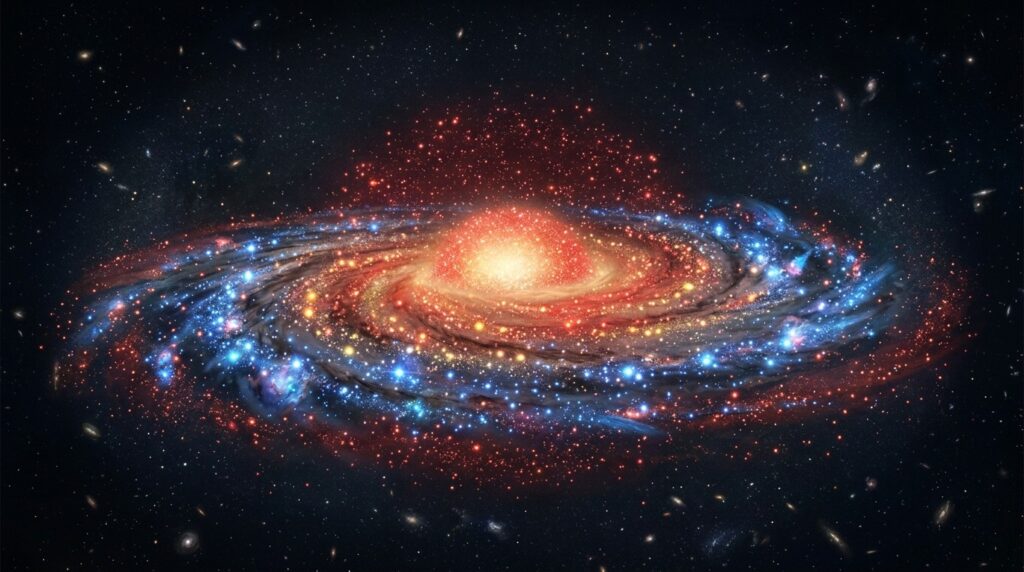
Schematic distribution of stars in the disk by age: young ones closer to the edge of the active zone, old ones in the center and beyond the disk boundary
This produces a characteristic picture: star ages first decrease with distance from the center, and then begin to increase again — forming a U-shaped profile. The minimum point (the youngest stars) marks the boundary of the star-forming disk.
How the Gaia Mission Measured the Size of the Milky Way
To build such a map, precise data on the positions and ages of an enormous number of stars are needed. This is where the European Space Agency’s Gaia mission came to the rescue — a space telescope that helped compile a detailed map of the Milky Way and over the years cataloged the positions and motions of nearly two billion stars with unprecedented accuracy.
Fiteni’s team used data from two independent spectroscopic surveys — LAMOST and APOGEE — combined with Gaia data. The researchers focused on giant stars near the galactic plane that move in nearly circular orbits. This selection helped exclude “outsiders” — stars in the Milky Way’s halo that have no relation to the disk and would have distorted the picture.
From the two datasets, the team obtained two close results: the minimum star age falls at a distance of about 36,800 and 39,600 light-years from the center. The error ranges overlap, making the estimate more reliable.
Where Do Stars Beyond the Milky Way Come From
Beyond the found boundary, stars don’t disappear. They’re simply all old travelers. There are at least two mechanisms that push stars beyond their “native” disk.
The first is spiral waves. The Milky Way’s arms are not rigid structures but density waves passing through gas and stars. A star caught in such a wave can gradually shift outward, like a chip of wood carried by a wave on water.
The second mechanism is supernova explosions. When a massive star in a binary system explodes, its companion can receive a powerful “kick” and fly far from its birthplace. In some cases, it looks as though the Milky Way is ejecting stars beyond its own boundaries. Such “runaway stars” sometimes accelerate to hundreds of kilometers per second and end up thousands of light-years from their cradle.
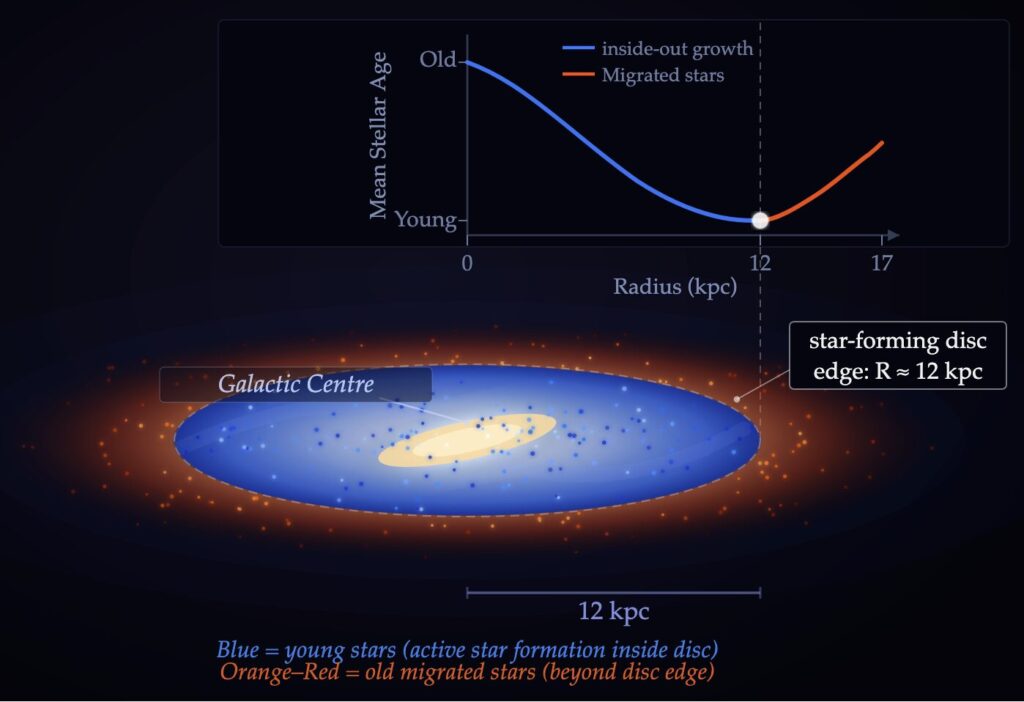
Star ages on the disk decrease with distance from the center until star formation ceased and increasingly distant stars began migrating.
This is precisely why stars are found for about another 10,000 light-years beyond the disk boundary. But all of them came there from “inside” rather than being born on the spot.
Why Stars Don’t Form Beyond the Galaxy
Interestingly, gas beyond the found boundary still exists — and in notable quantities. Moreover, scientists had previously noticed that there is too much gas in the galaxy, making the question of star formation even more complex. Why new stars don’t form from this material beyond the found line is still unknown, but scientists have two main “suspects.”
The first is the Milky Way’s central bar. Its gravitational influence can cause gas to accumulate at a certain distance, enhancing star formation inside this zone and suppressing it outside.
The second is the warp of the galactic disk. At great distances from the center, the plane of the Milky Way noticeably bends, like the brim of a hat. This warp can disrupt the conditions necessary for star formation: the gas becomes “unsettled” and cannot gather into sufficiently dense clouds.
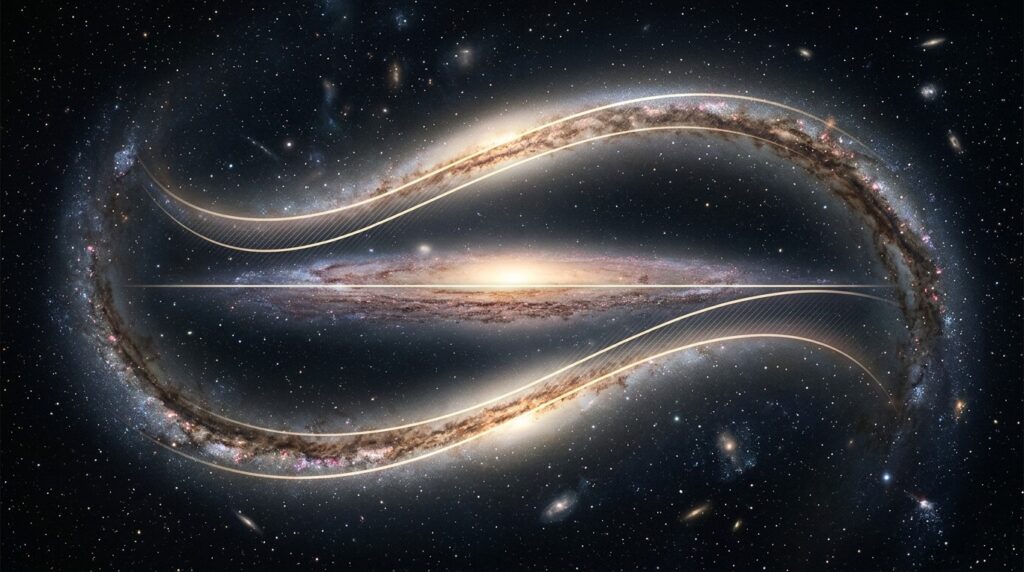
This is what the warp of the galactic disk looks like — its outer edges noticeably deviate from the plane
Which mechanism is the main one — or whether both act together — will be shown by future observations, including data from the new generation of surveys 4MOST and WEAVE.
Where Is the Solar System in the Milky Way
The Sun is located approximately 26,000–27,000 light-years from the center of the Milky Way and, together with other stars, orbits the galactic center. The edge of the star-forming disk, according to the new data, is at a distance of about 40,000 light-years. This means we are located roughly two-thirds of the way from the center to the boundary of the “living” part of the galaxy — where stars can still be born.
But it’s important to remember: the star-forming disk is not the only boundary of the Milky Way. Beyond it lie thousands of “migrated” stars, globular clusters, gas clouds, and a vast dark matter halo that extends for hundreds of thousands of light-years. If measured by the full diameter of the visible part, the Milky Way is estimated at about 100,000 light-years. And the mass of dark matter is likely distributed in a sphere with a radius of more than 100 kiloparsecs.
So the answer to the question “where does the galaxy end?” depends on what exactly we’re counting — only the “living” disk or everything that is gravitationally bound. The new study answered the first part of this question — and that is already a significant step. The results have been published in the journal Astronomy & Astrophysics in open access, meaning anyone can study the data and methodology.