
Why is it impossible to tickle yourself?
Everyone has tried to tickle themselves at least once in their life, and it never works. But as soon as someone else gets involved, you’re already squealing, trying to escape, and laughing, while the culprit is laughing right along with you, because laughter is contagious. The secret behind the lack of such a strong reaction to self-tickling is that the brain knows in advance what you’re about to do and simply switches off the response.
What Types of Tickling Exist
It turns out that tickling comes in different forms. Scientists distinguish two varieties, and each has its own unusual name.
- The first is a light, barely perceptible touch, for example with a feather or a hair. It sends goosebumps across the skin, but doesn’t make you want to laugh. This type of tickling serves a protective function: it’s what helps you feel that a spider or mosquito is crawling on your arm so you can brush it off in time.
- The second variety is that classic tickling that makes people laugh until they cry. This is when someone goes for the armpits, ribs, belly, or knees. That’s when laughter, squealing, and attempts to escape kick in.
Why Tickling Only Works from Someone Else’s Touch
An interesting detail: laughter from tickling doesn’t always happen. What matters is who exactly is tickling you. The reaction only occurs in a safe environment — when a close person you trust is nearby.
If a stranger approaches a child and starts tickling them, the child won’t laugh but will become frightened and scream. Charles Darwin noted this back in 1872: for tickling to produce laughter, a person must be in a calm, pleasant state of mind.
The hypothalamus is responsible for the burst of emotions during tickling — a small area of the brain that controls reactions to everything sudden and exciting. Essentially, it’s the same system that releases adrenaline in moments of fright (and sometimes makes us react in completely unexpected ways, such as laughing at inappropriate times). That’s why tickling is a mix of pleasure and mild stress at the same time.

Tickling a small child is incredibly easy, but making yourself laugh from tickling is practically impossible.
What Is Tickling Even For
There’s no single answer, but there are several plausible ideas. Scientists debate why nature even came up with such a strange thing.
- Tickling helps build social bonds between people and brings them closer together.
- Through tickling, children learn to understand what’s funny and develop a sense of humor.
- There’s also an unusual theory that tickling may function as self-defense training: a child learns to protect vulnerable parts of the body (belly, ribs, neck, and armpits).
Tickling is also found in other animals: monkeys also respond to it during play and social interaction. So it’s clearly an ancient phenomenon inherited from our ancestors.
Why the Brain Won’t Let You Tickle Yourself and Shuts Down the Sensation
Now for the most interesting part. Why is it impossible to tickle yourself? The answer is simple: you can’t catch yourself off guard.
When you move your hand toward your own side, the brain already knows where and when your palm will reach. It clearly distinguishes sensations that you create yourself from those that come from outside. This is a very useful ability: it allows you not to be distracted by signals from your own movements and to notice truly important external events (like that terrifying spider on your arm).
The cerebellum is responsible for this trick — a region at the back of the brain. It predicts what you’ll feel from your own movement and tells the rest of the brain in advance: “don’t pay attention, that’s us doing it.” So the tickling sensation is suppressed before it even has a chance to appear.
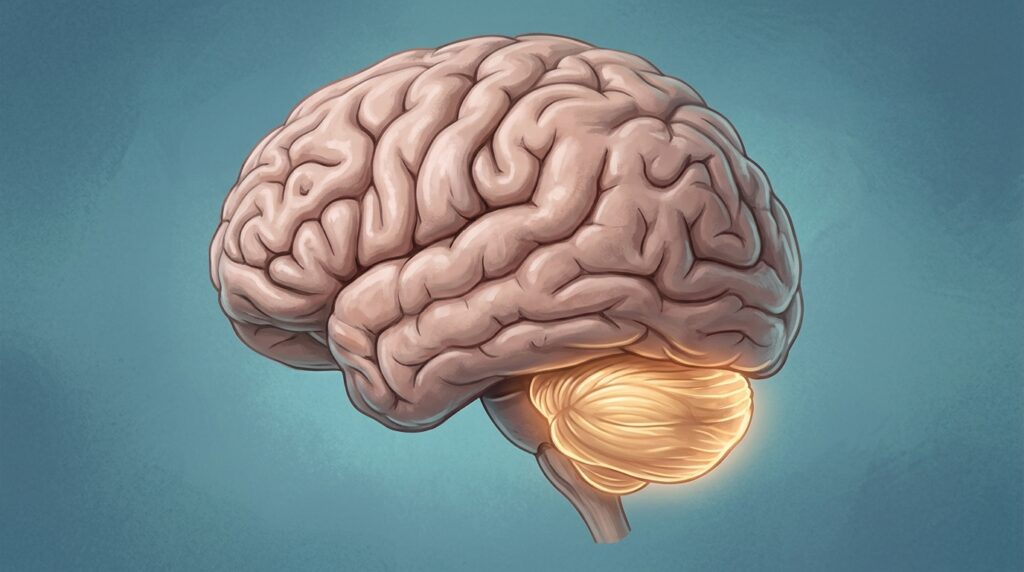
The cerebellum predicts sensations from our movements in advance
How to Actually Tickle Yourself
Scientists came up with a way to trick your own brain using a special device — a “tickling machine.” A person used one hand to control a device that touched the palm of their other hand. When the touch happened instantly, there was almost no tickling — the brain predicted everything. But as soon as a small delay of 1–3 seconds was added, the sensation became noticeably stronger: the brain could no longer confidently connect the hand movement with the touch.
It turns out that it’s all about predictability. As soon as the brain stops knowing exactly when and where a touch will occur, it starts perceiving it as something external again, and the tickling returns. So technically, you can tickle yourself after all — you just need to confuse your own brain a little bit.