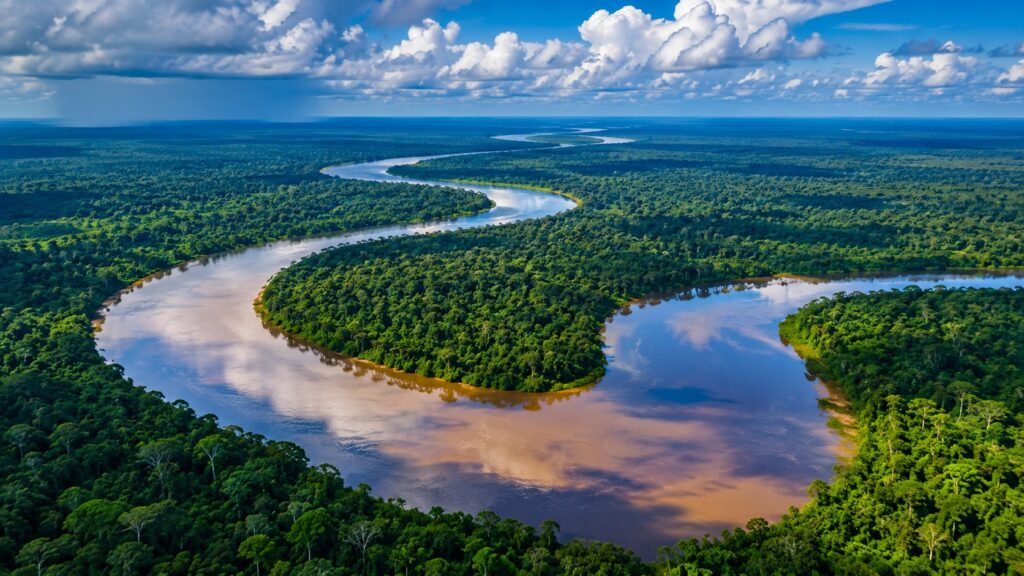
The Amazon and the Nile have long been unable to settle the title of the world’s longest river
The debate over which river is the longest seems like a simple school question. But the answer depends on where you consider the Amazon’s source to be, and as it turns out, that’s a surprisingly ambiguous topic. According to one calculation, the Amazon is longer than the Nile and becomes the longest river on Earth — but only if you accept as its source a location that is dry for nearly half the year.
The Amazon Is the Longest and Largest River in the World
One fact is undisputed. The Amazon is the largest river system on the planet — both by water volume and by basin area. According to IFL Science, it stretches approximately 6,400 kilometers, originates in the Peruvian Andes, crosses South America, and empties into the Atlantic Ocean.
But the title of the world’s longest river is a far more nuanced question. To measure a river’s length, you need to know exactly where it begins. And it is precisely the source of the Amazon where all the complications start, because different definitions yield different starting points, and therefore different total lengths.
When the Amazon Flowed in the Opposite Direction
Before diving into the source question, it’s worth recalling another astonishing fact: the Amazon didn’t always flow into the Atlantic. In 2006, geologist Russell Mapes, then a graduate student, was studying how sedimentary rocks are transported from the Andes to the ocean, and he noticed something that shouldn’t have been there — tiny ancient zircon crystals.
These mineral grains could not have originated from the relatively young Andes and must have come from the east. This meant that the Amazon once flowed in the opposite direction. Fossils of marine creatures found in the area support the same hypothesis.
Scientists still debate exactly how the reversal happened. One team suggested that before the Andes formed, the terrain tilted the river from east to west toward the so-called Purus Arch, and water from the western side of the arch drained into the Pacific Ocean. As the northeastern highlands eroded, the direction of flow began to change, and the growing Andes created a huge basin that eventually overflowed and set the current eastward course.
Another team in 2014 proposed a different picture: the rising Andes began intercepting more clouds, the Pebas wetlands formed, sediment accumulated, and the flow ultimately reversed. The reversal itself is believed to have occurred about 10 million years ago.
Where Is the Source of the Amazon
It seems like a simple question: where does the Amazon begin? In reality, this is the very heart of all the confusion. Formally, the river doesn’t have a single source: it is fed by more than a thousand tributaries, some of which, like the Madeira River, are significantly larger than the rest. But that answer doesn’t work if you want to name a specific point.
The problem is that the very concept of a source can be defined in different ways. In a 2014 scientific paper, researchers proposed distinguishing between two variants:
- Principal source — the most distant point along the main channel, which is traced by following the channels with the highest average water discharge;
- Most distant source — the absolute farthest point in the entire river basin that can be reached by traveling upstream along any tributary.
These two points may not coincide. This is precisely why the answer to the source question has changed along with the definition being used.
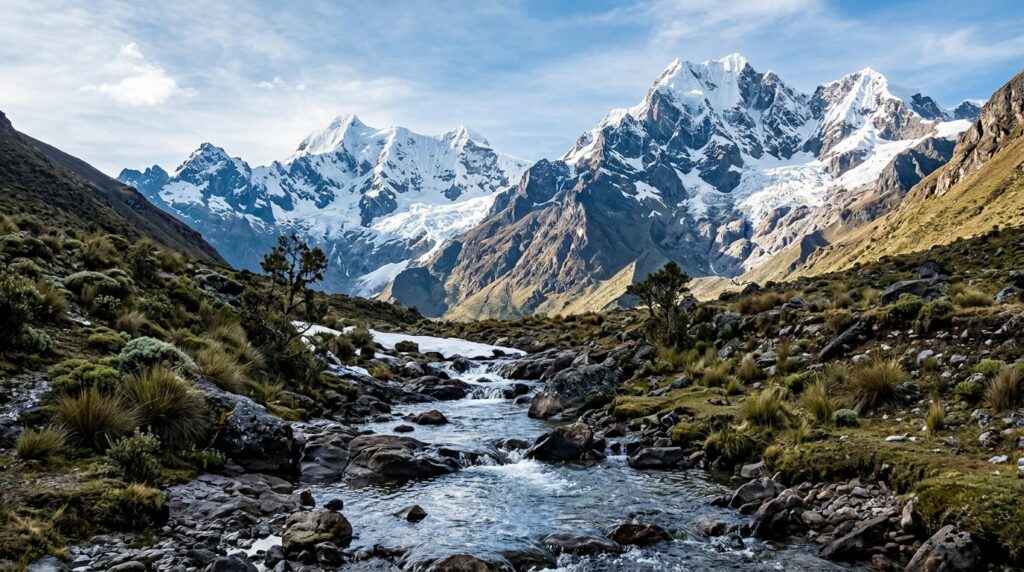
The sources of the Amazon are sought high in the Peruvian Andes
How the Amazon’s Source Point Has Changed
The history of searching for the source is a series of leadership changes. In the 18th century, the source of the Amazon was simply called the Marañón River in northern Peru, because it contributed the greatest volume of water, and this seemed like a reasonable choice. But over time, the definition of the source changed.
When the source came to be understood as the most distant point, the title passed to the Ucayali River, the longest of the Amazon’s tributaries. However, even that wasn’t the final word. Thanks to satellite imagery, in 2014 one team claimed that the source of the Amazon lies in the Mantaro River basin — and that with this source, the river becomes slightly longer than the Nile, making it the longest in the world.
The researchers indicated that the most distant source is not in the Apurímac basin but in the Mantaro drainage. Compared to the previous point near the summit of Nevado Mismi, the new source in the Cordillera Rumi Cruz range is located 754 kilometers to the northwest and significantly closer to the equator. This is a major shift for such a large geographical feature.
Why the Amazon’s Source Is Dry Five Months a Year
And this is where human intervention comes in. For about five months a year, the Mantaro River dries up because of the Tablachaca Dam, built in 1974. The result is a paradox: the source of the Amazon — a river famous for its colossal water volumes — stands dry for nearly half the year.
Many geographers find this unsatisfactory. You have to admit, it’s strange to declare the beginning of the world’s most voluminous river a place where there’s no water for half the year. That’s why the same team proposed a more precise definition — distinguishing between the most distant source and the most distant source of continuous flow. This way, formal length and real hydrology would no longer contradict each other.
If we return to the most honest answer, the Amazon doesn’t have a single starting point. The river is fed by numerous tributaries, with the greatest contributions to its flow coming from the Marañón, Apurímac, and Mantaro.
So Is It the Amazon or the Nile — Which River Is the Longest?
The honest conclusion sounds unusual for a school textbook: there is no definitive answer. The Amazon can be considered the longest river in the world, but only with a particular choice of source — and only if we’re willing to accept as a source a point that dries up for nearly half the year.
The main takeaway from this story isn’t about specific kilometers but about how geography works. A river’s length is not an objective constant but rather the result of an agreement about what counts as its beginning. Change the definition, and the source point shifts — and with it, the position in the list of the world’s longest rivers. The debate between the Amazon and the Nile will most likely not end until scientists agree on a unified and physically meaningful definition of a river’s source.