New biological clocks can predict when you will die
People don’t age on a schedule: one person at 50 has a body that functions like it’s 40, while another has the opposite. Scientists have long been searching for a way to measure this true, biological age, rather than the one recorded in your passport. And now a new tool has emerged. Researchers from Harvard Medical School have created biological clocks that assess the rate of aging based on gene activity and can reliably predict the risk of death.
What Are Biological Clocks and How Do They Differ from Chronological Age
Chronological age only tells you how many times you’ve celebrated your birthday. But it says nothing about the condition of your cells, organs, and blood vessels. Two people can both be 60, but one runs marathons while the other can barely climb stairs.
That’s exactly why scientists came up with so-called biological clocks — tools that assess the real wear and tear on the body. The more accurately they work, the easier it is to understand how lifestyle, diseases, or medications affect aging.
Until now, the most popular were epigenetic clocks. They appeared back in 2013 and count chemical marks on DNA that accumulate with age and stress. The problem is that they aren’t always reliable and sometimes produce contradictory results.
How the New Biological Clocks Work: Age Based on Gene Activity
The new method works differently. These are transcriptomic clocks — they look not at the DNA itself, but at its activity. To put it simply: DNA is the instruction manual, while RNA shows which pages of that manual are currently being read. In other words, which genes are turned on and which are turned off.
With age, this activity pattern changes in predictable ways. Some genes become more active, others quiet down. It’s precisely this set of changes that allows us to understand how far along a person or animal has progressed in life and take measures to extend it.
Scientists discovered a pattern: genes associated with healthy cell division and wound healing turned out to be markers of slow aging. Meanwhile, activity of genes responsible for cell death and inflammation, on the contrary, indicated accelerated aging and a higher biological age.
Why Aging Markers Are Similar in Mice and Humans
The most unexpected aspect of this work is its scale. The team collected more than 11,000 samples from four mammalian species: mice, rats, macaques, and humans. They compared how different organs and tissues age.
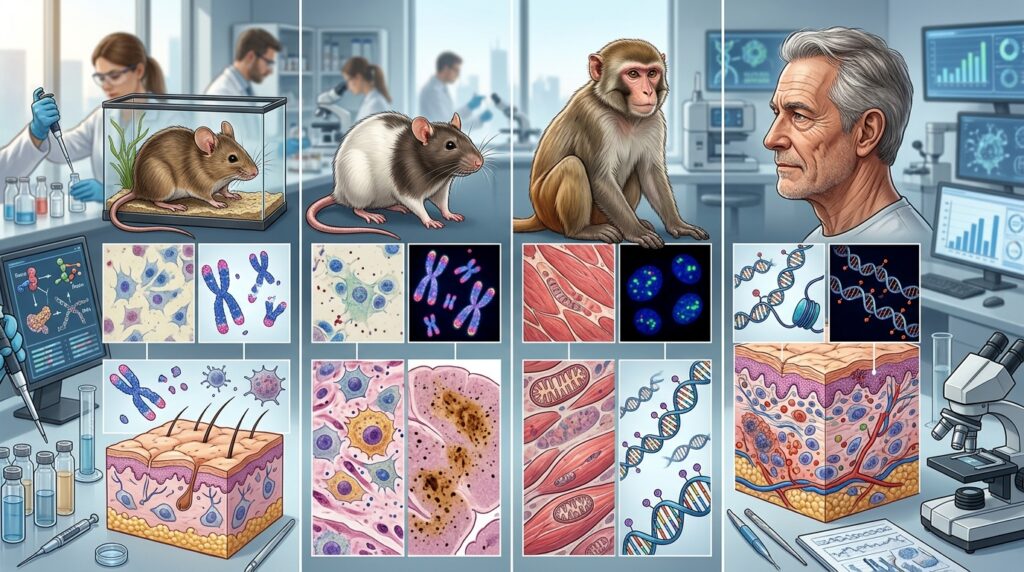
Aging markers turned out to be similar across four mammalian species
It turned out that genetic markers of aging are remarkably similar across all four mammalian species. Moreover, they matched even in very different tissues — for example, in muscles and blood cells. This commonality suggests that the identified markers are truly genuine signs of aging, not random noise.
“The same genes are associated with aging, for example, in the liver and heart of rats and humans,” said the lead author, bioinformatician Alexander Tyshkovskiy. “Although the cells perform completely different functions and have different origins, they still carry the same biomarkers of aging.”
Can Biological Clocks Predict Lifespan
Let’s clarify something important right away: these clocks will not give you an exact date of death. They won’t tell you how many days you have left. But on human blood samples, the method predicted the risk of death no worse than the best epigenetic clocks.
Additionally, the tool detected known factors that accelerate aging — for example, chronic diseases. It recognized them both in animal disease models and in tissues of real patients.
But there’s an honest caveat from the scientists themselves: it’s still unclear whether these genetic signals cause aging, simply accompany it, or are actually a protective response by the body. As molecular biologist João Pedro de Magalhães from the University of Birmingham noted, increased activity of genes that protect cells from stress looks more like the body’s response than a cause of aging.
How to Slow Down Biological Aging
The main practical value of the new method lies in testing what works against aging and what doesn’t. With its help, researchers can quickly assess how medications or lifestyle changes affect biological aging without waiting for lengthy multi-year trials.
We can already partially influence the rate of aging. It is known that:
- healthy nutrition can slow down biological clocks
- moderate physical activity helps maintain health, and therefore youth and longevity
- diseases, air pollution, and even extreme heat, on the contrary, accelerate aging
- even the surrounding environment plays a role: for example, there is evidence that green spaces slow down aging
This new direction is very promising: the better we learn to measure aging, the clearer it will become which habits and medications truly extend a healthy life, and which just sound good in advertisements.