We’ve already talked about how AMOLED differs from IPS. And here it’s important to briefly outline the difference in simple terms: AMOLED emits light on its own, while IPS is backlit from below. A popular myth is built on this distinction: AMOLED is more harmful to your eyes. Many people consciously buy smartphones with IPS — “for health reasons.” Let’s examine how justified this really is.

Examining the harm of AMOLED to your eyes
Where the Myth About AMOLED Being Harmful Came From
The complaints are real: some people notice eye strain after prolonged use of an AMOLED phone screen. Eyes water, headaches appear, and discomfort sets in (especially when working in the dark at low brightness).
But here’s what’s important: the problem isn’t with AMOLED technology itself. The problem lies in a specific parameter of its implementation that most manufacturers don’t prominently feature in their specifications. And it’s precisely this parameter that determines whether a particular AMOLED display will harm you or not.
What Is PWM and Why It Matters
Screen PWM — Pulse Width Modulation. This is the method used to regulate brightness in AMOLED panels. Instead of smoothly reducing the intensity of pixel illumination, the screen turns on and off very rapidly. The eye doesn’t have time to notice the flickering, but the brain reacts. IPS works differently: brightness is regulated by backlight voltage — smoothly, without flickering. That’s why eye strain from flickering is fundamentally impossible on IPS.
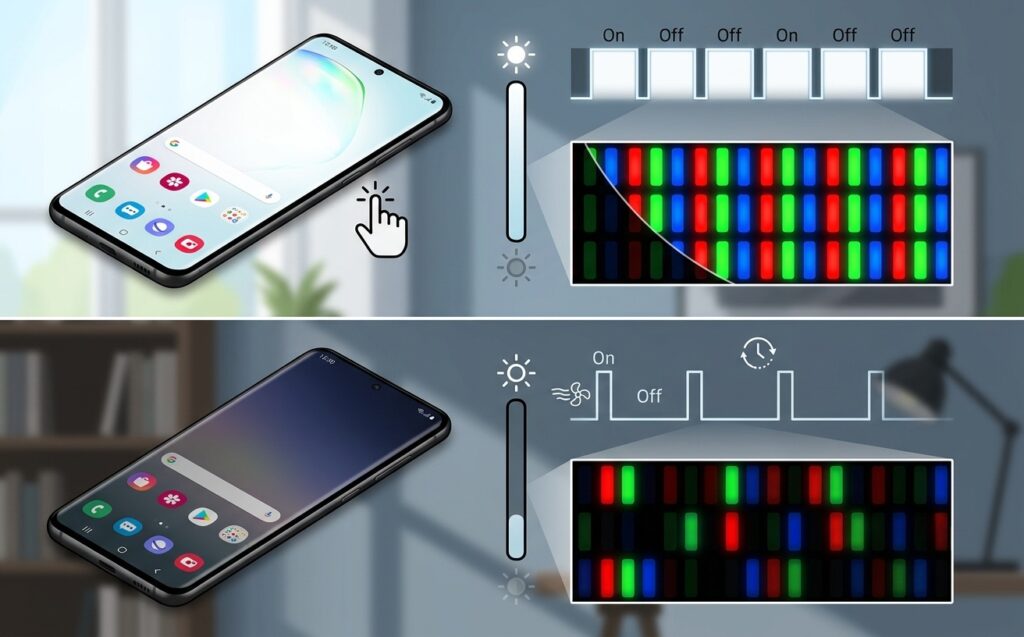
PWM is noticeable at low brightness
The critical detail with AMOLED is the flickering speed. At high brightness, the screen flickers so fast that it’s physiologically insignificant. At low brightness, the flickering slows down and becomes noticeable to the nervous system, even if you can’t consciously see it. That’s precisely why eyes get tired from an AMOLED screen in the dark at minimum brightness.
PWM Frequency — Why the Number Matters
PWM frequency is measured in hertz, and this is exactly the number you should look for in specifications — not just whether it’s AMOLED.
Guidelines:
- up to 240 Hz — rough flickering, clearly noticeable at low brightness, causes fatigue quickly;
- 480-960 Hz — noticeably better, but at minimum brightness some people still feel discomfort;
- 1920 Hz and above — flickering is practically imperceptible for most users;
- 2160 Hz and above — the gold standard for 2026 flagships.
For comparison: Xiaomi 17 Ultra uses 3840 Hz PWM, while realme P4 promotes low-frequency PWM dimming as an advantage. Budget AMOLED smartphones often operate at 60-120 Hz PWM — and these are the ones generating most complaints about eye strain. In other words, an AMOLED panel with high-frequency PWM is no more dangerous than a budget IPS. A cheap phone with AMOLED at 60 Hz PWM is potentially more harmful than a quality IPS. The technology isn’t to blame — the implementation is.
Does Blue Light From the Screen Cause Harm?
A separate myth: AMOLED harm is associated with blue light. There’s a grain of truth here, as blue light does indeed suppress melatonin production and disrupts circadian rhythms. Using a smartphone before bed worsens the quality of falling asleep.
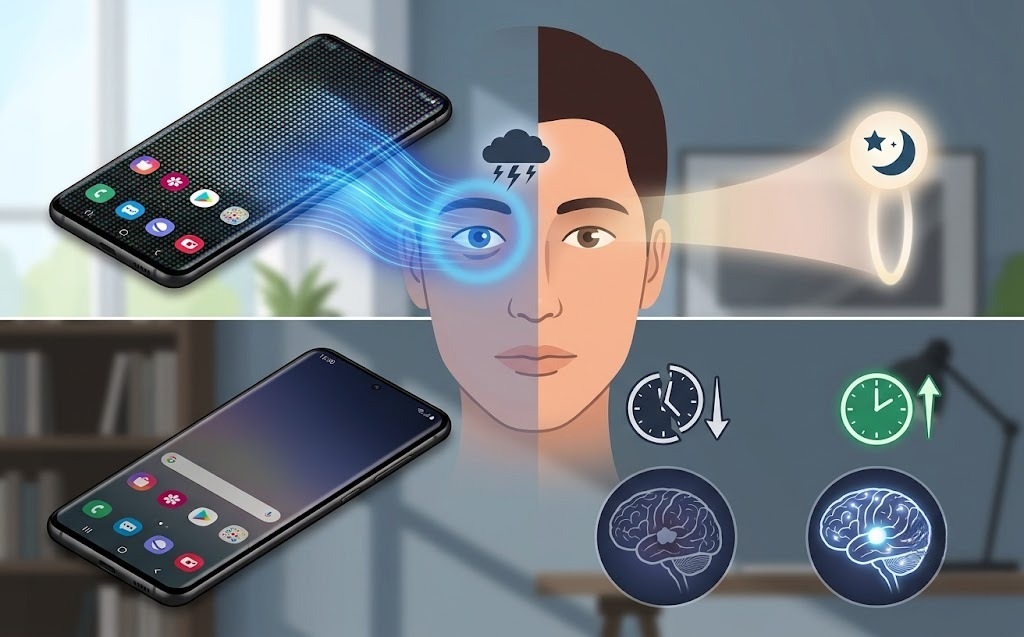
Blue light makes it harder to fall asleep
But this applies to any screen — IPS, AMOLED, OLED, LED. They all emit blue light. AMOLED doesn’t stand out as worse in this regard. Night Mode and warm tones help but don’t completely solve the problem — blue light reduction is partially compensated, but falling asleep with a phone in your hands is still not the best idea regardless of screen technology.
By the way, AMOLED has a real problem unrelated to eyesight: screen burn-in. Static interface elements leave a mark on the panel over time. This doesn’t harm your eyes, but it does harm the screen itself.
How to Reduce Eye Strain From Your Smartphone
Practical tips that work regardless of panel type:
- don’t lower brightness to minimum in the dark — it’s better to slightly dim the room light than to torture your eyes with PWM flickering at 1% brightness;
- enable dark theme: fewer white elements means less strain on your eyes and battery at the same time;
- the 20-20-20 rule: every 20 minutes, look for 20 seconds at an object 20 feet (6 meters) away from you;
- when choosing a smartphone, look for TÜV Rheinland Low Blue Light or TÜV Rheinland Flicker Free certification — this is a real independent verification, not a marketing claim;
- check the PWM frequency in specifications: 1920 Hz and above is a good indicator for an AMOLED smartphone.
Screen danger to eyesight is greatly exaggerated with proper use. Screens damage vision not on their own, but in combination with poor habits: too long, too close, too dark around you.