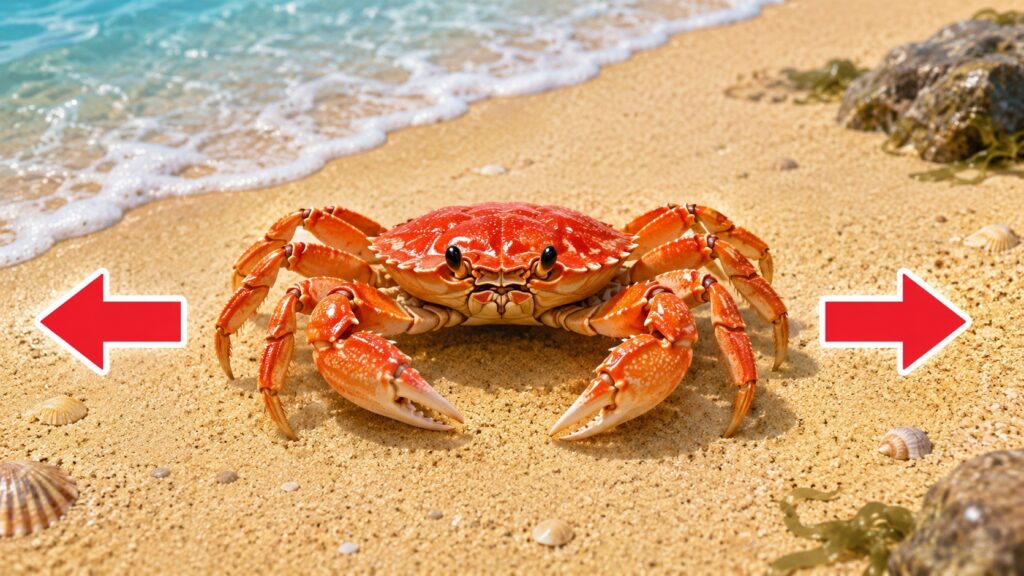
The reason for crabs’ sideways movement was found in ancient times
Are you sure you know why crabs walk sideways? Well, because their legs are built that way, right? Too many joints, flat body, so they have no choice. That’s exactly what Google will tell you. But the truth is different. It turns out that scientists were wrong for a long time, and the real reason was hidden deep in evolution, approximately 200 million years ago. A new large-scale study has shown that the sideways gait emerged… only once. And it was precisely this trait, as it turned out, that made crabs one of the most resilient creatures on the planet.
How Crabs Evolved
For a long time, scientists knew that most crabs move sideways, but they didn’t understand exactly when this began or how many times this type of movement appeared during the course of evolution. Data on how different crab species move was surprisingly scarce, despite the fact that a great deal is known about crabs themselves.
A group of Japanese scientists led by Yuuki Kawabata set out to change this. They conducted the largest comparative study of crab locomotion to date and published the results as a peer-reviewed preprint in the journal eLife. The analysis showed that sideways walking in crabs appeared approximately 200 million years ago, at the very beginning of the Jurassic period, immediately after the Triassic-Jurassic extinction.
The Triassic-Jurassic extinction was one of the five largest mass extinctions in Earth’s history, occurring 201.4 million years ago. About 80% of all known species disappeared at that time. But it was precisely after this catastrophe, according to the new data, that the ancestor of modern crabs developed that very sideways gait.
How Scientists Studied Crab Locomotion
Kawabata and his colleagues studied the movement patterns of 50 crab species. Each species was filmed for 10 minutes in circular plastic arenas that simulated their natural habitat. Due to practical limitations, one individual was recorded from each species.
These observations were then combined with data from a large-scale genetic family tree of crabs. The evolutionary history of the crab infraorder Brachyura had been previously reconstructed based on sequences of 10 genes for 344 species, covering most major lineages of true crabs. Since behavioral and genetic data didn’t always match by species, the scientists simplified the tree to 44 genera, five families, and one superfamily.
In simpler terms, the biologists did two things. First, they literally watched how living crabs walk, and then they mapped this data onto their family tree to understand when and how the sideways step appeared.
One of the reviewers noted that using a single individual per species is a limitation of the study, since there’s no guarantee that this particular individual moves in a way typical of its species. The authors acknowledge this but emphasize that an analysis on this scale was conducted for the first time.
How the Sideways Gait of Crabs Emerged
Of the 50 species studied, 35 predominantly moved sideways, and 15 moved forward. By mapping these data onto the evolutionary tree, the researchers concluded that sideways walking most likely arose only once — in a single ancestor that walked forward, at the base of the more advanced crab group Eubrachyura.
This is a very important result. The reason is that the crab-like body form arose in evolution at least five times — a phenomenon biologists call carcinization. This is a form of evolution in which crustaceans that are not crabs develop a crab-like body plan. Hermit crabs, spider crabs, porcelain crabs — all of them independently turned into something resembling a crab.
But with sideways walking, everything is different. This single event stands in stark contrast to carcinization, which occurred multiple times. This shows that body forms can converge repeatedly, while behavioral changes, such as sideways walking in crabs, can be rare. That is what the authors of the study said, at least.
Why Crabs Need Their Sideways Gait
The main advantage of sideways walking is the ability to move quickly in both lateral directions at equal speed, which has been confirmed by experiments with crab-like robots, among other things. Multiple escape directions make the trajectory unpredictable for a predator.
Imagine the situation. A predator attacks, and the crab instantly darts left or right, equally fast in either direction. Guessing the escape direction is virtually impossible. An animal that only runs forward is far more predictable.
But if sideways walking is so advantageous, why do 15 of the 50 studied species still walk forward? Sideways walking, despite its advantages, is clearly difficult to evolve in the animal world. It fundamentally changes the axis of behavior, affecting burrowing, mating, and foraging.
Those crabs that reverted to walking forward often rely on other defensive strategies. Soldier crabs move in large groups. Spider crabs use camouflage. Pea crabs live inside other animals. In these cases, speed is less important — protection is provided by behavior or habitat. At the same time, according to the authors, crabs that currently walk forward arrived at this through a sideways stage, rather than retaining the original gait of their ancestors.
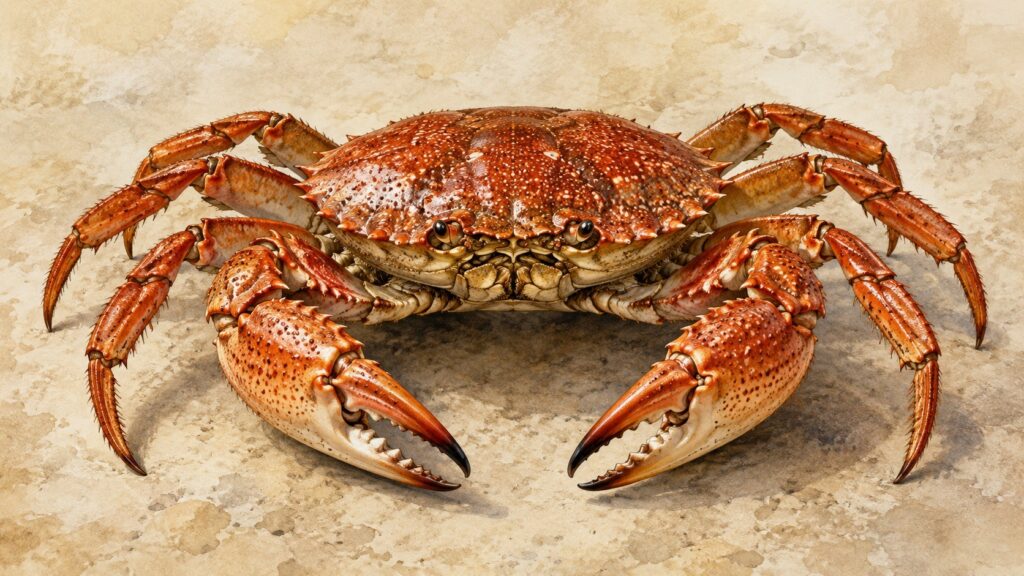
Sideways movement of crabs is very important for their survival
Mass Extinction and the Rise of Crabs
The coincidence with the Triassic-Jurassic extinction cannot be called accidental either. External factors, such as mass extinctions, play a crucial role in evolutionary diversity. According to the analysis, sideways walking in crabs appeared about 200 million years ago, at the very beginning of the Jurassic period, right after the extinction. This period is marked by the breakup of the supercontinent Pangaea, the expansion of shallow marine ecosystems, and the beginning of the Mesozoic Marine Revolution.
After a catastrophe, ecological niches are freed up. Species that possess something new — like an unusual body form or an atypical mode of locomotion — get a chance to fill the empty spots. The single origin and diversity of the Eubrachyura group are consistent with the idea that sideways walking became a key evolutionary innovation that contributed to the ecological success of true crabs.
Today, true crabs number more than 7,600 species, significantly more than their closest relatives. They are found in all the world’s oceans, as well as in freshwater bodies and on land, especially in tropical regions.
What Crab Evolution Tells Us About the Animal World
This study revealed a curious paradox. The crab body form arose again and again — nature seemed to reinvent the crab over and over. But the specific mode of movement — sideways — appeared only once. It’s as if many architects independently designed similar buildings, but only one invented the elevator.
The authors note that sideways walking is a rare phenomenon in the animal world. Possible parallels exist only in crab spiders and leafhopper nymphs. This underscores how difficult it is to fundamentally change a mode of locomotion, even if it provides an advantage.
To definitively separate the roles of behavioral innovation and environmental changes, further research is needed, including fossil analysis and performance tests linking sideways crab movement to specific adaptive advantages. The work was published as a peer-reviewed preprint, meaning it has undergone expert evaluation, but scientists have not yet found answers to all questions, and new investigations lie ahead.
But it is already clear that one behavioral change 200 million years ago helped crabs become one of the most widespread and diverse groups of animals on Earth. Sometimes one step sideways — literally — changes everything.