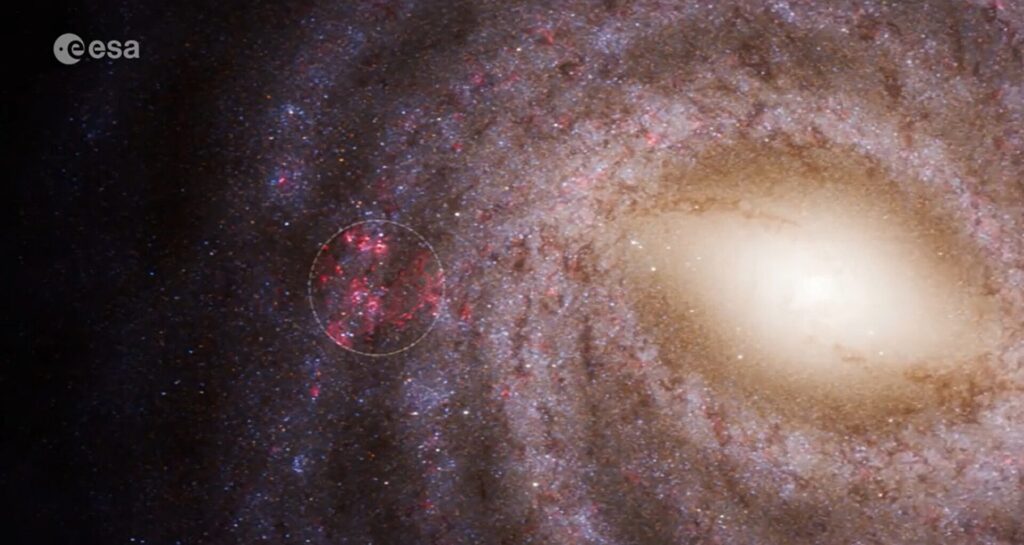
The Milky Way devoured the Loki galaxy: scientists discovered its remains
Inside the Milky Way, scientists have discovered traces of previous galaxy mergers. Among them is the dwarf galaxy Loki from the ancient Universe, which was devoured in the first few billion years after the Big Bang. Twenty unusual stars in the Milky Way that scientists found turned out to be not just random guests in our galaxy, but the “bones” of the long-“eaten” Loki galaxy. And this is yet another clue to how our galaxy came to be: not all at once, but through a chain of ancient absorptions.
How the Milky Way Was Assembled from Other Galaxies
The Milky Way is not a single structure that appeared in finished form. Large galaxies are assembled gradually, over billions of years, through collisions and mergers with smaller ones. Shortly after the Big Bang, matter began clumping together into gas clouds from which the first primitive galaxies formed. These small systems fell into each other, merged, and gradually grew into the massive structures we observe today.
Much like how a large river forms from many streams, the Milky Way was assembled from dozens of dwarf galaxies. And traces of these ancient mergers can still be found — if you know where to look. Astronomers have discovered the edge of the Milky Way galaxy and found that it is significantly larger than it seemed, meaning there were quite a few mergers throughout its history.
A new study is dedicated to one of these ancient mergers. A team of astronomers studied 20 old stars with very low metal content that orbit unexpectedly close to the galactic disk — the flat rotating region where our Sun is also located.
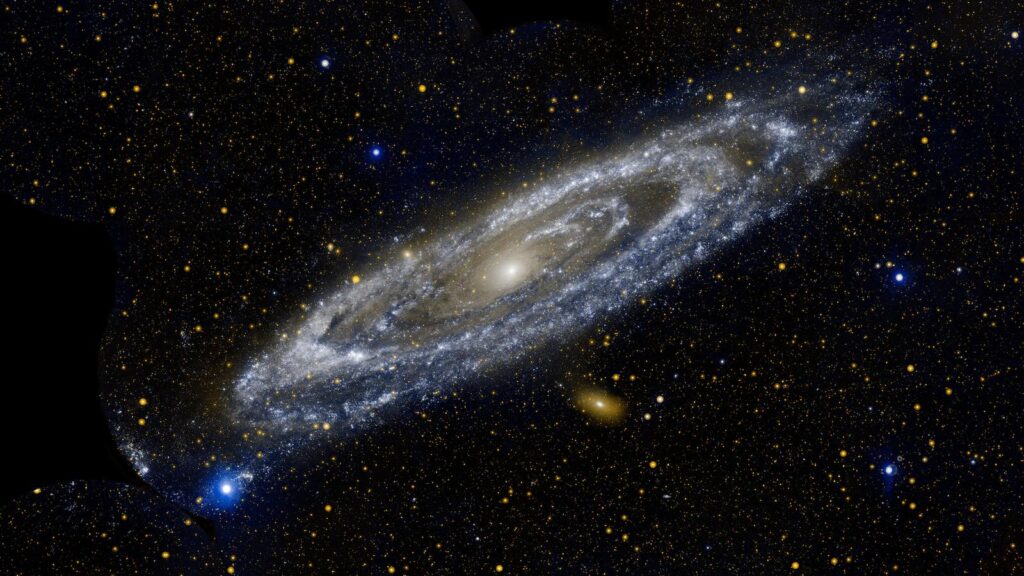
Astronomers discovered several strange stars in the Milky Way that may have once belonged to another galaxy.
What Metals in Stars Tell Us About Their Age
To understand why these 20 stars so intrigued scientists, we need to understand what metallicity is. The very first stars in the Universe consisted almost entirely of hydrogen and helium — nothing heavier existed at that time. Heavier elements, which astronomers traditionally call “metals” (even carbon and oxygen), only appeared inside these first stars through thermonuclear fusion.
When the first stars exploded, they enriched the surrounding gas with heavy elements. The next generation of stars was born from slightly more “metallic” material. And so on — each new generation slightly richer than the previous one. The metal content of a star works like a chemical clock: the fewer the metals, the older the star.
The stars found by the researchers turned out to be extremely metal-poor, indicating their venerable age. But here’s the puzzle: usually such ancient stars are found in the halo — a vast spherical region surrounding the galactic disk. Yet these twenty stars were located very close to the disk, within 6,500 light-years of the Sun.
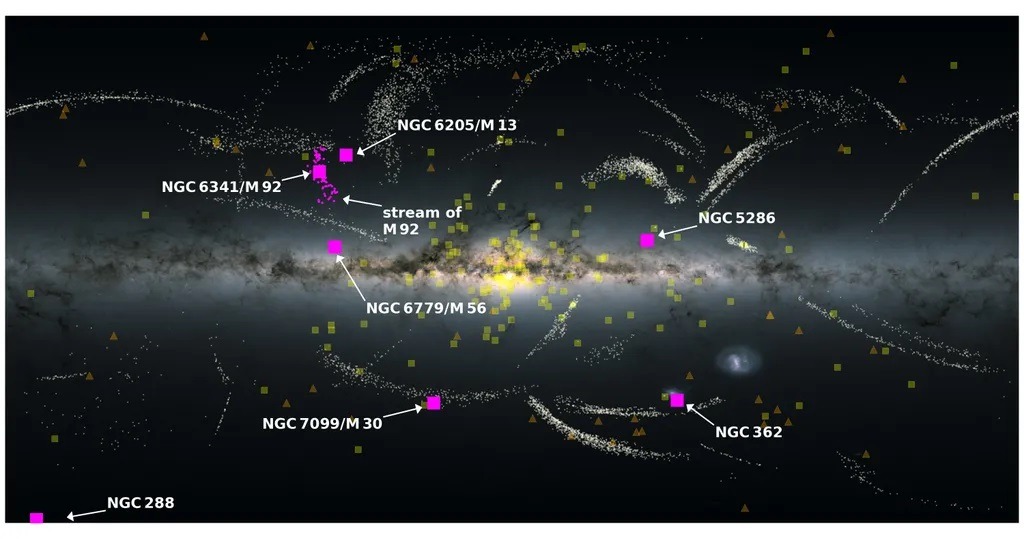
It is believed that over its 12-billion-year history, the Milky Way merged with a dozen or more dwarf galaxies. On this map, compiled using the Gaia telescope, purple marks star clusters formed as a result of suspected mergers.
“Usually stars in the disk are metal-rich and relatively young, like the Sun, — explained lead author Federico Sestito. — But our stars are old and very metal-poor, like stars in dwarf galaxies.”
Why Loki’s Stars Move in Different Directions
Another peculiarity was related to the direction of movement of these stars. Some of them moved in the same direction as the overall rotation of the Milky Way, while others moved in the opposite direction. At the same time, the chemical composition of both groups was identical, meaning all the stars most likely originated in the same environment.
Computer models of galaxy formation helped explain how stars from a single source could have scattered in opposite directions. If the merger occurred early enough, when the young Milky Way was still lightweight and had not yet spun into a stable disk, the infalling dwarf galaxy could have scattered its stars in all directions.
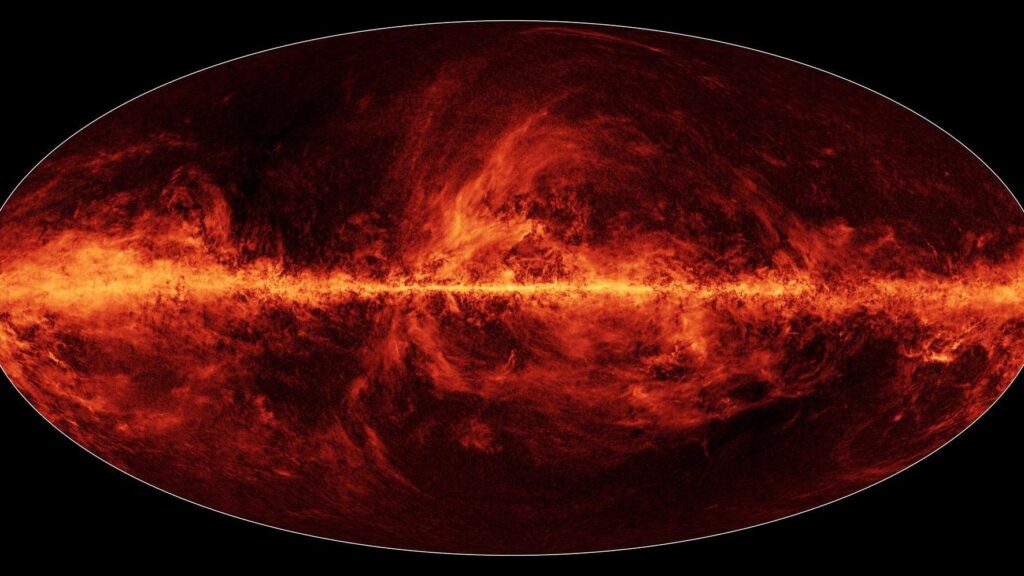
A map of the Milky Way obtained from ESA’s Planck satellite. The horizontal disk of the Milky Way contains traces of previous galaxy mergers.
“The early merger history of a large galaxy could have been very chaotic — many small systems collided and scattered their stars across a wide variety of orbits,” explained Federico Sestito.
Modeling showed that a single dwarf galaxy, devoured more than 10 billion years ago, could have left exactly the orbital pattern that astronomers observe. The calculations also allowed them to estimate the total mass of this galaxy — about 1.4 billion solar masses.
Why the Ancient Devoured Galaxy Was Named Loki
The team named the discovered devoured galaxy Loki — after the Norse god of trickery and deception.
“In Norse mythology, Loki is the god of deception, and since he is a trickster, his intentions are hard to understand,” said Federico Sestito. “In the same way, it was not easy for us to understand the origin of these stars.”
The name fits perfectly. These stars look “wrong” for where they are located, and explaining their behavior turned out to be truly challenging. They are too ancient and metal-poor for the disk, yet too close to it for typical halo residents.
Our galaxy holds within it traces of the very first primitive galaxies of the young Universe. Detecting such traces in the crowded disk is quite difficult, but that is precisely where key clues may be hidden about how exactly the Milky Way became what we know it as today.