There are plenty of ways to extend battery life. But one of the most popular arguments when choosing a smartphone goes like this: “get a compact one, a big screen eats up the battery.” It sounds logical. But is it really true? Let’s break it down with specific numbers so you have no questions left.
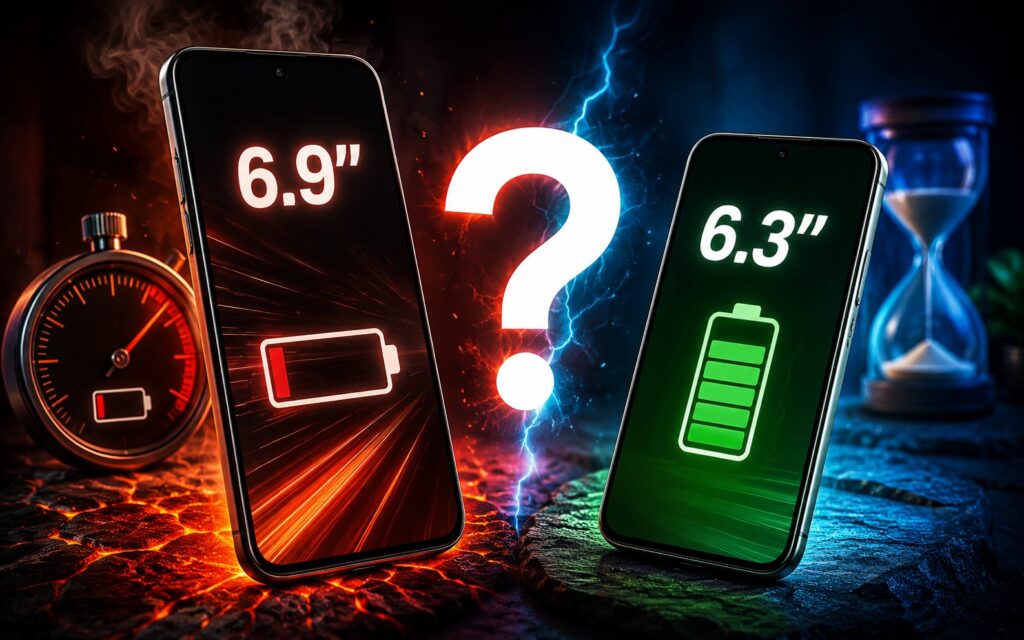
Debunking a popular smartphone myth
Does a Smartphone With a Bigger Screen Die Faster — True or Not?
The logic is simple and seems rock-solid at first glance: the phone screen is big — more surface area — more pixels — more energy consumed — the phone charge runs out faster. Most people think this way, and there is a grain of truth in this chain of reasoning.
The phone display is indeed one of the main energy consumers (with active use, it takes 30-40% of total battery consumption). This is a real figure, not marketing. So intuition tells you: since the screen consumes so much, a bigger screen will consume even more. But there’s a nuance here that changes everything.
How Much Energy Does the Screen Actually Consume?
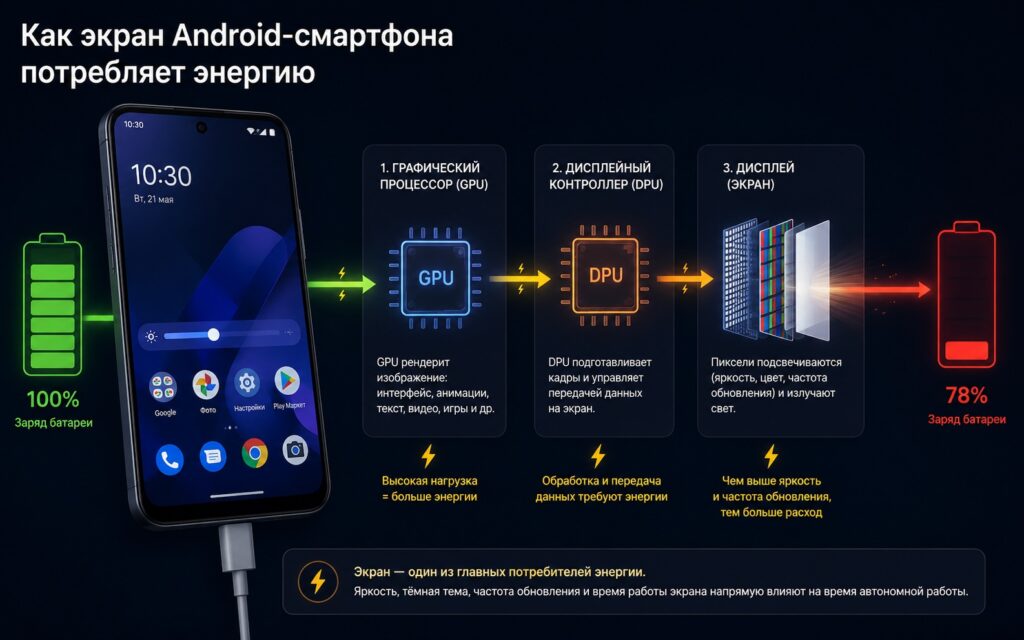
A smartphone screen does consume a lot of energy
The screen drains the charge — that’s a fact. But here’s what’s important: consumption is determined not only by diagonal size. There are three parameters that have a stronger impact than size:
- Display type. AMOLED screens only light up the necessary pixels — black color is literally turned off. With a dark interface theme, an Android phone’s AMOLED display consumes noticeably less than IPS, which backlights the entire screen regardless of content. A large AMOLED can consume less than a small IPS.
- Brightness. This is the main variable. At maximum brightness, the screen consumes 3-4 times more than at minimum. The difference in diagonal between 6.3 and 6.8 inches is negligible in comparison.
- Refresh rate. A 120 Hz smartphone screen consumes noticeably more than the same screen at 60 Hz. Adaptive refresh rate, where the smartphone automatically lowers the Hz for static content, partially solves this problem but not completely.
Why Smartphones With Bigger Screens Often Last Longer
This is where it gets really interesting. Manufacturers know that a phone with a big screen consumes more and compensate for this with a bigger battery. This isn’t a coincidence — it’s engineering logic.
Let’s look at specific examples. The Samsung Galaxy S26 with a 6.3-inch screen has a 4,300 mAh battery. The Galaxy S26 Ultra with a 6.9-inch screen has a 5,000 mAh battery. Does this help the bigger smartphone last longer? Yes!
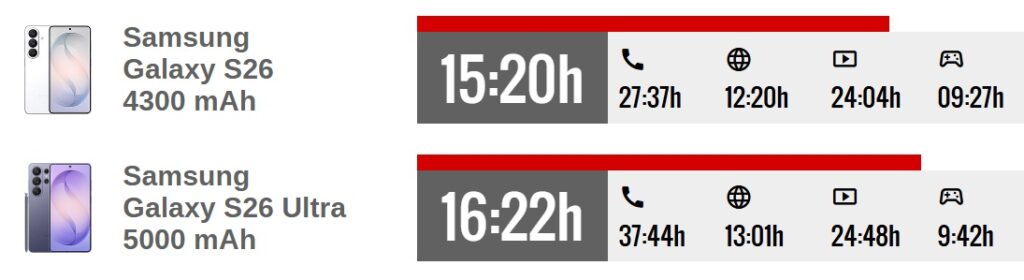
A bigger smartphone usually lasts longer. Source: gsmarena.com
The smartphone battery grows along with the screen. As a result, real-world battery life is determined not by the display size but by the ratio of battery capacity to the total device consumption. And larger smartphones often win over compact ones in this ratio.
What Actually Affects Battery Drain
If you build an honest ranking of factors that kill phone charge the fastest, screen size would be far from first.
The real enemies of battery life in order of significance:
- screen brightness — the most powerful factor, increases consumption several times over;
- 120 Hz refresh rate versus 60 Hz without adaptive mode;
- 5G (constant signal searching in areas with poor coverage drains the battery quickly);
- background apps, especially those that actively access the network;
- GPS in constant tracking mode;
- processor under load (heavy games and video editing);
- screen size — last on the list when all other conditions are equal.
Android energy saving starts with brightness and background processes, not with choosing a more compact smartphone.
When a Bigger Smartphone Does Die Faster
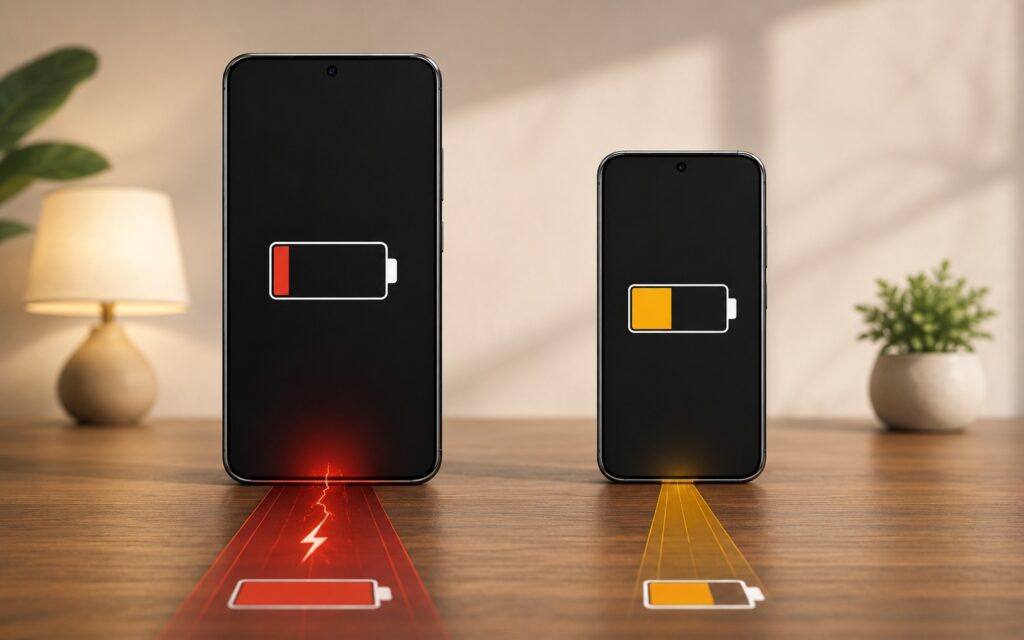
In rare cases, the myth’s logic does actually work
A smartphone with a big screen loses on battery life in certain cases:
- budget large-screen smartphones where the manufacturer increased the screen size but didn’t increase the battery to keep the price down;
- high resolution paired with a small battery;
- a compact smartphone with a large battery and an energy-efficient AMOLED — here a smaller screen truly wins.
Bottom line: the rule “a bigger screen dies faster” only works if the manufacturer didn’t bother with an adequate battery. In normal 2026 flagships, it’s actually the opposite — larger models last longer than compact ones precisely because they fit more capacity inside.