T-Bank has launched a service that helps you figure out where fuel is available. The map features over 20,000 gas stations across Russia, and it doesn’t work with actual reservoir levels but rather with forecasts based on payments and reviews. Let’s break down who will actually find this useful and why a green mark shouldn’t be read as a promise of fuel at the pump.
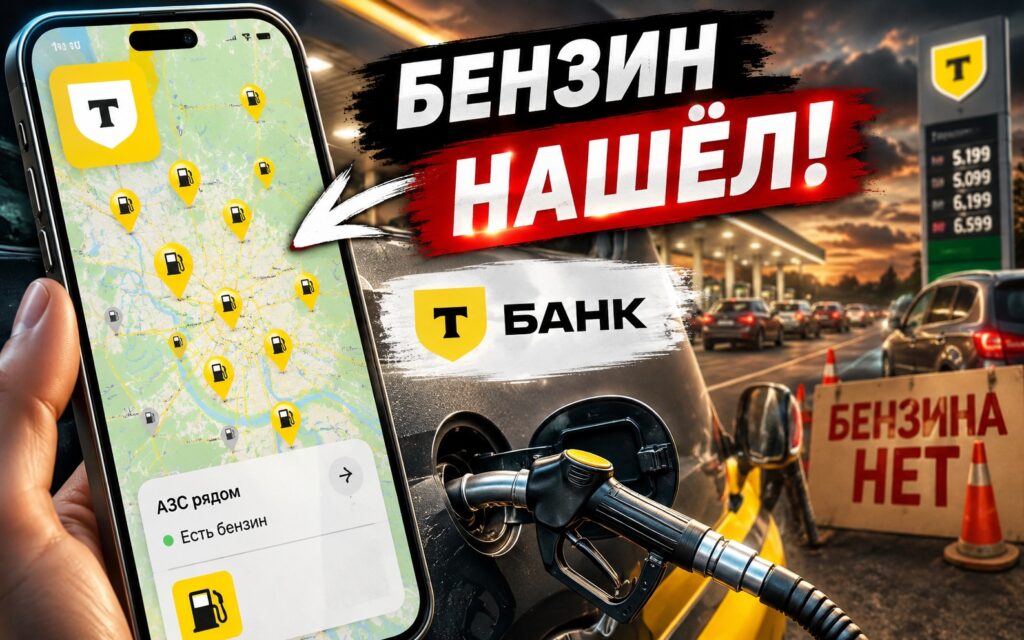
T-Bank’s map helped me find fuel
The service is available without installing a separate app: it opens on the website, through a search in the T-Bank app using the query “gasoline,” as well as on the main page of the Auto.ru app and at the website toplivo.tbank.ru. For Android owners, this is convenient because you don’t need to install extra software or grant location access to yet another app.
What T-Bank’s Gas Station Map Shows
The key word here isn’t “availability” but forecast. The map doesn’t show how much fuel remains in a reservoir, nor does it guarantee that you’ll reach the right pump before the fuel runs out. Instead, it looks at the purchase history of the bank’s customers, the flow of recent transactions, and driver reviews, then evaluates how up-to-date the data is for a specific station.
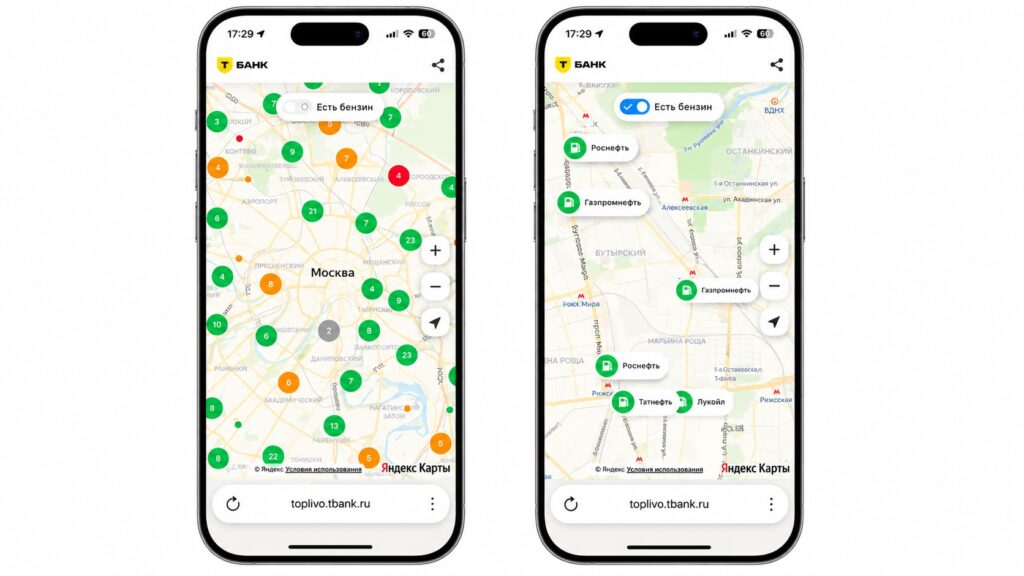
The map allows you to sort gas stations by fuel availability
For each gas station, the service shows the time of the last transaction and data freshness level. If a payment recently went through at a station, it’s most likely operating, and fuel was available very recently. If there are no recent transactions, there could be many reasons: fuel ran out, the station is closed, people paid with cash or cards from other banks, or there simply aren’t enough signals.
There’s a subtle detail that changes the meaning of the service. The last transaction at a gas station doesn’t always mean a fuel purchase specifically: the person may have paid for coffee, a car wash, or another item. But even such a payment shows that the location is open and accepting payments, so the algorithm uses this signal as part of its forecast.
The Fuel Situation — Real Reviews
Users can supplement automated data manually. In the station’s card, you can leave a review about fuel availability and queues. This crowdsourcing helps when the situation changes faster than payment signals update.
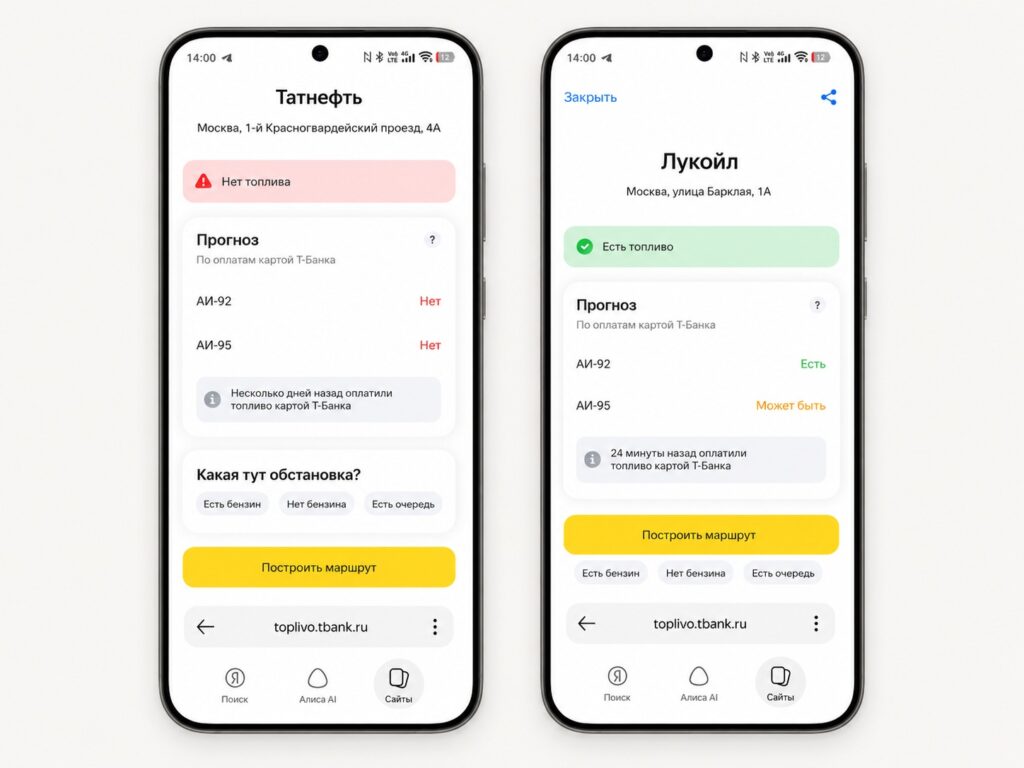
Each gas station has reviews
But manual marks have a downside. They become outdated, people make mistakes, and during shortages, the situation at a popular gas station can change in just a few minutes. That’s why reviews should be treated as a hint, not as an accurate real-time status.
Why T-Bank’s Gas Station Map Is Useful
The service addresses a simple problem that regular navigators handle poorly. A navigator knows where a gas station is but doesn’t know whether it’s worth going there right now. T-Bank’s map adds an operational layer: when a payment was last seen at the station, how fresh the signal is, and what drivers are saying. The clearest use case is on a highway, in an unfamiliar city, or in a region with supply disruptions. You can plan several stops along your route in advance and avoid running on empty. If the nearest station shows a fresh signal but people complain about long lines, it’s smarter to head to a neighboring one. And if there are no recent marks in the area at all, that doesn’t prove the absence of fuel, but it increases the reason to look for a backup option.
The emergence of such maps fits well with driver behavior in summer. According to T-Data analysts, in June 2026 the number of nighttime refueling sessions from midnight to 6:00 AM grew by 50–280% compared to May, depending on the region. At the same time, the average fuel volume per receipt decreased by 2–15% year-over-year, while the number of transactions remained stable or grew. In other words, people started stopping more often but filling up less each time.
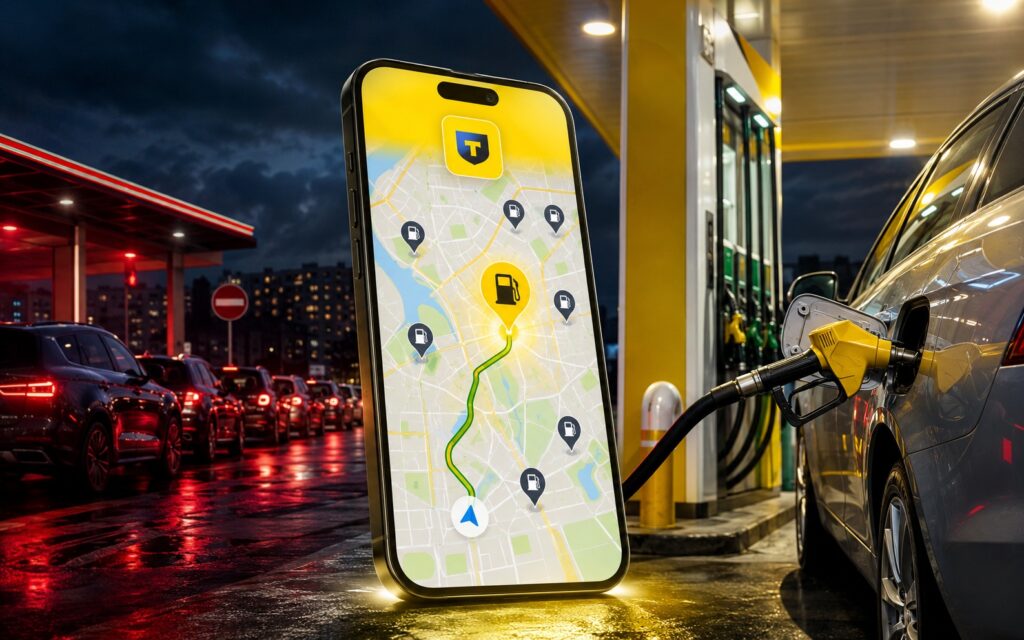
A very convenient tool for finding fuel
How to read different signals from the service:
- Time of the last transaction — the station recently accepted payment, but it may not have been a fuel purchase.
- Availability forecast — the algorithm estimates the probability of available fuel, but this is not an inventory count.
- Data freshness level — shows how recent the data is, although even fresh data becomes outdated quickly when there are queues.
- Driver reviews — help understand the on-site situation but depend on the reliability and timing of the post.
Where to Find Fuel in 2026 — Which Service to Use
T-Bank isn’t the only one trying to solve the fuel search problem. Yandex is testing a similar map for Yandex Pro drivers: it shows gas stations where someone managed to refuel within the last hour, with data coming from Yandex Refueling. More than 10,000 stations are connected to the test, but the map isn’t available to everyone yet. There are also community-driven maps like “GdeBENZ,” where drivers manually mark fuel availability, queues, limits, and available fuel grades. This format quickly gains an audience during shortages but is less protected against errors and false marks. Against this backdrop, T-Bank’s approach looks more sustainable because it relies on real payments — but even payment data doesn’t turn a forecast into a guarantee. However, it’s not without its drawbacks:
- The main risk — reading the map too literally. A fresh mark doesn’t mean that the AI-92 or AI-95 you need will definitely be available in ten minutes. The algorithm works with indirect signals, not fuel level sensors, and in a tight market, supplies can run out between the last transaction and your arrival.
- The second problem — incomplete data. The bank doesn’t see the entire payment market: at gas stations, people pay with cash, fuel cards, cards from other banks, and through the networks’ own apps. Therefore, the absence of a recent payment in the model doesn’t always equal an empty station — sometimes the service simply doesn’t see enough signals.
- The third point concerns fuel grades. You don’t need generic gasoline but a specific grade. If a general forecast is shown but there’s no certainty about the grade you need, it’s wiser to keep a backup option on your route. And separately about privacy: before using such maps, it’s worth checking what data the platform collects, whether it requires registration and location access, especially given the Ministry of Energy’s warnings about the risks of third-party fuel maps.
T-Bank’s map is useful as a quick navigation layer on top of regular maps, especially during fuel supply disruptions. But it should be read as a probabilistic indicator, not a promise. Check the transaction freshness, look at the forecast for the grade you need, cross-reference reviews about queues, and keep a backup station on your route. The most dangerous mistake a driver can make is to assume that a mark on the map equals fuel at the pump.