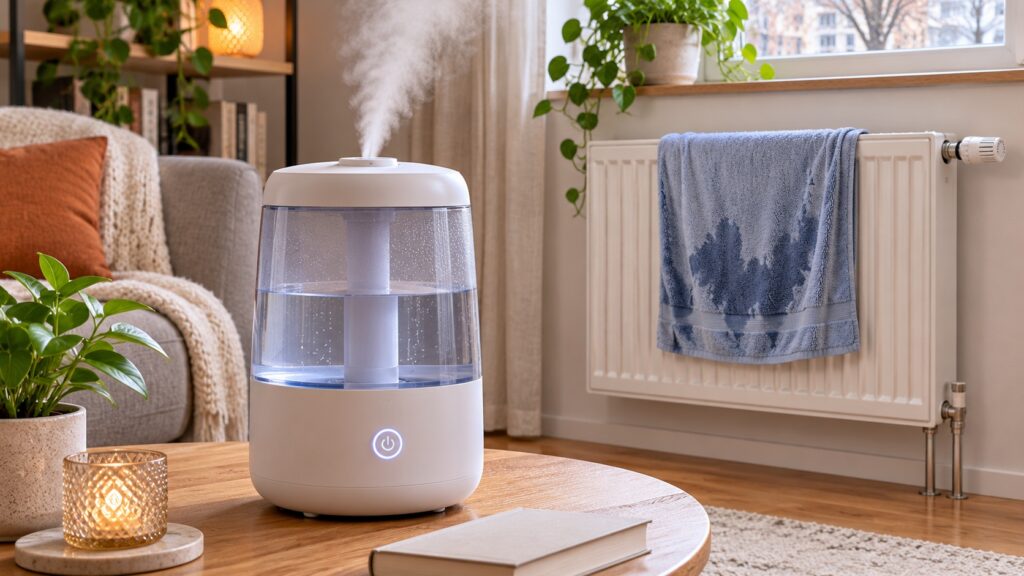
A humidifier and a wet towel on a radiator
A wet towel on a hot radiator does raise indoor humidity. It is not a myth. But it only works while the towel is wet, it releases only as much water as the fabric holds, and the extra moisture stays mostly near the radiator. A household humidifier adds water continuously and can put several times more moisture into the air overnight. Models with a hygrostat can also hold a chosen humidity level. Neither option is automatically right. Each has conditions that must be met, and either one can cause problems if used carelessly.
What you need to know
- Winter air indoors gets dry because cold outdoor air holds little water vapor. When it is heated to 22–24°C, its relative humidity can fall to 20–30% or lower.
- By a rough estimate, a humidifier using 300 ml per hour releases about 2.4 liters in eight hours. A towel holding 200 ml would need to be re-wetted about 12 times to match that.
- A reasonable target for most apartments is around 40–50%. Above 60%, the risk of mold and dust mites rises, according to Roskachestvo.
- A humidifier tank needs fresh water every day. Ultrasonic models spray whatever is in the tank into the air.
Why indoor air gets dry in winter
During the heating season, many people in apartments with central heating notice the same symptoms. Skin flakes, lips crack, and throats feel scratchy in the morning. Noses feel blocked and eyes feel gritty. People also tend to feel thirstier than usual by evening. Low indoor humidity is often the cause.
Radiators do not “burn up” moisture, though. The cause is physics. Frosty outdoor air contains very little water vapor, even when a weather forecast shows 80–90% humidity. That figure is relative humidity. It shows how saturated the air is compared with the maximum it can hold at its current temperature. Cold air holds little vapor, so even a small amount produces a high percentage.
This air enters the apartment through ventilation and gaps around windows and is warmed to 22–24°C. The amount of vapor in it stays the same, but warm air can hold much more. As a result, relative humidity drops sharply, sometimes to 20–30% or lower.
According to Roskachestvo, Russia’s consumer quality organization, skin and mucous membranes can dry out when humidity falls below 40%. The fix is to add water to the air. The question is how to do it.
A wet towel on a radiator works, but not for long
The method does work. The hot radiator warms the water in the fabric, the water evaporates, and the vapor spreads into the room. It is essentially the same as drying laundry, with heat speeding things up. Evaporation is faster when the wet area is larger, the radiator is hotter and the air moves more.
The method has three limitations:
- A towel holds little water. If a wrung-out towel holds 200 grams of water, it cannot release more than those 200 grams into the air.
- It slows down as it dries. The drier the fabric, the more slowly it evaporates water, and a dry towel adds no humidity at all.
- Moisture is uneven. The air near the radiator gets more humid, but the difference is barely noticeable in a far corner of the room.
It is impossible to say in advance how many percentage points a towel will add. That depends on the room size, radiator temperature, ventilation and how much water evaporates, so any figure without measurement is a guess. In a small room a towel can help, especially if it is re-wetted regularly. It will not keep humidity steady through the night.
A humidifier can evaporate as much water overnight as a dozen towels
The main advantage of a humidifier is that it supplies water to the air without interruption. According to Rospotrebnadzor, Russia’s consumer protection agency, a typical household humidifier uses roughly 300–500 ml per hour and is designed for a room of about 20–30 square meters. Real-world results depend on conditions.
A simple example shows the difference. A unit using 300 ml per hour will release about 2.4 liters of water into the air over eight hours. A towel holding 200 ml would have to dry out and be re-wetted 12 times to match that. This is a rough calculation, not a laboratory comparison, but it does show the difference in scale.
| Criterion | Wet towel | Humidifier |
|---|---|---|
| Raises humidity | Yes | Yes |
| Works all night | Until it dries | Yes, if there is enough water |
| Adjustable output | Practically none | On most models |
| Holds a set humidity level | No | Yes, if it has a hygrostat |
| Cost | Almost free | Requires buying a device |
| Maintenance | Washing and drying | Rinsing, cleaning, filters |
A hygrostat is a built-in sensor that switches the device on and off to maintain the chosen humidity level. A humidifier does not produce any “special” water. If a humidifier and a towel evaporate the same amount of clean water, the effect on humidity is roughly the same. The differences are speed, duration and control.
Ultrasonic, evaporative and steam humidifiers
There are three main types of humidifier, and they work differently:
- Ultrasonic. A vibrating plate breaks water into tiny droplets, producing a cool mist. These units are quiet and use little energy. With hard tap water, they can leave a white residue on furniture.
- Evaporative (traditional). A fan blows air through a wet filter, and the water evaporates on its own. It is the same principle as the towel, but far more efficient. It leaves no residue, but the filters need maintenance.
- Steam. These units boil water and release steam. They humidify quickly but use more electricity, and the hot steam can cause burns.
For a typical bedroom, the most sensible choice is between an ultrasonic and an evaporative model. The ultrasonic type is quieter, and the evaporative type does not spread mineral dust around the room. Roskachestvo also warns that a device’s real output can be lower than claimed, so the room size given in advertising is best treated with some margin.
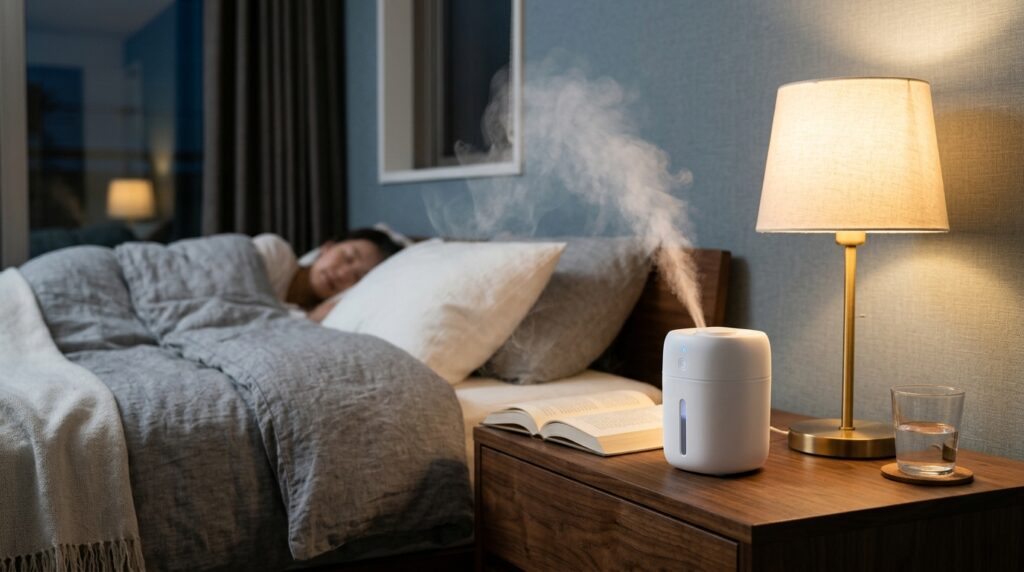
A white humidifier releasing mist on a nightstand beside a bed
Drying laundry and other device-free options
A towel on a radiator is not the only free option. There are others:
- Dry washed laundry indoors. A rack of wet clothes holds much more water than a single towel and has a large evaporating surface, so the effect is sometimes noticeable.
- Place a wide container of water near a heat source, in a safe spot. Water evaporates slowly from a still surface, so a wider container works better.
- Turn the heating down slightly if the home is hot. Cooler air with the same amount of vapor has a higher relative humidity.
All these methods share one drawback: none of them regulates itself. In some conditions they barely help. In others, such as drying a large load of laundry, they can make a room too humid.
Humidity above 60% raises the risk of mold and dust mites
More humidity is not always better. When the air holds too much vapor, condensation forms on cold windows and walls. If those surfaces stay wet for long, mold can grow there.
Dust mites also multiply more actively in humid air, which is a particular concern for people with allergies. According to Roskachestvo’s recommendations, the risk of mold and mite problems increases above 60%.
For most apartments, a sensible target is around 40–50%. There is no need to aim for exactly 50%. If a home is at 40–45% in winter and the windows and walls stay dry, that is usually enough.
A dirty humidifier tank can spread microbes
A poorly maintained humidifier can become a problem in itself. Water sits in the tank constantly. If it is not changed for a long time, a slimy coating and a film of microbes form on the walls.
Ultrasonic models need particular attention. They spray water as very fine droplets, and whatever is in the tank goes into the air with them. Switching one on after several days with stale water is a bad idea.
The basic rules are simple:
- change the water every day;
- rinse the tank regularly and clean the device according to its manual;
- replace filters on time;
- where possible, use distilled or demineralized water in ultrasonic models.
Boiled water is not a substitute for distilled water, because the salts remain in it. Aromatic oils should only be added to devices specifically designed for them.
A simple home test with a hygrometer and a towel
Before buying anything, it is worth finding out how humid your home actually is. A hygrometer is a small, inexpensive device that shows humidity as a percentage. Place it away from radiators, windows and humidifiers so the reading reflects the whole room.
You can then test the towel method like this:
- Note the hygrometer reading.
- Hang a wet towel on a water-heated radiator, if the manufacturer allows it.
- Check the hygrometer again after one to two hours, ideally at the same room temperature.
- To see how much water evaporated, weigh the towel before and after. Each 100 grams lost means roughly 100 ml of water released into the air.
Ventilation, temperature and other moisture sources such as cooking all affect the result, so it is best to repeat the test several times. One important limit: do not cover electric heaters with wet towels unless the manual explicitly allows it. The device can overheat and break.
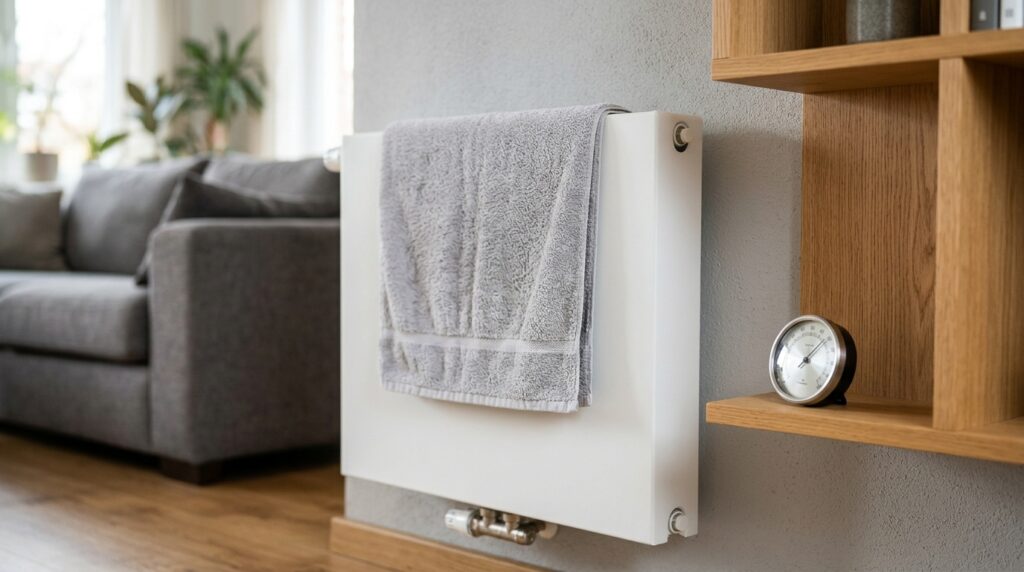
A towel on a white radiator with a hygrometer on a nearby shelf
When a towel is enough and when you need a device
If the air at home is constantly dry, a humidifier is the more practical choice. It supplies far more water for longer, and a model with a hygrostat maintains the chosen level on its own. If humidity is only slightly below normal and you would rather not spend money, a towel is a reasonable temporary measure, especially in a small room. If the hygrometer already reads 40–50%, no extra humidification is needed.
A humidifier is not a substitute for opening a window. It adds water to the air but does not remove excess carbon dioxide or other pollutants. Rooms still need regular ventilation in winter.