An old cassette player can act as a speaker for your smartphone — no cables, no Bluetooth, and no cassette required. You simply place your phone’s speaker directly on the tape deck’s playback head, and the player amplifies the sound through its own speakers. The trick relies on basic electromagnetic induction: the phone’s speaker generates a changing magnetic field that the tape head picks up just as it would from magnetic tape. It is a fun physics demonstration rather than a practical audio solution, and it will not work reliably for everyone.
What you need to know
- The trick works because the phone’s speaker magnet creates a changing magnetic field that the cassette player’s tape head can detect, just like magnetized tape would.
- No cassette should be inserted — the tape compartment must be empty and the player set to Play mode.
- Sound quality is described as quiet, muffled, and noisy — this is a novelty, not a replacement for a real speaker.
- The effect works in principle with any smartphone, not just iPhones, since the underlying physics is the same.
Step-by-step instructions
The procedure is straightforward and takes about a minute:
- Start playing music on your phone and turn the volume up to near maximum.
- Open the cassette compartment and make sure it is empty — no tape inside.
- Switch the cassette player to playback mode and press Play without a cassette.
- Place the phone with its speaker facing down directly onto the exposed tape transport mechanism, where the tape would normally pass over the playback head.
- Slowly move the phone around until sound begins coming through the cassette player’s speakers.
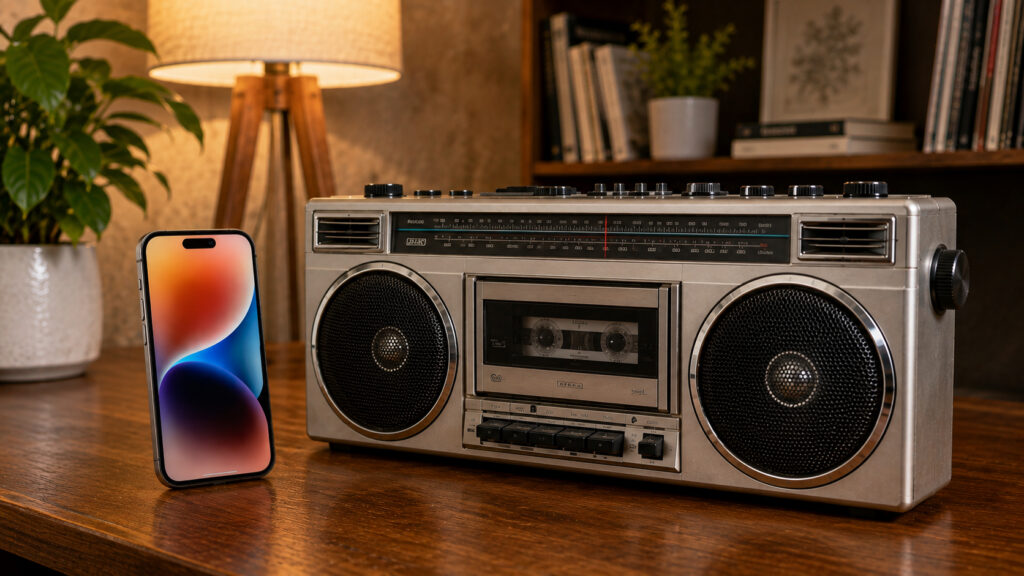
An old cassette player can play music from a phone without any cables
Why it works: electromagnetic induction
Inside every cassette player is a magnetic playback head — essentially a tiny coil of wire with a narrow gap. During normal operation, magnetized particles on the tape pass over this head, creating a changing magnetic field that induces a small electrical current in the coil. The player’s built-in amplifier boosts that current and sends it to the speakers.
A phone’s speaker also contains a magnet and a coil. When music plays, current flows through the coil, vibrating a membrane to produce sound. As a side effect, the speaker generates a changing magnetic field around itself. When the phone is placed directly on the tape head, the head picks up this field in exactly the same way it would detect a moving tape. The cassette player does not distinguish between the two sources — it simply amplifies whatever signal the head receives.
The underlying principle is electromagnetic induction, the same phenomenon discovered by Michael Faraday nearly two centuries ago and used today in transformers, wireless chargers, and countless other devices.
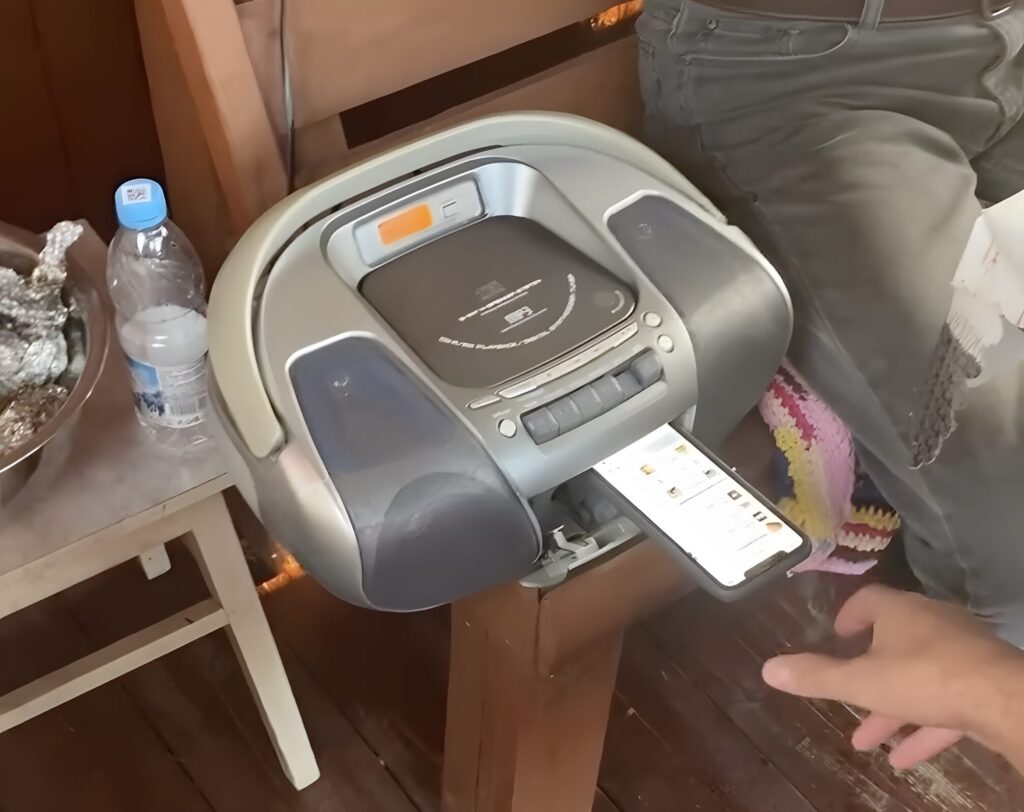
The phone needs to be positioned like this on the tape transport
Limitations and caveats
This trick will not work for everyone. Several factors affect success:
- Speaker shielding: Newer smartphones often have better-shielded speakers, meaning less magnetic field leaks out for the tape head to detect.
- Precise positioning: The playback head is a small target deep inside the tape transport. You may need to slide the phone around carefully to find the sweet spot.
- Volume: The phone’s volume must be set to maximum or near-maximum to generate a strong enough field.
- Sound quality: Even when it works, the output is described as quiet, muffled, and accompanied by interference. This is a novelty demonstration, not a viable audio setup.
Not just iPhones
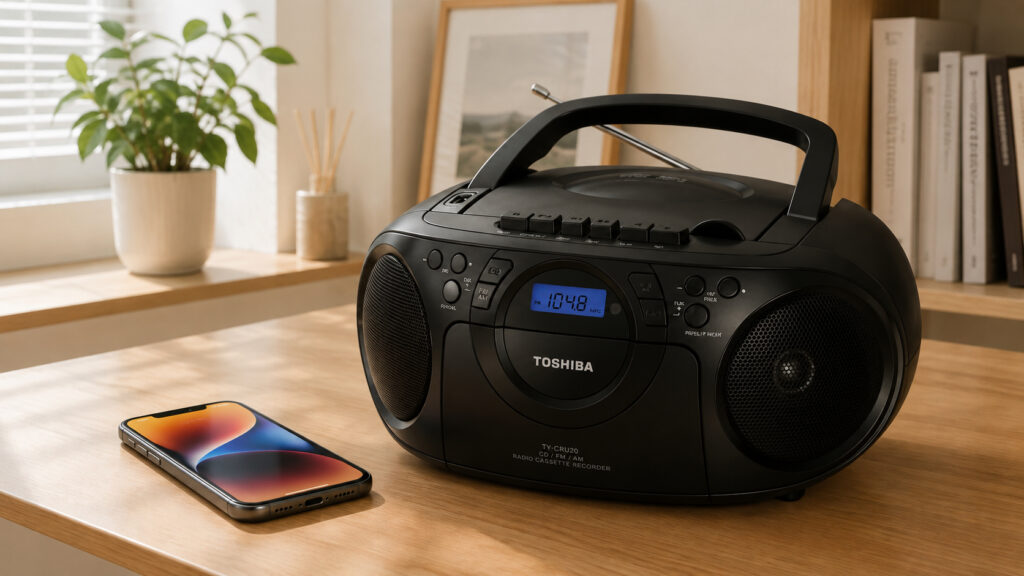
You may need to experiment with positioning, but the effect can be impressive
This trick is not exclusive to iPhones. Any smartphone with a conventional speaker should be capable of the same effect, because the physics is identical. The only variables are how much magnetic field a particular phone’s speaker emits and how sensitive the cassette player’s head is. If you have an old boombox and any smartphone handy, the experiment takes just a couple of minutes.
Beyond the novelty factor, this is a useful hands-on demonstration of electromagnetic induction — potentially more engaging for students than a textbook diagram, since it shows the principle at work between two real devices from different eras of technology.