Russia’s Ministry of Education has sent methodological recommendations to the regions on how much time children can spend with smartphones, computers, and television. These are not bans or strict restrictions, but guidelines for parents and educators, broken down by age. However, it is very important for minors to follow these recommendations, since prolonged interaction with gadgets leads to mental health issues and other unpleasant consequences. Below are the specific numbers and a sober analysis of what can realistically be done with them.

How much screen time can a child have — answer from the Ministry of Education
What Screen Time Standards Has the Ministry of Education Introduced
The agency has distributed methodological recommendations on children’s gadget use to the regions. The document covers three major scenarios at once: phone, computer use, and watching television. Essentially, this is the government’s first attempt to give parents clear guidelines on screen time, rather than an abstract “spend less time on your phone.”
It’s important to set the right expectations right away: these are recommendations, not regulations. There are no fines, inspections, or mandatory enforcement — the document is addressed to parents and schools as a guideline, not a rule that anyone will force you to follow. So technically (and practically too), if your child spends all day on a tablet or smartphone, no one will punish either you or them.
How Much Screen Time a Child Can Have by Age
For smartphones, the recommendations are structured so that the youngest children get as little screen time as possible, with the limit gradually increasing with age. Here’s what the agency suggests:
- Under 2–3 years — smartphone use should be minimized as much as possible
- 2–3 years — up to 20 minutes per day
- 3–7 years — up to 1 hour per day
- 7–11 years — up to 1.5 hours per day
- 11–16 years — up to 2 hours per day
The logic is simple: the younger the child, the less time they should spend with a phone. For preschoolers, we’re talking literally minutes, and a full couple of hours only appears for teenagers.
Using gadgets is fine, the key is to do it wisely
Computer Screen Time Standards for Schoolchildren
With computers, the approach is different: what matters here is not so much the total duration per day, but rather breaks and continuous time at the screen. The recommendations are tied to the student’s age:
- 7–11 years — no more than 30 minutes at a time, with breaks every 20 minutes for eye exercises and stretching
- 12–14 years — no more than 45 minutes at a time, followed by a mandatory break
- 15–17 years — a total of 1–2 hours per day with regular breaks and alternating with offline activities
The emphasis here is on breaking time into short sessions, rather than an outright ban. The idea is clear: children’s eyes get tired from continuous screen exposure, so it’s more important to take timely breaks and stretch than to simply turn off the computer after a certain hour.
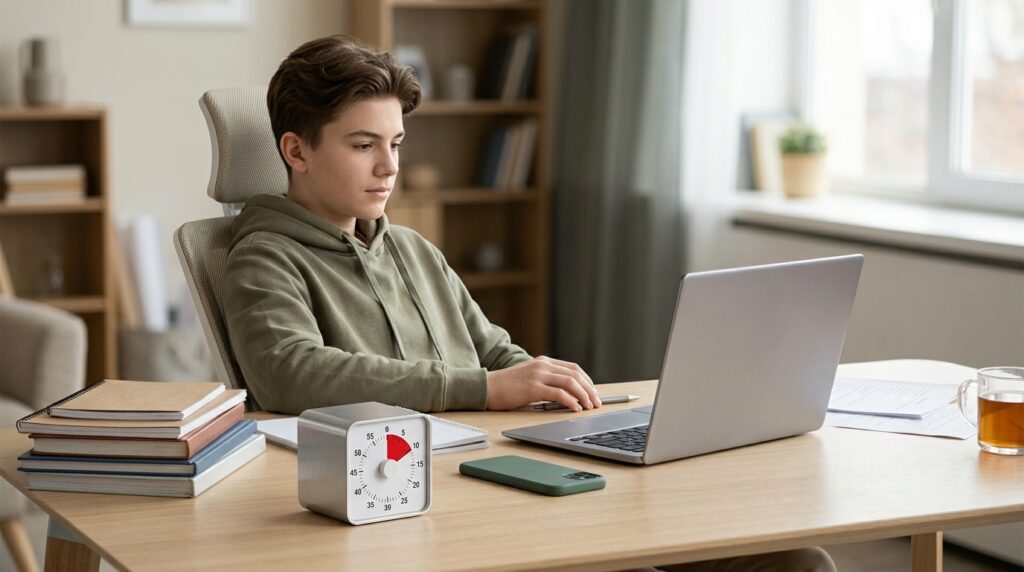
For computer use, the Ministry of Education emphasizes regular breaks
How Much TV Can Children Watch
The agency didn’t overlook television either — and here the limits are noticeably more lenient than for phones. The recommendations are as follows:
- 3–7 years — up to 30 minutes per day
- 8–10 years — up to 1 hour per day
- 11–14 years — 1.5–2 hours per day
- 14–18 years — up to 3 hours per day with breaks every hour
Interestingly, more time is allowed for television than for smartphones: a teenager aged 14–18 is allotted up to three hours of TV screen time, while the phone limit at this age is about two hours.

Moderation with gadgets is important not only for children, but for adults too
How to Tell If Your Child Has a Gadget Addiction
The numbers from the Ministry of Education are a guideline, but it’s more important to watch behavior than minutes. Parents should be concerned when the screen starts displacing everything else: the child gets irritated when the phone is taken away, loses interest in walks and face-to-face communication, sleeps worse, or can’t do anything without a gadget at hand. The warning sign is not the number of hours, but dependency on the screen at the expense of studies, sleep, and mood.
What helps here is not bans, but calm agreements and leading by example. Additionally, Android has built-in parental control tools through the Family Link app, where you can set a daily time limit and see what the hours are actually being spent on. This is more convenient than standing with a stopwatch and manually counting minutes.
Are These Standards Mandatory for Parents and Schools
The short answer is no. This is an advisory document, not a law or a sanitary standard with inspections. No one is required to report to the school about how long a child spent on their phone, and there are no consequences for exceeding the limits.
It’s also worth being realistic about the numbers themselves: the specific values look more like rounded guidelines than the result of rigorous research, and the exact scientific justification for these particular numbers from the document is not entirely clear.