iPhone and Mac security has always been one of the key arguments in favor of the Apple ecosystem. But even the most protected devices regularly receive updates that patch dozens of vulnerabilities. Artificial intelligence is changing the rules of the game: now AI helps find and fix code flaws faster than hackers can exploit them. However, new Mac viruses are bypassing macOS protections more frequently, so the race never stops. Let’s explore exactly how AI makes iPhone and Mac more secure, what technologies are already at work, and what awaits Apple users in the near future.

Every year, hacking an iPhone becomes more expensive
Why Vulnerabilities Are Constantly Found in iOS and macOS
Modern software is incredibly complex. The iOS and macOS operating systems contain millions of lines of code, supplemented by third-party libraries, frameworks, APIs, and intermediate components. Each of these elements is a potential entry point for an attacker. In the cybersecurity world, this is called the “attack surface”, and it only grows with each passing year.
How artificial intelligence makes iPhone and Mac more secure
The task for Apple’s security engineers is to find and patch all vulnerabilities. But the problem is that a hacker only needs to discover a single unpatched flaw, while defenders need to find absolutely every one. This is the fundamental inequality in cybersecurity: the attacker always has the advantage. That’s why security updates for iPhone and Mac are released with impressive regularity — every few weeks, and each one closes dozens, sometimes hundreds of potential issues.
Until recently, the security strategy was less about closing every hole and more about making hacking as expensive and complex as possible. iOS exploits, for example, cost millions of dollars on the black market precisely because Apple has built a multi-layered defense system. But even that doesn’t stop targeted attacks.
Neural Networks Search for Code Bugs
Artificial intelligence — specifically modern large language models and AI agents for working with code — is radically changing the approach to vulnerability discovery. These systems can analyze enormous volumes of source code with a speed and accuracy that is inaccessible even to large engineering teams.
One illustrative example is an experiment by Mozilla. The Firefox browser developers used Anthropic’s Claude Opus model to scan their codebase. The AI agent discovered 22 critical security-related bugs. After further analysis, the model found an additional 271 vulnerabilities in the same code. These are issues that had remained undetected for years during manual audits and traditional static analysis tools.
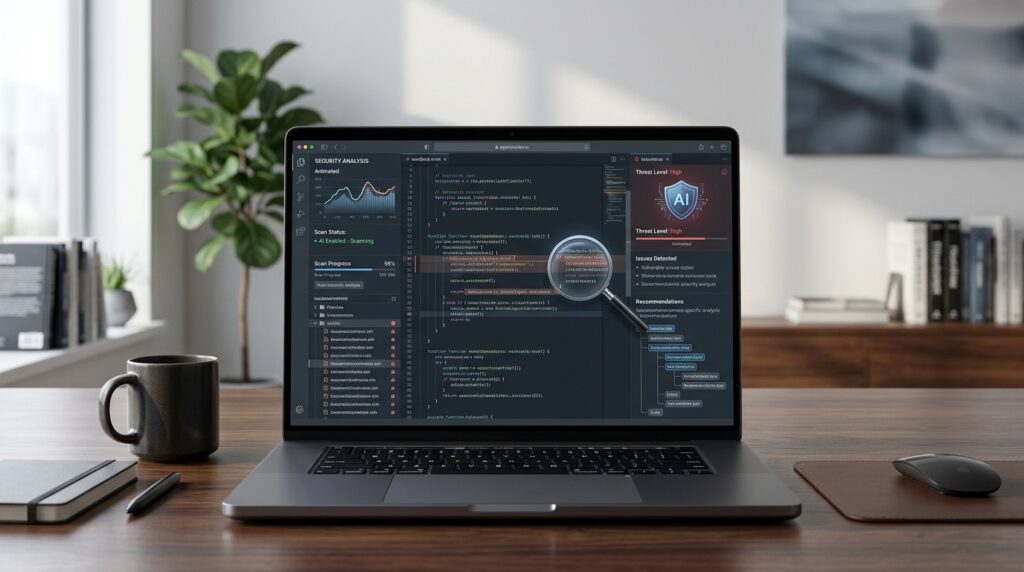
AI agents analyze millions of lines of code and find vulnerabilities that traditional tools miss
The key advantage of AI over traditional methods is scale. Classic code-checking tools operate on predefined rules and templates. They find typical errors but miss nonstandard and complex vulnerabilities. AI models, trained on millions of code examples, recognize patterns of complex vulnerabilities that don’t fit simple rules. They understand context, can trace call chains across different modules, and find vulnerabilities at the intersection of components.
For Apple, this is especially important. The Apple ecosystem includes several operating systems — iOS, macOS, iPadOS, watchOS, tvOS, visionOS — that share common components. A vulnerability in a shared module can affect all devices at once: from iPhone to Mac and Apple Watch.
Technologies Apple Uses to Protect Devices
Apple traditionally does not disclose the details of its internal security processes. However, the company actively invests in machine learning and applies it in several areas of user protection.
- On-device malware detection. macOS has a built-in XProtect system that uses signature analysis and heuristics to detect malicious software. Apple regularly updates its databases, and there is reason to believe that AI models help build these databases by analyzing the behavior of suspicious software.
- App behavior analysis. Starting with iOS 16, Apple strengthened its sandbox mechanisms — the isolated execution environment for apps. AI algorithms help identify anomalous app behavior in real time, even if a specific threat has not yet been added to the databases.
- Phishing and fraud filtering. Safari uses intelligent systems to recognize phishing websites. Machine learning models analyze visual and textual patterns of pages, comparing them with known legitimate resources.
- Private Cloud Compute. With the launch of Apple Intelligence, the company introduced Private Cloud Compute — a cloud platform for processing AI requests with an unprecedented level of privacy. The architecture is designed so that even Apple cannot access user data during processing.
In addition, major technology companies have begun joining forces. Google, Microsoft, and other players are already using AI for proactive vulnerability discovery in their products. Google Project Zero, for example, uses fuzzing (automated testing with random data) combined with AI, which has helped find thousands of bugs in open-source software that is also used in Apple products.
How Neural Networks Help Hackers Attack Users
It would be naive to think that only defenders use AI. Attackers have gained access to the same tools, and this creates new challenges. AI models help hackers automate several key processes:
- Generating phishing emails that are virtually indistinguishable from real ones. While phishing used to be recognizable by awkward language and errors, AI-written texts look convincing.
- Automated vulnerability scanning in open-source code. The same models that help engineers are available to attackers.
- Creating malicious code. AI assistants can generate working exploit code from a vulnerability description.
- Profiling and social engineering. AI analyzes leaked data and creates personalized attacks on users.
However, there’s an important nuance here. AI provides an asymmetric advantage specifically to defenders, not attackers. The reason is that companies like Apple have full access to their source code. An AI agent can scan the entire codebase systematically and methodically. A hacker, on the other hand, works blind — they only see the compiled program and must search for vulnerabilities from the outside. Therefore, with equal computational resources, a defender with AI will find and close more holes than an attacker can discover.
Protecting iPhone and Mac with AI
Apple integrates machine learning into security at multiple levels — from silicon to the cloud.
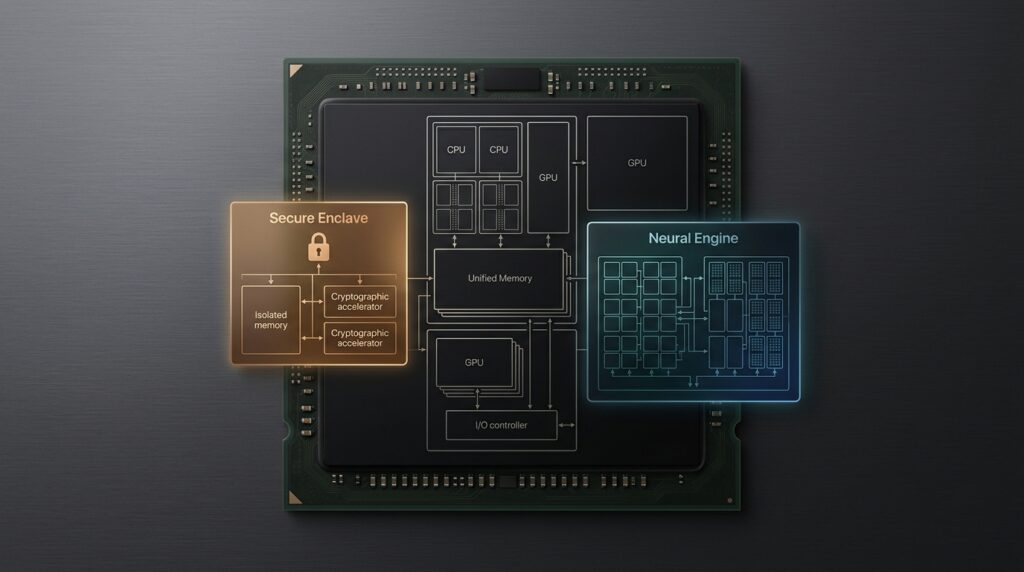
At the hardware level. Apple Silicon chips (M1, M2, M3, M4, and A-series) contain a dedicated Secure Enclave — an isolated processor for handling encryption keys, Face ID and Touch ID biometrics. This component is hardware-separated from the main system, and even if an attacker gains control of the operating system, the data in Secure Enclave remains inaccessible.
At the operating system level. iOS and macOS feature the Rapid Security Response system — a mechanism for fast security updates that install without restarting and without a full OS update. AI helps prioritize threats and release patches faster for the most critical vulnerabilities.