A person in a spacesuit against the planets of the Solar System
On almost every planet in the Solar System other than Earth, an unprotected human would lose consciousness within roughly 10 to 15 seconds, mainly because there is no breathable oxygen. Venus is the grim exception: its crushing pressure and extreme heat would cause critical damage almost immediately. Films tend to show people instantly freezing or exploding in space, but reality works differently, and the scenario changes from world to world. On some planets the main threat is a near-vacuum, on others enormous pressure, and on the giant planets there is not even a surface to stand on.
What you need to know
- On Mercury, Mars, Jupiter, Uranus and Neptune, loss of consciousness is expected in about 10–15 seconds; on Saturn, within a matter of seconds.
- These figures mostly describe time until unconsciousness, not death: if normal pressure and oxygen are restored very quickly, survival may still be possible.
- On Venus, surface temperatures average around +464 °C and pressure is about 92 times Earth’s, so critical injury would begin almost at once.
- The body would not explode and blood would not instantly freeze, although exposed moisture such as saliva can boil at very low pressure.
On the rocky planets, the atmosphere decides everything
Mercury
Mercury has practically no atmosphere, only a very thin exosphere. During the day its surface can heat up to +430 °C, and at night it can cool to around −180 °C.
Yet neither the heat nor the cold would become the main problem. Because of the near-total vacuum, oxygen would rapidly leave the blood, and a person would pass out in about 10–15 seconds. If normal pressure were restored within the next minute or two, there would still be a chance of survival.
On Mercury, a person would lose consciousness before having time to freeze or, quite literally, to roast. In a vacuum, heat is transferred far less efficiently than in air or water.
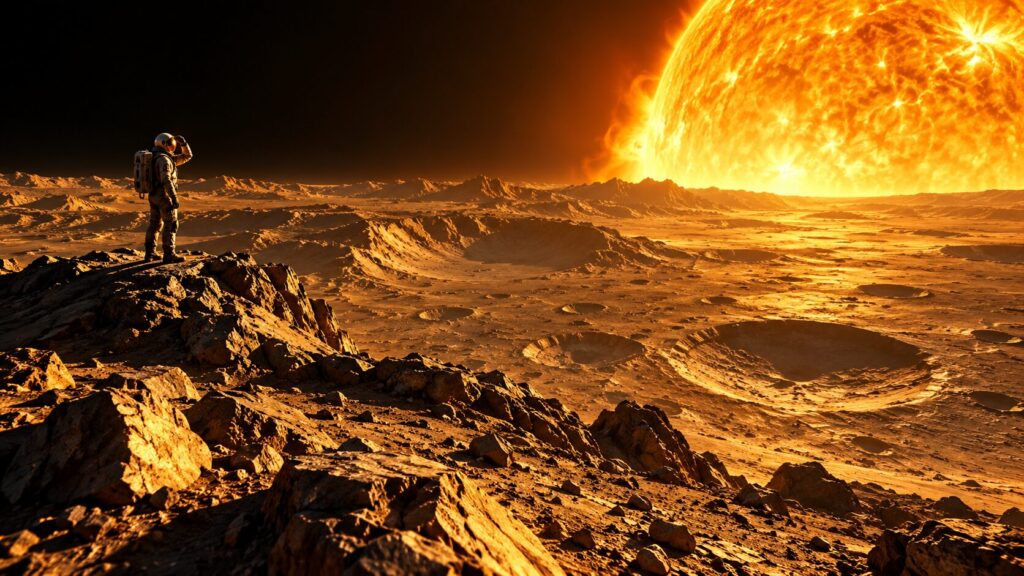
A person on the scorching surface of Mercury
Venus
Here things get much worse. The average temperature near the surface of Venus is about +464 °C, and the pressure is roughly 92 times that on Earth. That is comparable to the water pressure at a depth of about 900 meters.
The atmosphere is also made almost entirely of carbon dioxide. A person would therefore face several problems at once: no breathable air, a drastic pressure difference and heating in an extremely hot, dense gas.
On the surface of Venus, critical damage would begin almost immediately, and it is impossible to honestly name an exact number of seconds. Claims such as “a person would survive exactly one second” are more of a dramatic convention than an established fact.
Interestingly, about 50 kilometers above the surface conditions are much milder: the pressure there is close to Earth’s, and the temperature can be fairly tolerable. That is why Venus, despite its reputation as the hottest planet, is sometimes considered a site for theoretical floating stations. Even there, however, there is no oxygen, and the clouds contain sulfuric acid.
Earth

Earth is the only planet suitable for human life
Here, things are surprisingly good. With normal atmospheric pressure, a suitable temperature and access to air, a person can go without a spacesuit for an entire lifetime.
Earth is the only planet in the Solar System where a human does not need a spacesuit for everyday life at all.
Of course, this stops being true at high altitude, underwater or in Antarctica. But in those cases the problem is not the planet itself but the specific local conditions.
Mars
Compared with Venus, Mars looks almost cozy. Daytime temperatures near the equator sometimes even rise above freezing. But the average surface pressure is only about 6.4 millibars, less than one percent of Earth’s.

A person in the thin atmosphere of Mars
Mars does have air, but it is about 95% carbon dioxide and far too thin for humans to breathe.
At such low pressure, moisture on the tongue and mucous membranes begins to boil, tissues swell, and the brain is starved of oxygen. Loss of consciousness is expected after about 10–15 seconds. With immediate rescue, a person could theoretically still survive, but after one to two minutes the situation becomes critical.
Mars seems far friendlier than Venus, but for the human body its atmosphere is barely different from a vacuum.
The giant planets offer nowhere to land
Jupiter, Saturn, Uranus and Neptune introduce a new problem: they have no surface in the usual sense. To make any comparison possible, imagine a person placed in the layer of the atmosphere where the pressure is roughly equal to Earth’s.
Jupiter
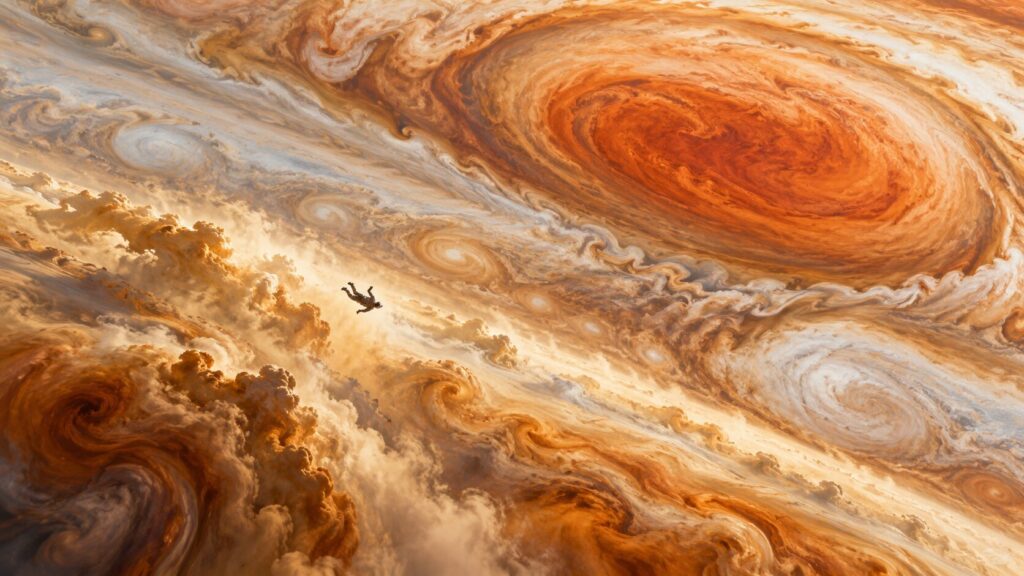
A person falling into the atmosphere of Jupiter
Jupiter is made mostly of hydrogen and helium and has no solid surface. At the level where pressure equals one Earth atmosphere, the temperature is about −108 °C.
There is nothing to breathe, so a person would lose consciousness in the same 10–15 seconds or so. But the fall would not end there: deeper down, the gas becomes ever denser and hotter, and the pressure keeps rising.
On Jupiter, the brain would shut down first from lack of oxygen, and only afterward would the rising pressure and temperature destroy the body.
A person would never reach any kind of “bottom”: Jupiter simply has no clear boundary between its atmosphere and its inner layers.
Saturn
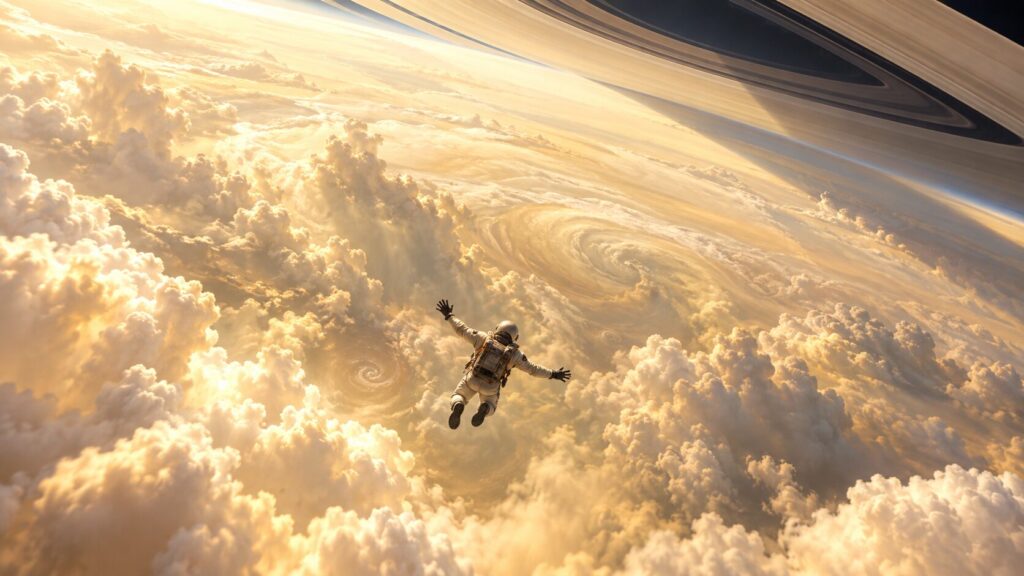
A person among the clouds of Saturn’s atmosphere
Saturn is built in a similar way. Its atmosphere is also mostly hydrogen and helium, and the temperature at the Earth-pressure level is somewhere around −140 °C.
As for whether anyone could land on Saturn at all, the answer is simple: there is nowhere to land. A person would keep sinking deeper and deeper.
Without oxygen, consciousness would vanish within seconds, long before the pressure deep inside Saturn became the main problem.
Uranus
Uranus is an ice giant, and its atmosphere is noticeably colder. At a pressure level of about one atmosphere, the temperature is roughly −197 °C, and in some higher layers it drops below −220 °C.
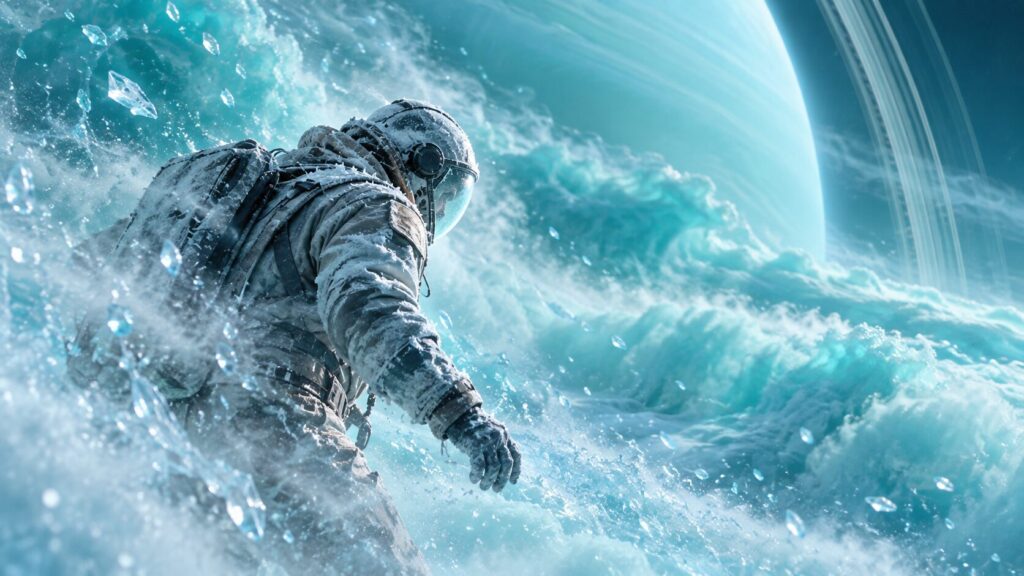
Extreme cold in the atmosphere of Uranus
Even this intense cold would not turn a person into an ice statue instantly. The lack of oxygen would take effect much sooner.
On Uranus, a person would most likely lose consciousness after about 10–15 seconds, with the severe cold becoming only a secondary problem.
Neptune
Neptune is similar, only the weather is even nastier. Its atmosphere is mostly hydrogen and helium with some methane, the temperature stays around −200 °C, and winds reach roughly 2,000 km/h.
There is no solid surface here either. A person would fall through the clouds, gradually entering denser, hotter and higher-pressure layers.
On Neptune, lack of oxygen would switch off consciousness before the extreme cold and wind could do most of the damage.
So where would a person last the longest?
These figures are approximate. Naturally, no such experiments have ever been carried out on people, and the outcome depends on pressure, temperature and how quickly the person could be returned to safe conditions. The numbers below are therefore rough guides, and in most cases 10–15 seconds refers to the time until loss of consciousness, not death. If normal pressure and oxygen are restored very quickly, a person may still survive.
| Planet | Main hazard | What happens without a spacesuit |
|---|---|---|
| Mercury | Near-total vacuum | Consciousness lasts about 10–15 seconds; a chance of rescue remains for roughly 1–2 minutes |
| Venus | +464 °C and pressure of about 92 atmospheres | Critical damage begins almost immediately |
| Earth | None under normal conditions | You can live here your whole life |
| Mars | Very low pressure and no oxygen | Consciousness lasts about 10–15 seconds; after that, the clock runs in minutes |
| Jupiter | No oxygen and no solid surface | Consciousness lasts about 10–15 seconds, then the person keeps falling into the atmosphere |
| Saturn | No oxygen and severe cold | Loss of consciousness within seconds |
| Uranus | No oxygen and extreme cold | Loss of consciousness after about 10–15 seconds |
| Neptune | No oxygen, cold and extremely strong winds | Loss of consciousness after about 10–15 seconds |
In short, none of the other planets is a clear “best place.” On Mercury and Mars a person would stay conscious for roughly the same length of time, while Venus would be far more dangerous because of its combination of enormous pressure and heat. On the giant planets there is an added problem: any rescue would have to happen literally in mid-air, since there is no solid surface.
The body would not explode, and blood would not turn to ice
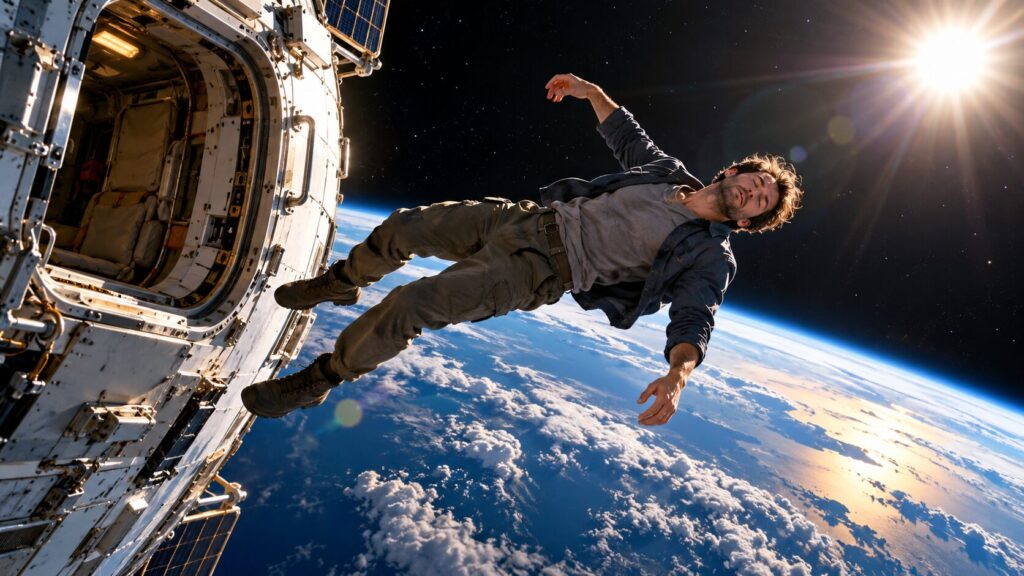
An unprotected person in open space
The most popular space myth holds that, without a spacesuit, a person would instantly balloon and explode. That is not the case. Tissues would indeed start to swell, but skin is strong enough to keep the body intact. Blood inside the vessels would not start boiling violently either. However, at very low pressure, exposed moisture such as saliva on the tongue can boil.
Freezing does not happen instantly either. A vacuum has no air to carry heat away from the body quickly, so on Mercury or Mars a person would lose consciousness from lack of oxygen before freezing. The Moon, incidentally, would produce roughly the same result as Mercury and Mars; it simply is not a planet.
One more important point: during a sudden decompression, you should not hold your breath, because the expanding air can seriously damage the lungs.