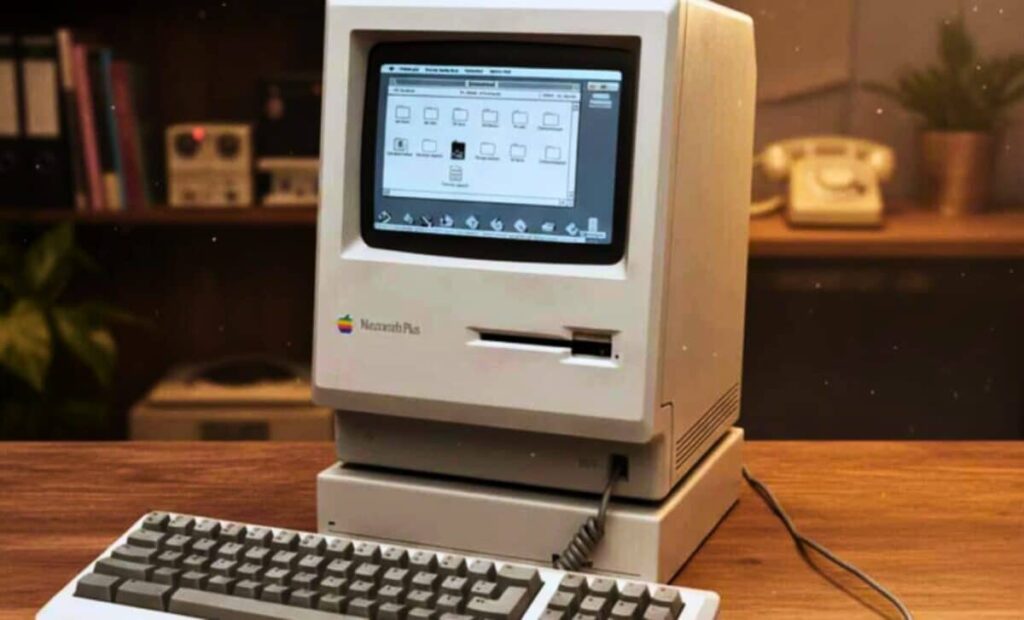
How one student accidentally created Photoshop while trying to fix a computer in 1987
Thomas Knoll didn’t plan to create the most influential graphics editor in history. He simply wanted his computer to display images properly. But the utility he wrote — just a few lines of code — set off a chain of events that led to the creation of Adobe Photoshop, a program without which it’s impossible to imagine image editing, cinema, or web design today.
How the Photoshop Story Began: The Display Utility
In 1987, Thomas Knoll was a graduate student at the University of Michigan working on computer vision. His primary tool — a Macintosh Plus — could only display images in black and white, without halftones. For his research, this was a serious obstacle: without shades of gray, analyzing visual data was extremely difficult.
Knoll wrote a small utility he called Display. It made the screen pixels simulate grayscale gradations — essentially tricking the monitor. The program solved a specific problem and didn’t aspire to anything more. But it was precisely this student code that became the foundation of Photoshop.
By that point, Knoll already had an unusual skill set. He had started programming in high school, teaching himself BASIC on a time-sharing terminal. And he had taken up photography at age eleven, when his father handed him an Argus rangefinder camera and taught him to develop film in a darkroom. These two worlds — code and photography — existed separately from each other for the time being.
How Photoshop Ended Up Being Needed by the VFX Studio ILM
Everything changed when John Knoll — Thomas’s older brother — saw Display. John worked at Industrial Light and Magic, George Lucas’s legendary visual effects studio. There he was involved in analog image compositing, and the company was just beginning to experiment with digital processing: scanning film frames into numerical data, modifying them, and recording them back onto film.
John immediately recognized the potential of the approach. As Thomas recalled in an interview for the Adobe blog in 2015, his brother explained the logic simply: you turn a frame into numbers, numbers back into a frame, and everything between those steps is an open field for manipulation. John said that was exactly where visual effects were heading.
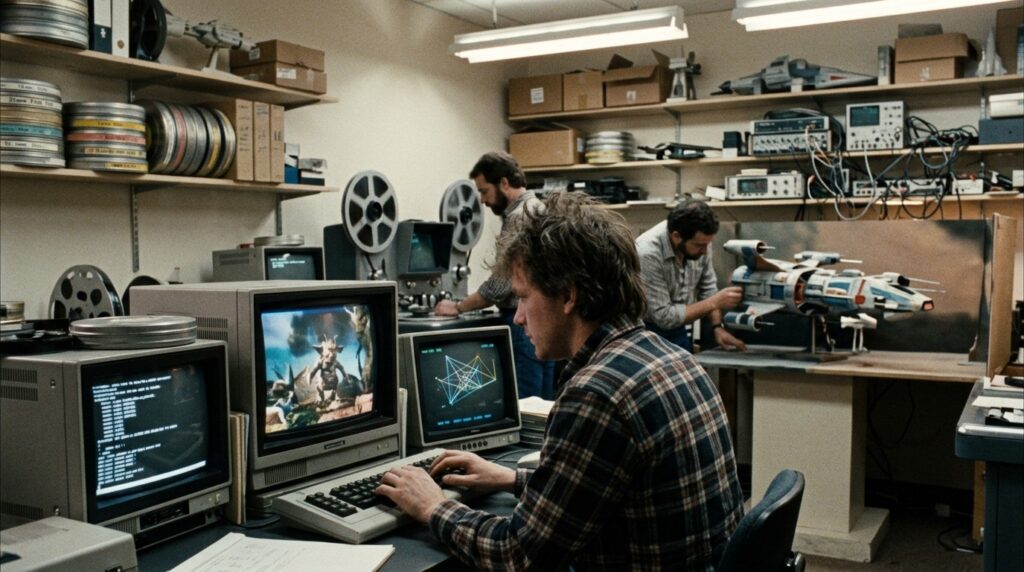
A late 1980s visual effects studio — at the intersection of analog and digital processing
Thomas gave his brother a set of his image processing utilities. John started using them but quickly ran into an inconvenience: switching between separate programs was slow and tedious. He asked Thomas to combine all the tools into a single application. The request was purely practical, without any grand ambitions. But it was precisely this request that established the principle of an integrated workspace that defines Photoshop to this day.
How the Darkroom Helped Create Levels in Photoshop
Once the tools were under one roof, a new problem surfaced. The monitors on John’s different computers had different gamma settings, and the same image would look lighter or darker depending on the machine. The program needed a way to adjust brightness and contrast.
This is where Thomas’s photography experience came into play. He knew how in a traditional darkroom, photographers use chemical solutions, paper types, and enlarger settings to control the tonality of a print. This knowledge guided him to create the Levels tool — the first serious image correction feature in the future Photoshop. A direct line from the wet darkroom to the digital slider was built into the product from the very beginning.
Initially, the brothers named the project ImagePro, but then settled on the name Photoshop. By October 1988, they had an alpha version — 0.63 — though it never made it to store shelves.
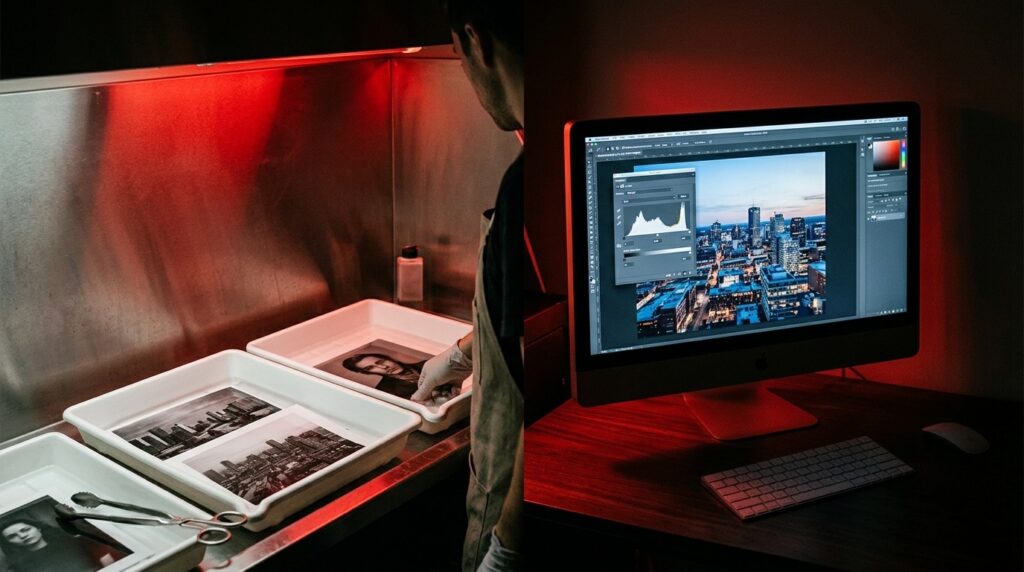
The darkroom and the digital editor — two worlds that merged in Photoshop
How Adobe Got Photoshop After Competitors Turned It Down
The Knoll brothers pitched their program to several technology companies — and were rejected time after time. Some firms wouldn’t even look at the demo, claiming they had their own developments in the field. Others said that image editing didn’t fit into their product lineup.
Adobe reacted differently — interest arose within the first minutes of the demonstration. The company’s team saw how organically the software would fit into their catalog. Adobe secured distribution rights, and on February 19, 1990, Photoshop 1.0 was released exclusively for Macintosh.
The specifications of the first version are amusing by modern standards:
- it required Mac System 6.0.3
- the program took up about two megabytes
- the price was $895 — the product was aimed at design agencies, publishers, and graphics professionals
Even in the first version, the Lasso and Magic Wand tools appeared, reducing image selection tasks from hours to minutes. These conventions were quickly adopted by competitors.
But there was a strict limitation: consumer digital cameras didn’t exist yet, and home photo printers were nonexistent. To get a print from Photoshop, you had to create a four-color separation and send it to a print shop. Producing a single photograph could cost several thousand dollars.
Photoshop Was Ahead of Its Time and Waited for Its Market
Photoshop’s trajectory shot upward with the arrival of the public web in the early 1990s. Website creators needed tools for processing and compressing images — and Photoshop was ready. Then affordable inkjet printers arrived: photographers could scan film, edit on a computer, and print at home. And then consumer digital cameras came along, eliminating the scanning step and feeding files directly into the editor.
Thomas Knoll noted in a 2015 interview that digital photography would hardly have spread so quickly without an already existing processing and printing pipeline. The program was ready years before the supporting hardware matured. It waited — and the market gradually grew around it.
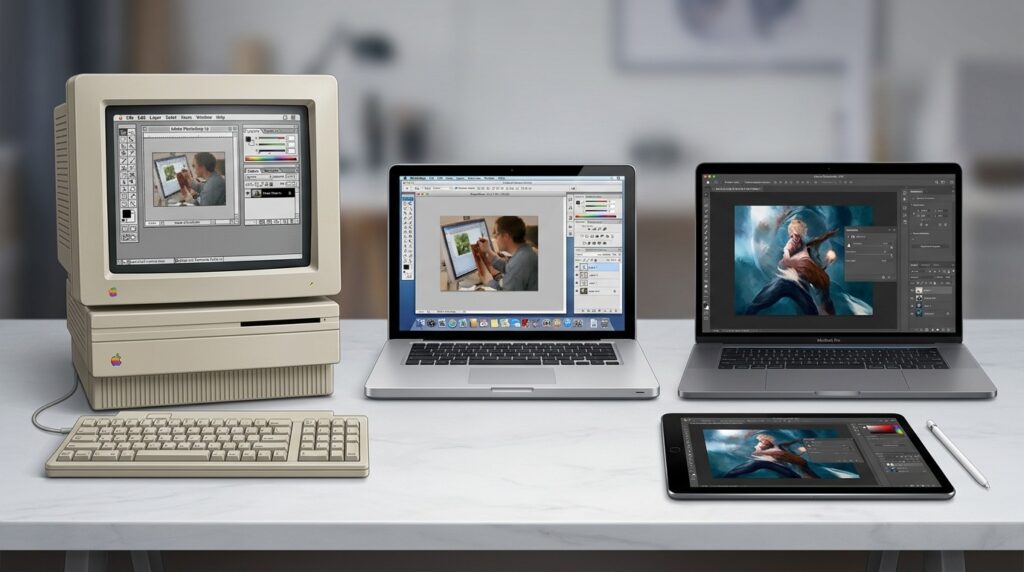
The evolution of Photoshop: from early 1990s Macintosh to modern devices
Since then, Adobe has released Photoshop on numerous platforms — from desktop computers to mobile devices. The source code of Photoshop 1.0 was donated by the company to the Computer History Museum, securing its place in the annals of technology. And Thomas Knoll admitted in the same interview that he still takes pleasure in watching artists use the program’s low-level features to create works he never foresaw. It is precisely this versatility, he says, that keeps the tool alive.