Hantavirus: everything an adult needs to know about the deadly virus
Three deaths aboard a cruise liner in the open ocean, quarantine for one hundred and fifty passengers, and medical evacuations across several countries. Hantavirus, which most people have never heard of, became one of the top stories in world medicine within just a few days. What is this infection, why is it dangerous, and should we fear a pandemic?
Hantavirus Outbreak on the Cruise Ship MV Hondius
In April 2026, a hantavirus outbreak was detected aboard the cruise ship MV Hondius, stationed off the coast of Cabo Verde. According to WHO data as of May 5, 2026, seven cases were identified, including three deaths. The cruise departed on April 1 from Ushuaia in southern Argentina and included a route through Antarctica and remote islands of the South Atlantic.
The first person to fall ill was an adult male: on April 6 he developed fever, headache, and diarrhea. By April 11 his condition deteriorated rapidly, and he died on board that same day. His wife, a close contact of the first patient, disembarked on the island of Saint Helena on April 24. During a flight to Johannesburg her condition worsened, and on April 26 she died in the hospital’s emergency department.
Later, authorities confirmed that the hantavirus strain in this outbreak was the Andes virus, which is capable of human-to-human transmission. South African medical professionals identified this exact strain in two passengers evacuated to South Africa. Additionally, another passenger with a confirmed Andes virus diagnosis was hospitalized in Switzerland after seeking medical attention upon returning home.
What Is Hantavirus and Why Is It Dangerous
Hantaviruses are zoonotic viruses (transmitted to humans from vertebrate animals) that naturally infect rodents and occasionally spread to humans. Other diseases from animals arise by the same principle: a pathogen lives in one species but under certain conditions jumps to humans. Infection in humans can lead to severe illness and often death, although the clinical picture varies depending on the virus type and geography.
- In the Americas, the infection causes hantavirus cardiopulmonary syndrome (HCPS), which rapidly affects the lungs and heart.
- In Europe and Asia, hantaviruses lead to hemorrhagic fever with renal syndrome (HFRS), affecting the kidneys and blood vessels.
Put simply: hantavirus attacks the walls of small blood vessels and makes them "leak."
 — In the pulmonary form, fluid seeps into the air spaces of the lungs.
 — In the renal form, the kidneys are damaged and may fail.
Hantavirus infections are relatively rare on a global scale, but the fatality rate ranges from less than 1% to 15% in Asia and Europe and up to 50% in the Americas. Between 10,000 and more than 100,000 cases of infection occur worldwide annually, with the main burden falling on Asia and Europe. In total, approximately 40 hantavirus strains are known to exist around the world.
How Hantavirus Is Transmitted from Rodents
The primary route of human infection is contact with the urine, droppings, or saliva of infected rodents. Less commonly, infection occurs through bites. Those at greatest risk include people who clean enclosed or poorly ventilated spaces, engage in farming or forestry, or stay overnight in places where rodents are present.
The Andes virus is primarily carried by the long-tailed pygmy rice rat (Oligoryzomys longicaudatus) — a common species in rural areas of Argentina and Chile. You can become infected without ever seeing a rodent in person: simply inhaling dust containing particles of their excretions — for example, while cleaning a barn or visiting a place where mice have been — is enough.

The long-tailed pygmy rice rat — the main carrier of the Andes virus
This is presumably what happened to the Dutch couple on MV Hondius. Two Argentine officials investigating the origin of the outbreak stated that the government’s main hypothesis is that the couple became infected while birdwatching in Ushuaia before boarding the ship. During the excursion, they visited a landfill where they may have come into contact with rodents.
Can Hantavirus Spread from Person to Person
This aspect of the MV Hondius outbreak is generating the most interest and concern. To date, human-to-human transmission has been documented only for the Andes virus — and it remains a rare occurrence. When it does happen, it is associated with close and prolonged contact, especially between family members or intimate partners, and is most likely during the early stage of illness, when the virus is most contagious.
To put it in perspective: according to virologist Gustavo Palacios, over the entire history of observation, fewer than 300 cases of the Andes virus were transmitted from person to person out of a total of approximately 3,000 infections.
The largest known outbreak involving human-to-human transmission occurred in 2018 in the tiny Argentine village of Epuyén. It claimed the lives of 11 people. Research into the outbreak showed that the window of infectiousness for this virus is very short — approximately one day. Peak contagiousness occurs on the day fever appears. Meanwhile, more than 80 healthcare workers had contact with patients in Epuyén, and almost none of them became infected, even though few used protective equipment. The limited spread among healthcare workers suggests the window of infectiousness is indeed very narrow.
In the case of the cruise ship, WHO representative Maria Van Kerkhove stated: “We believe that among very close contacts — husband and wife, people sharing a cabin — human-to-human transmission may have occurred.” But she emphasized: “This is not the next COVID, but it is a serious infectious disease.”
Hantavirus Symptoms, Treatment, and Survival
Symptoms usually appear 1 to 8 weeks after infection and include:
- fever,
- headache,
- muscle pain,
- gastrointestinal disturbances — abdominal pain, nausea, vomiting.
At this stage, the illness can easily be mistaken for ordinary flu, making early diagnosis difficult.
On the cruise ship, the disease presented with fever, gastrointestinal symptoms, and then rapidly progressed to pneumonia, acute respiratory distress syndrome, and shock. According to the U.S. Centers for Disease Control and Prevention (CDC), approximately 38% of people with respiratory hantavirus symptoms may die.
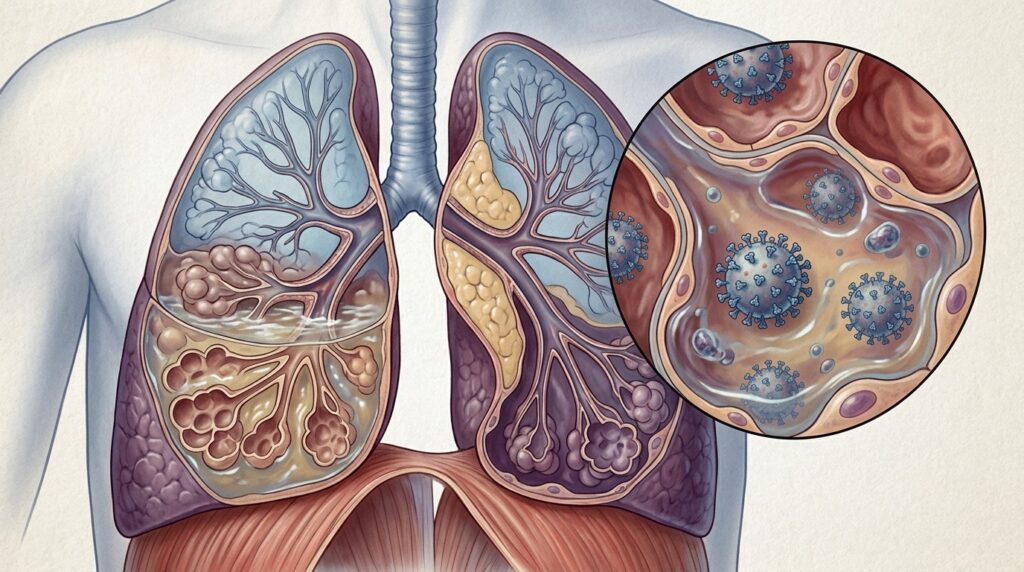
In hantavirus pulmonary syndrome, fluid fills the air spaces of the lungs
As for treatment, while ribavirin has shown effectiveness against hemorrhagic fever with renal syndrome, it has not demonstrated efficacy against the pulmonary syndrome and is not licensed for the treatment or prevention of HCPS. There is no specific antiviral treatment approved for the pulmonary syndrome.
Early supportive medical care is the key to survival: it involves monitoring the patient’s condition and managing respiratory and vascular disturbances. In cases of severe lung damage, oxygen therapy and mechanical ventilation in intensive care may be required.
If you develop unexplained fever and shortness of breath after traveling, you should seek medical attention as quickly as possible: with hantavirus, early treatment determines the outcome.
Can Hantavirus Cause a New Pandemic
News of mysterious deaths on a cruise ship inevitably draws comparisons to COVID-19. But experts are confident: the mechanism of hantavirus spread is fundamentally different.
Maria Van Kerkhove from the WHO explained: “When we talk about close contact, we mean very close physical contact — sharing a bed or cabin, providing medical care. This is very, very different from COVID and the flu.”
Professor Greg Mertz from the University of New Mexico, who has studied hantavirus for more than 30 years, stated that the necessity of close contact for transmission makes a pandemic scenario highly unlikely.