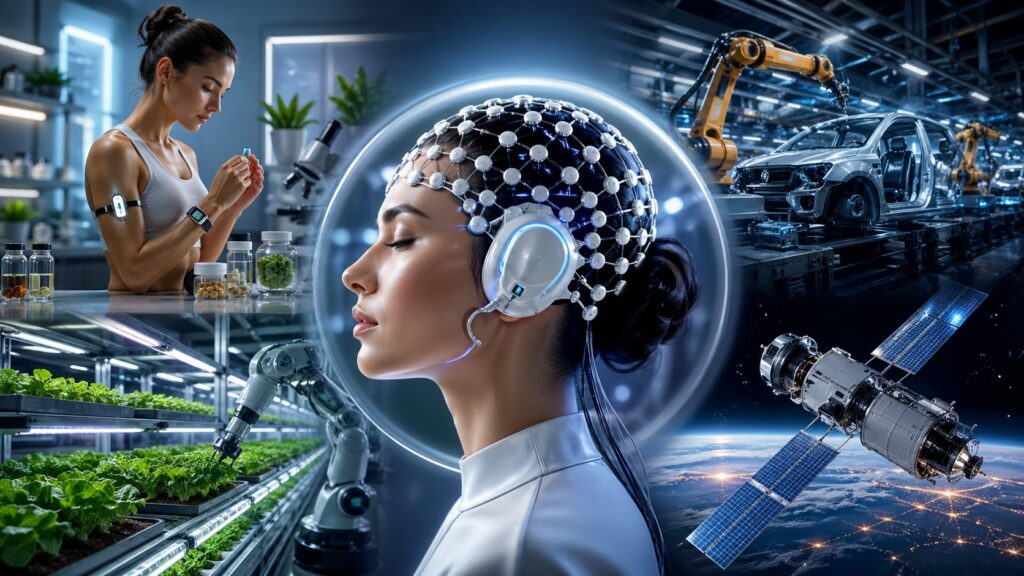
What seemed like the future has actually already become the present
When you hear the words “future technologies,” something out of science fiction usually comes to mind. Robot butlers, flying cars, and colonies on Mars. But while we’ve been waiting for the sci-fi stuff, the future has quietly arrived — and is generating real money right now. We’re used to thinking of the tech industry as smartphones, apps, and cloud services. But the most interesting things are happening at the intersection of technology and seemingly completely unrelated fields. Biohacking, neural interfaces, private space travel — all of this sounds like a TV series plot, but has long since turned into multi-billion-dollar markets with real revenue. Let’s figure out which five non-standard industries are already making money from future technologies and why they’re worth watching.
What Is Biohacking and Why Does It Generate Billions
Just five years ago, biohacking was associated with eccentrics who drank “bulletproof coffee” with butter and wore a ring for sleep tracking. Today it’s a full-fledged industry with its own clinics, devices, and subscription services.
According to Market.us forecasts, the global biohacking market will reach $140.6 billion by 2034. The average annual growth rate is nearly 19%. For comparison: this is comparable to the growth rate of the smartphone market in its best years.

Biohacking is one of the most promising investment directions
What exactly do they sell? Continuous glucose monitors, personal DNA tests, vagus nerve stimulation devices (which is responsible for switching the body from stress mode to rest mode), AI blood analysis, and even biohacking clinic franchises with a payback period starting from 14 months. Goldman Sachs and Bank of America estimate the total potential of the wellness industry, into which biohacking is integrating, at $600 billion by 2030.
Biohacking is moving toward “biohealing”: now it’s not about “hacking” the body, but a personal data-driven recovery system
Simply put, if biohacking used to be a hobby for enthusiasts, now the world’s largest banks consider it a promising investment direction.
Neural Interfaces: How to Control Technology With the Power of Thought
Elon Musk’s Neuralink is the most hyped project in this field, but far from the only one. In 2025, total investment in neurotechnology exceeded $10 billion. And Morgan Stanley estimates the potential of the neural interface market in the US alone at $400 billion.
What already works? In March 2026, Neuralink presented the results of the N1 chip trials: a patient with amyotrophic lateral sclerosis (ALS) was able to “speak” using a neural interface. The chip reads brain signals and turns thoughts into words. The speed is about 32 words per minute.
Neuralink is not a monopolist. A competitor from China, NeuroXess, has performed more than 50 implantation surgeries and demonstrated that a paralyzed patient can control a cursor within five days of chip installation. And Precision Neuroscience was the first to receive full FDA certification for a next-generation wireless neural interface.
China has declared neural interfaces a national strategic sector and allocated about $1.6 billion for the industry’s development. The goal is to grow 2–3 world-class companies by 2030.
For now, neural interfaces help people with paralysis and neurological diseases. But in the future, we’re talking about cognitive augmentation — expanding the capabilities of healthy people’s brains. Controlling devices with the power of thought, instant text input, and even neuromarketing, where ads could be selected based on brain reactions rather than cookies.
Space Tourism in 2026: Prices, Companies, and New Spacecraft
Over the past three years, space tourism has transformed from an extravagant entertainment for billionaires into a growing business. In 2022, 19 private passengers went to space; in 2024, already 51. Industry revenue grew from $1.7 to $4 billion over the same period.
In 2026, a suborbital flight on Blue Origin or Virgin Galactic will cost between $300,000 and $600,000. Sounds crazy, but for comparison: the first space tourist Dennis Tito paid $20 million in 2001. Prices are dropping 20–30% annually thanks to reusable rocket technology.
In the fall of 2026, Virgin Galactic plans to begin missions on the next-generation Delta spacecraft — it seats six passengers and can fly up to twice a week. And Chinese company CAS Space has already tested the reusable Lihong spacecraft, designed for 30 flights.
SpaceX isn’t standing still either: at the end of 2026, a Starship will head to Mars with an Optimus robot on board — and this is not a joke, but preparation for future crewed missions.
Synthetic Biology in Simple Terms: From DNA to New Materials
If biohacking is “tuning” your own body, then synthetic biology is programming life from scratch. Scientists have learned to edit DNA the same way programmers write code. Only instead of an app, the output is a bacterium that produces insulin, fuel, or eco-friendly plastic.
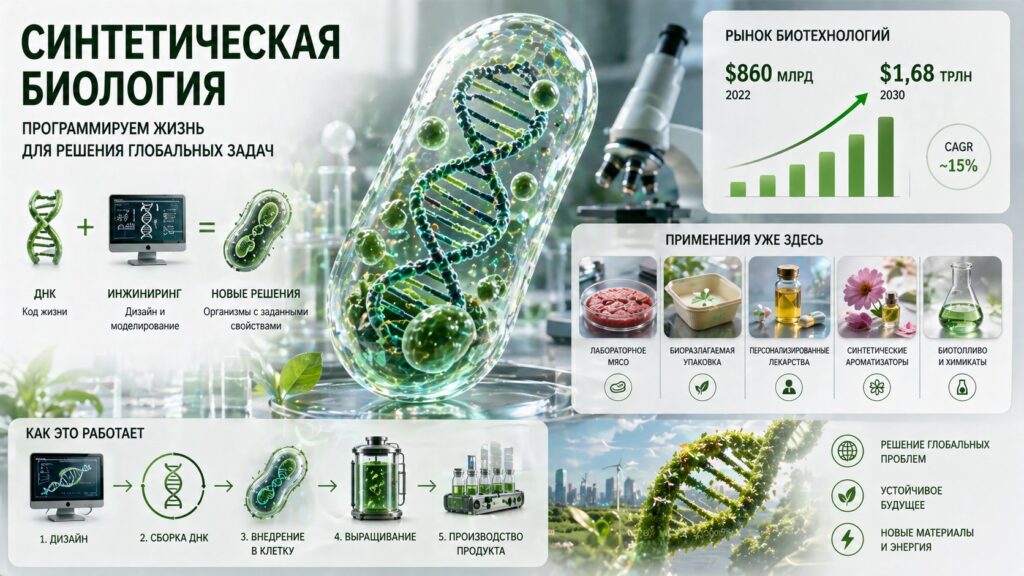
Synthetic biology is also aimed at solving a huge number of problems
The global biotech market was valued at $860 billion in 2022, and by 2030, according to Precedence Research forecasts, it will nearly double — to $1.68 trillion. Mordor Intelligence projects annual growth rates of 15%.
Practical applications are already here: lab-grown meat, biodegradable packaging, personalized medicines based on a patient’s genetic profile. And also synthetic flavorings that replace natural ingredients and cost many times less. Essentially, synthetic biology is doing to biology what the internet once did to information: making it programmable and scalable.
Quantum Computing in Business: From Drugs to Cybersecurity
Quantum computers still sound like something from a physics lecture, but businesses are already investing billions in them. According to forecasts by Rexoft Consulting, the quantum computing market in Russia will reach 184 billion rubles by 2040. Globally, the numbers are even more impressive.
Why is this needed? A quantum computer solves problems that are beyond the capability of classical ones. Molecular modeling for drug development, supply chain optimization, financial modeling — these are all areas where the quantum advantage is already tangible.
But there’s a flip side. A quantum computer could potentially crack modern encryption algorithms. That’s why companies around the world are already preparing for the “quantum transition” — migrating their security systems to post-quantum cryptography. According to Positive Technologies, the number of cyberattacks in Russia will grow by 30–35% in 2026, and quantum technologies are one of the factors driving this race.
Why Future Technologies Have Already Become Profitable Markets
The five industries we’ve covered share one thing: they’ve stopped being “the future” and have become the present. Biohacking clinics are opening as franchises, neurochips are being implanted in real patients, and a ticket to space can be purchased online.
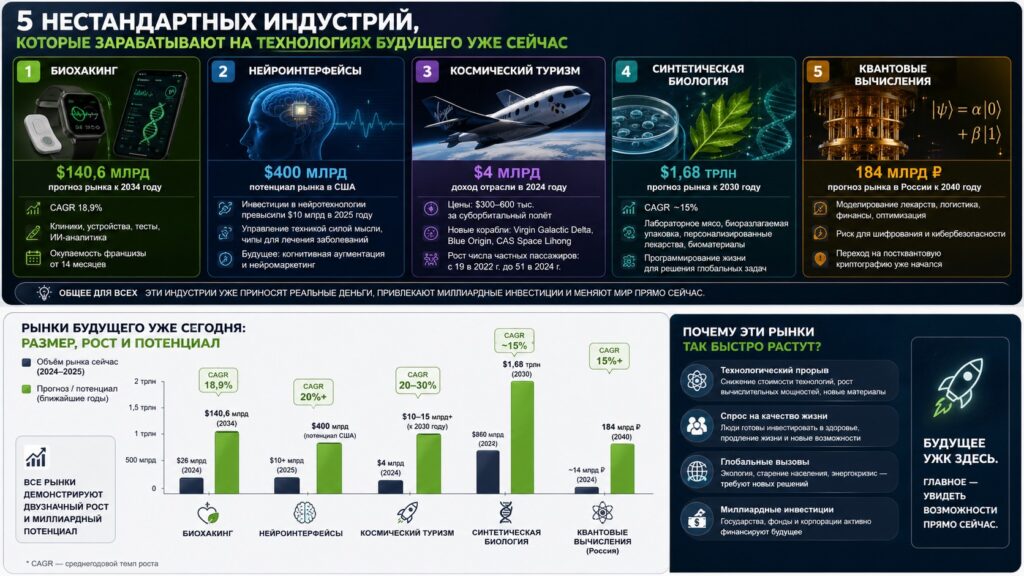
5 markets growing through new technologies
We’re used to following new iPhones and iOS updates. But the real technological revolution is happening where digital technologies meet biology, space, and quantum physics. And these are no longer garage startups — these are markets with turnovers in the hundreds of billions of dollars.