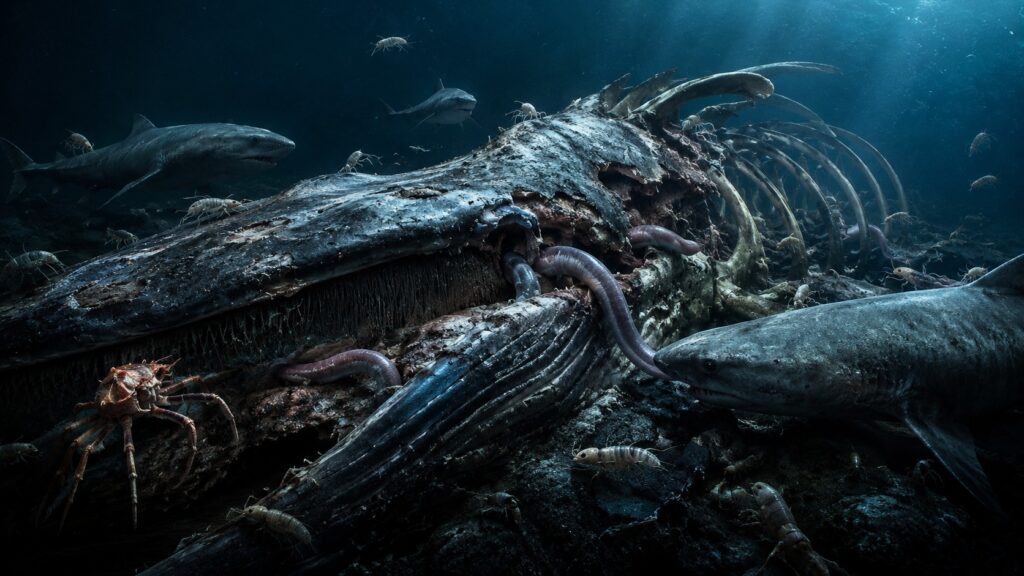
A whale’s body can feed millions of creatures for decades
When a massive whale dies in the ocean after 200 years of life, its body doesn’t vanish without a trace. It sinks to the ocean floor and becomes food for thousands of deep-sea creatures. Essentially, a whale’s body is a giant stockpile of meat, fat, and bones. And it is one of the largest sources of nutrients in the ocean. So who devours the body of a dead whale? What remains of this enormous creature?
What Happens to a Whale’s Body After Death
According to Daily Galaxy, after death, a whale carcass may briefly remain near the surface. This is because decomposition gases accumulate inside the body, keeping it afloat like an inflated balloon. But sooner or later the gases escape, and the body begins its long journey downward, through the water into the complete darkness of the deep.
At depth, there is no sunlight, the temperature is near zero, and the pressure is enormous. This is where the whale settles — on the bottom. For deep-sea creatures, this is a rare and incredibly rich event, because they usually have to make do with tiny bits of organic matter slowly falling from above, and here they have an entire mountain of food.
Interestingly, deep-sea animals are quite well adapted to long periods of starvation. Their metabolism is slowed down, and they can go without food for extended periods, conserving their energy. So when they get a feast like this, they make the most of it and can feed on a single carcass for a very long time.
Which Creatures Are First to Devour a Whale Carcass
The first to arrive at a dead whale are large scavengers capable of detecting food from far away. This group includes Greenland sharks, hagfish, and hordes of amphipod crustaceans. They descend upon the soft tissues and gradually expose the skeleton.
This phase, called the mobile scavenger stage, can last for years. Among the most unusual visitors are hagfish — the only known animals that have a skull but no spine. They burrow directly into the carcass and devour it from the inside out. Sounds terrifying, doesn’t it?
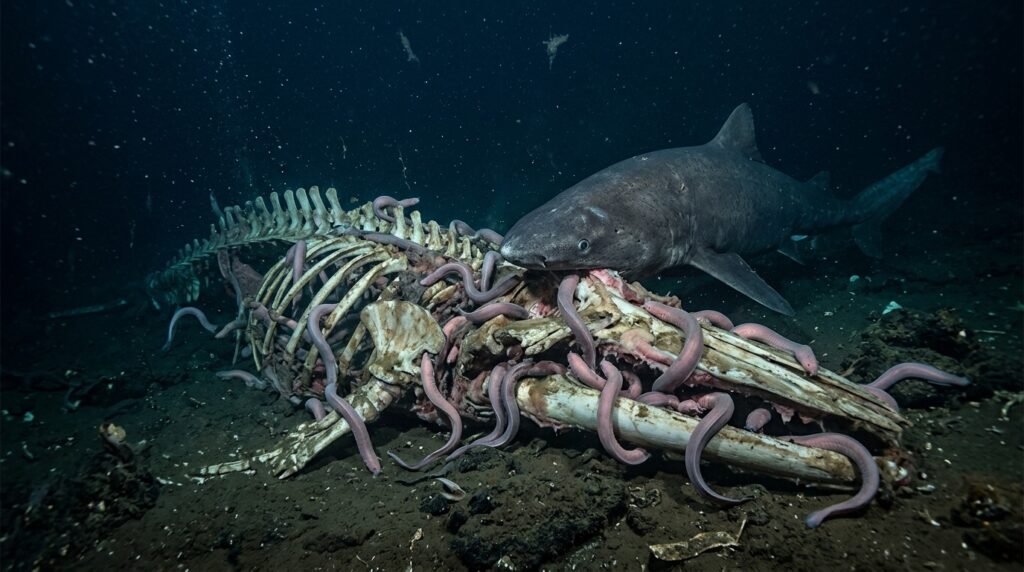
A Greenland shark and hagfish feeding on a whale carcass on the seafloor
Frequent visitors to a whale fall are also grenadier fish (macrourids). They live at depths of up to 4,000 meters and find food in near-total darkness using especially sensitive organs. Their large eyes catch the faint glow of living organisms, barbels under their chin detect movement in the sediment, and their keen sense of smell helps them locate carrion from dozens of meters away.
What Are Osedax Bone-Eating Worms
When almost no soft tissue remains, an entirely different team takes the stage. The main characters of this phase are Osedax worms, also known as bone-eaters. They arrive in enormous numbers at the stage when the feast for large scavengers is over, but plenty of valuable material is still hidden within the bones.
One species, Osedax mucofloris, was first described in 2005 on a whale carcass off the coast of Sweden. These worms are truly bizarre because they have no mouth or stomach in the conventional sense and live entirely off the bones of dead animals.
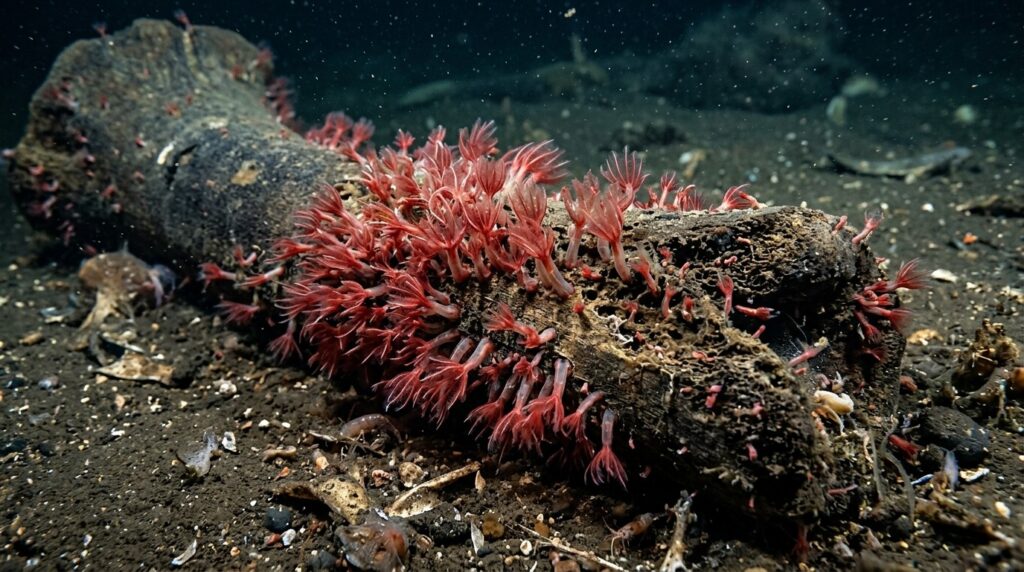
Osedax worms covering a whale bone
The story of their discovery began slightly earlier: in 2004, researchers from the Scripps Institution of Oceanography described the first such worms on a gray whale skeleton in the Monterey Canyon in California. Since then, scientists have found more than two dozen Osedax species in various oceans, from the Atlantic to the Antarctic. The deepest known species was found on a whale carcass at a depth of 4,204 meters off the coast of Brazil.
How Worms Dissolve Whale Bones with Acid
The most remarkable thing about these worms is their feeding method. They don’t gnaw on the bone — instead, they inject acid into it, dissolving the hard material and reaching the nutrients hidden inside. Essentially, they etch their way deep into the skeleton.
The worms break down the bone to reach the collagen. Afterward, the bone becomes porous, like a sponge, and is easily scavenged by crabs and other creatures. In other words, Osedax not only feed themselves but also unlock access to the bones for everyone else.
As mentioned above, these worms have neither a mouth nor an intestine. Nutrients from the bone are absorbed with the help of symbiotic bacteria that live directly in their root-like projections embedded in the skeleton. It’s a well-coordinated partnership where the worm extracts raw materials and the bacteria process them into food.
How One Whale Skeleton Feeds Animals for Decades
Entire generations of Osedax worms can grow, reproduce, and die on a single whale over ten years. Before the resources run out, the worms release larvae into ocean currents so they can spread across the seafloor and find the next whale skeleton.
But that’s still not the end. While scavengers and worms are feeding, a third, chemical phase unfolds around the remains. Bacteria decomposing organic matter inside the bones release hydrogen sulfide — the same gas that smells like rotten eggs. And this gas becomes fuel for special organisms that derive energy not from light but from chemical reactions.
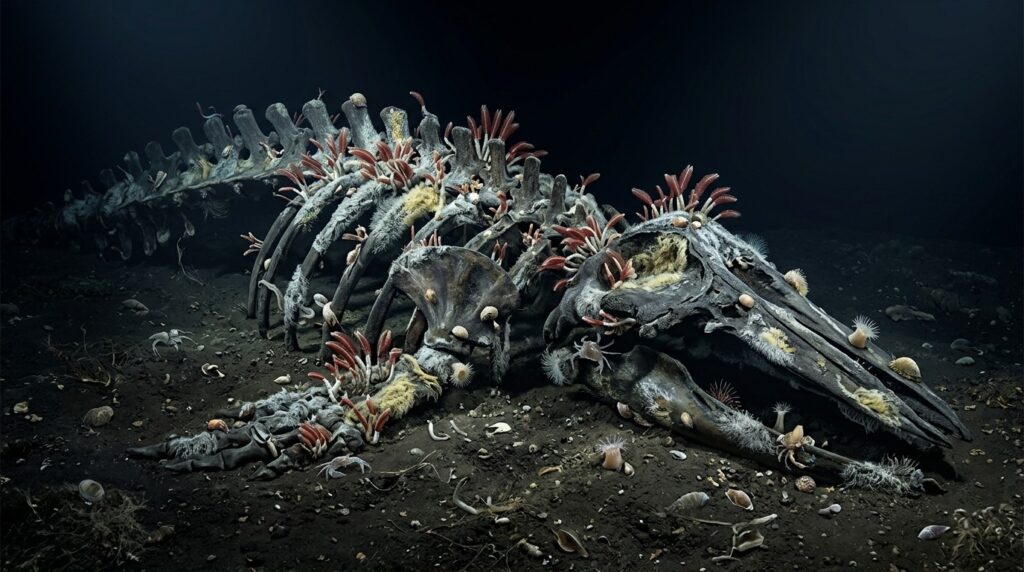
Bacterial mats and invertebrates on whale bones in a deep-sea ecosystem
Many of these microbes live in symbiosis with invertebrates and supply them with nearly all of their nutritional needs. Such a sulfur-based ecosystem can persist for up to 50 years — meaning one whale sustains life on the seafloor for half a century after its death. This is especially remarkable because these communities resemble those found at hydrothermal vents, where life also relies on chemistry rather than sunlight.
Why Scientists Study Dead Whales
It turns out that a dead whale becomes something like a unique natural laboratory. It demonstrates how life adapts to extreme conditions: darkness, cold, pressure, and a perpetual scarcity of food. By studying these communities, biologists gain insights into how life can exist without sunlight at all — and this is also important for the search for life beyond Earth, in the oceans of icy moons.
Researchers never cease to be amazed by the ability of organisms to develop such strange and incredible adaptations to such unusual conditions. Every new whale fall is a chance to discover previously unknown species and understand a little more about how inventive life is on the ocean floor.
In short, a single dead whale’s body sets off a chain of life lasting decades: from sharks and hagfish to bone-eating worms and sulfur-feeding bacteria. And as scientists lower their cameras ever deeper, they will almost certainly find new inhabitants of this strange and remarkably vibrant underwater world.