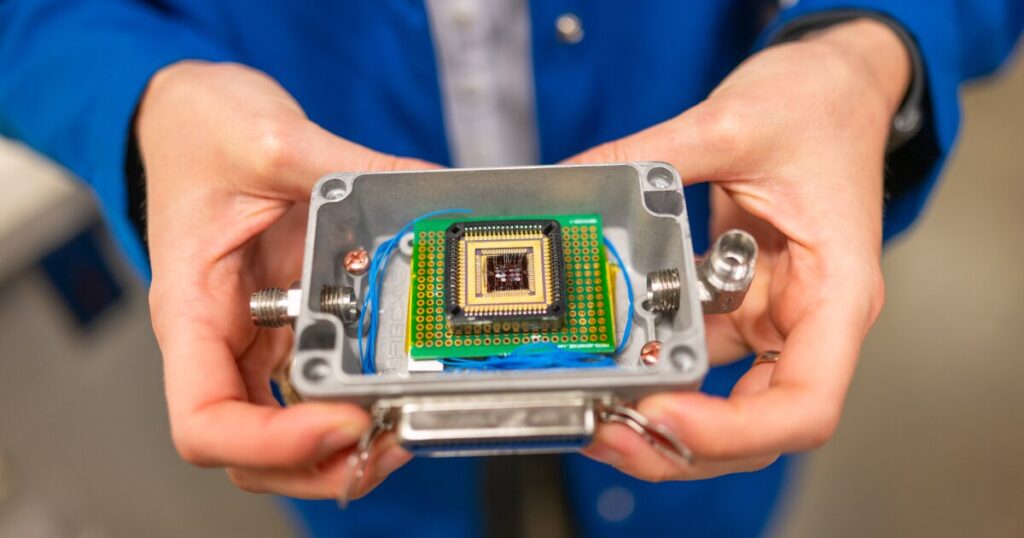
Electronic nose found a way to detect dangerous food in seconds
Most people only smell spoiled food when the odor is already strong, and almost nobody can tell by smell whether a dish contains traces of nuts. Researchers at the University of California, Berkeley have created an “electronic nose” that detects gases from expired products and food allergens — and, according to them, does so more accurately than the human nose.
How the Electronic Nose with 16 Gas Sensors Works
The main idea behind the device is not one sensor for one gas, but an entire array of different sensors that together create a “fingerprint” of a smell. The device consists of 16 tiny gas sensors, each coated with its own sensitive film that reacts uniquely to gas molecules.
The author of the work, graduate student Carla Bassil, compares the chip to a set of digital taste receptors: each sensor responds uniquely to different molecules that reach it. The sensor converts the chemical reaction between its surface and a gas molecule into an electrical signal — and then machine learning takes over.
There’s no magic: no single sensor “recognizes” a product. It’s the combination of reactions from all 16 sensors that identifies it — like a set of dots forming a distinctive pattern.
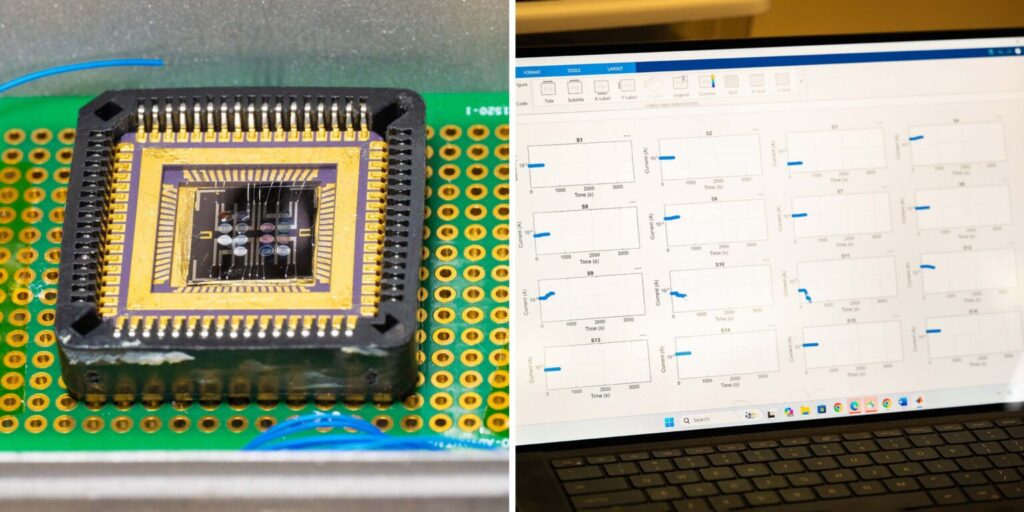
The electronic nose contains 16 different gas sensors (small circles in the center left). It records the reactions of the unique material in each sensor and uses a machine learning model to determine which set of reactions corresponds to a specific product or smell (right).
Why Conventional Sensors Can’t Handle Smell Recognition
A home carbon monoxide detector is simple: it’s tuned to a single gas. But combining many different gas sensors on a single chip turned out to be technically challenging — and that was the main obstacle.
Typically, such sensors are made from metal oxides, but they need to be heated to function, and high temperatures limit the choice of materials. Bassil took a different approach and used carbon nanotubes as the conductive material.
Nanotube layers are a hundred times thinner than a human hair and are sensitive even at room temperature. This made it possible to select a much wider range of gas-sensitive materials, including those that would break down when heated — such as polymers. The sensors themselves were applied using a simple drop-casting method (a thin film is literally “dropped” onto the surface), rather than complex laboratory techniques.
What Products and Allergens the Device Learned to Identify
The machine learning model was trained to recognize reaction profiles for seven products: strawberries, blueberries, bananas, walnuts, hazelnuts, cashews, and peanuts. Separately, it was trained on the smell of fresh raw chicken, milk, and eggs — and on how that smell changes after 24 and 48 hours at room temperature.
The idea behind the approach is to combine the selectivity of sensors with a neural network’s ability to recognize patterns. This way, the system determines which product a specific “gas fingerprint” belongs to. According to Bassil, the result is more sensitive and objective than any human nose.
This is especially important for people with allergies: traces of peanuts or walnuts that a person simply can’t smell can be life-threatening.
How Sensitive the Electronic Nose Really Is
The results are impressive: the device detected a walnut fragment weighing 0.05 grams — roughly one hundredth of a standard shelled walnut. This level of sensitivity is critically important, since even microscopic amounts can be dangerous for allergy sufferers.
But the Berkeley electronic nose is not yet a ready-made kitchen gadget — it’s a working prototype with a published scientific study. Bassil has not yet tested whether the nose can isolate an allergen when many other smells are present — for example in a cake or salad, or when spoiled food sits in the refrigerator alongside other products.
This is a typical situation for early-stage development: the technology has proven itself in the lab, but it still needs to be refined for everyday use.
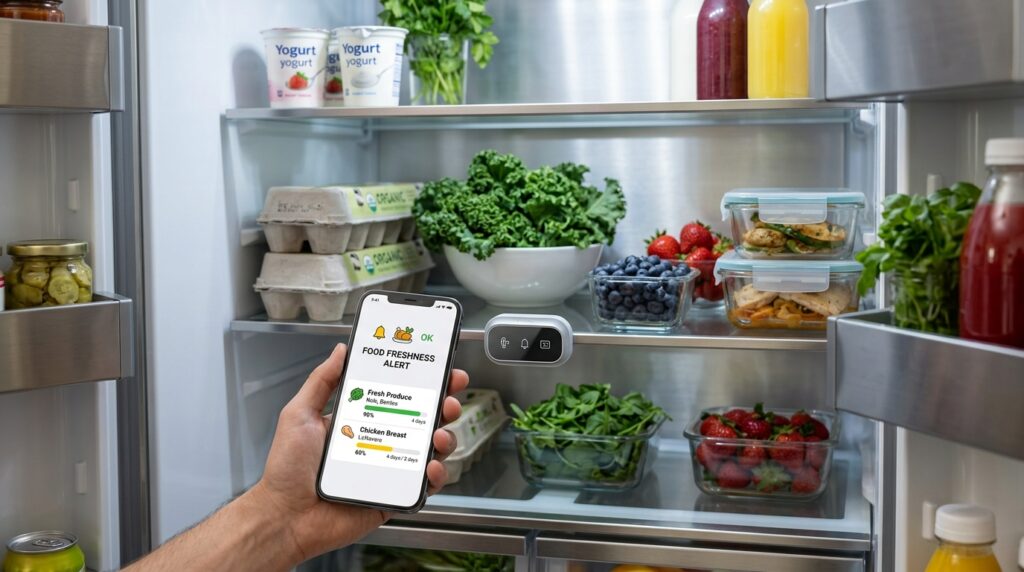
The electronic nose could become part of smart refrigerators of the future
Where the Electronic Nose Could Be Useful: Smart Refrigerators and a Smartphone App
Bassil has already assembled a portable version of the device that can be controlled via an iPhone app. And she considers “smart” refrigerators with sensors that can be managed from a smartphone to be the most promising application.
The idea is simple and intuitive: the refrigerator itself would tell you that your broccoli is about to go bad and should be eaten, or that the chicken is on its last day. This means convenience, less food waste, and real protection for allergy sufferers.