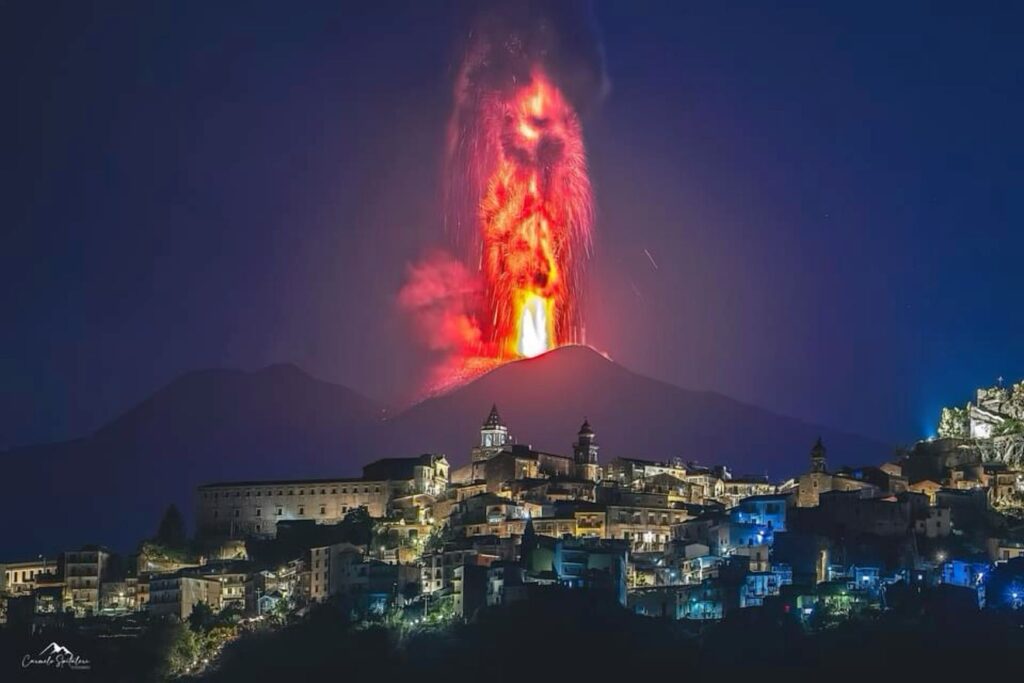
How Mount Etna is changing what we knew about the life of volcanoes. Image source: ru.pinterest.com
Etna is the most active volcano in Europe, but for a long time scientists couldn’t figure out where its magma comes from. It seemed like everything was long known: there are three main types of volcanoes and well-understood mechanisms behind their activity. But with Etna, this framework didn’t hold together — too many oddities couldn’t be explained. A new study proposes an unexpected theory, and if the hypothesis is confirmed, the established classification of volcanoes will have to be revised and textbooks updated with a fourth type of volcanism.
Etna Doesn’t Fit Any of the Three Known Types of Earth’s Volcanoes
Volcanoes on our planet form when mantle rocks melt and rise to the surface. Until now, it was believed that this happens through three main pathways:
- Mid-ocean ridges — tectonic plates diverge, mantle material rises and forms new ocean floor.
- Subduction zones — one plate “dives” beneath another, water from the subducting plate lowers the mantle’s melting temperature, giving rise to explosive volcanoes like Mount Fuji.
- Hot spots — anomalously hot mantle material pushes upward in the middle of a plate, creating volcanic chains like Hawaii.
Etna doesn’t fit into any of these categories. The volcano is located near a subduction zone, but its chemical composition is more similar to hot spot products — even though there is no hot spot beneath it. Scientists debated this for decades, proposing ever new hypotheses — and none of them explained all of Etna’s peculiarities at once.
Etna’s Strange Lava That Stumped Geologists
Etna surprises not only with its location but also with the history of its eruptions. In its early stages, the volcano erupted small volumes of silica-rich lava. Later, it began ejecting enormous quantities of lava enriched with alkali metals — potassium and sodium.
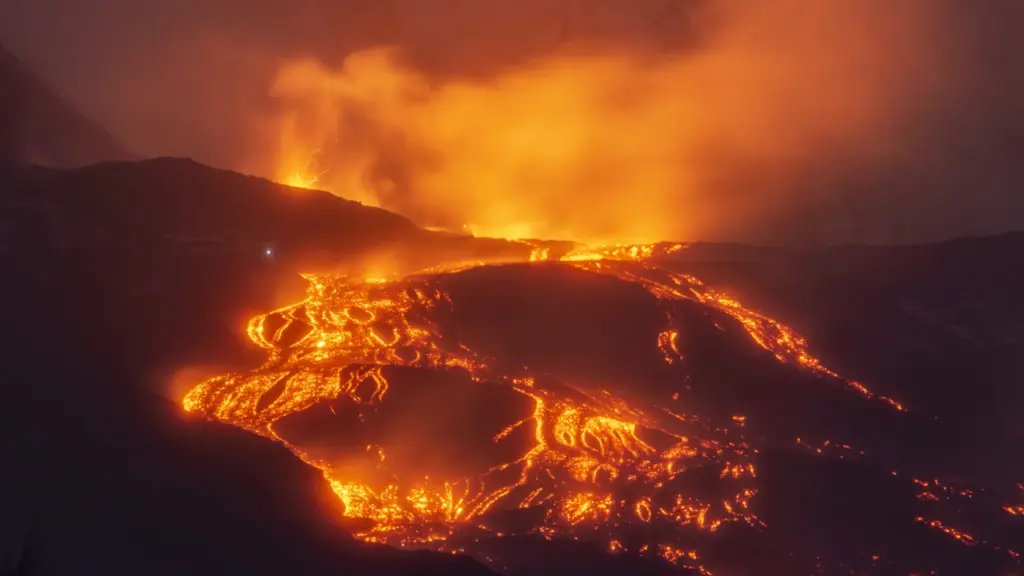
Mount Etna’s strange lava long puzzled scientists. Now they know what makes it special.
It sounds like a simple recipe change, but for geologists it’s a serious puzzle. Usually it’s the other way around: lava with high silica content is associated with large magmatic reservoirs and high-volume eruptions, while alkaline lava forms from weakly melted mantle rocks and therefore erupts in small quantities. Etna breaks this rule — such an evolution is directly opposite to what is observed, for example, in Hawaii.
Imagine a faucet that first released a thin trickle of water with limescale, and then suddenly gushed a powerful stream of pure spring water. Where did all that “pure” material suddenly come from? That’s exactly what puzzled volcanologists.
The Source of Etna’s Magma: Ancient Melt From 80 km Deep
New research shows that, unlike ordinary volcanoes where magma forms shortly before eruption, Etna is fed by small portions of magma that already exist in the upper mantle at a depth of about 80 kilometers. This magma is stored in what is called a low-velocity zone — a layer where seismic waves slow down because part of the rock is in a partially molten state.
Such zones are probably widespread across the entire planet, but melt from them rarely reaches the surface. Sicily’s situation is special. The collision of the African and Eurasian plates creates complex tectonic movements. The plate bends near the subduction zone, cracks open within it, and magma rises through them — roughly the same way liquid is squeezed out of a sponge.
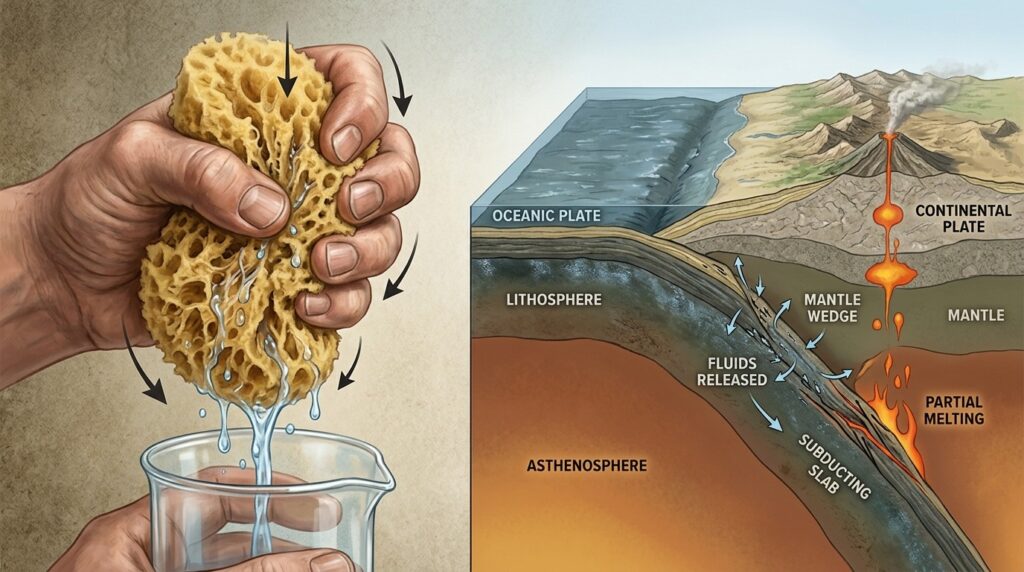
Scientists’ analogy: magma is squeezed from the mantle like water from a sponge under compression
The study authors themselves called Etna a “leaky pipe” through which ancient melt from the depths of the mantle is delivered to the surface in batches. Scientists from the University of Lausanne, led by Professor Sébastien Pilet, studied the geochemistry of lava layers across the volcano’s entire 500,000-year history. The data showed that Etna’s magma composition remained generally stable throughout this entire period, even as tectonic conditions changed. Variations in eruption volumes were primarily determined by plate movements.
Petit-Spot Volcanoes: Etna May Be a Giant of This Type
According to the study authors, Etna may belong to a little-known fourth category of volcanoes — the so-called “petit-spot” — tiny underwater volcanoes first described in 2006 by Japanese geologists. These tiny volcanoes became convincing evidence that pockets of magma exist at the boundary between the lithosphere and asthenosphere — an idea first proposed back in the 1960s.
But here’s the catch: petit-spot volcanoes are tiny formations only a few hundred meters tall, while Etna rises 3,403 meters above sea level. How could the same mechanism create both an underwater hillock and a giant stratovolcano?
“Our study suggests that Etna may have formed through a mechanism analogous to the one that generates tiny underwater volcanoes, — explains Sébastien Pilet. — This is unexpected, since such processes were previously observed only in very small volcanic structures.”
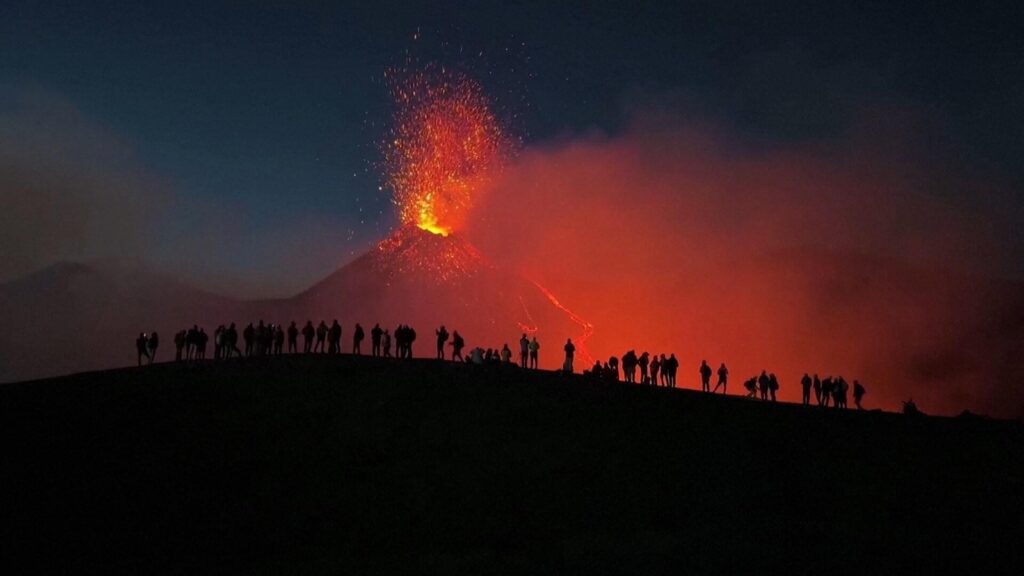
People against the backdrop of Mount Etna erupting, coast of Sicily.
The answer likely lies in Sicily’s unique tectonic position. The collision of two enormous plates creates enough fractures and pressure to “pump” magma from deep pockets on a scale impossible under normal conditions. In essence, Etna is a petit-spot volcano that grew to unprecedented size thanks to a special tectonic setting.
The Etna Discovery Will Help More Accurately Forecast Eruptions
Petrologist Sara Lambart from the University of Utah, who was not involved in the study, called the described mechanism “a new type of volcanism.” According to her, this discovery extends far beyond a single volcano.
The role of magma-lithosphere interaction in volcanic processes has not been sufficiently studied. This means that although Etna is unique, the type of volcanism described for it may point to larger-scale phenomena. If low-velocity zones are indeed widespread across the planet, then similar processes may play a role in other volcanoes as well — they simply haven’t been looked for until now.
There is also a practical aspect. Etna looms over the cities of Catania and Messina in eastern Sicily, where hundreds of thousands of people live. The study results could help improve eruption forecasting, because understanding the source of magma is key to assessing the scale of future events.
It’s important to emphasize: for now this is a hypothesis, albeit one supported by serious geochemical analysis published in the peer-reviewed Journal of Geophysical Research: Solid Earth. The authors themselves cautiously note that Etna “may be” a unique place on Earth where the composition of low-velocity zone melts can be studied right at the surface. This is not a final verdict, but an invitation for further research — and possibly a rethinking of our understanding of what can actually create volcanoes.