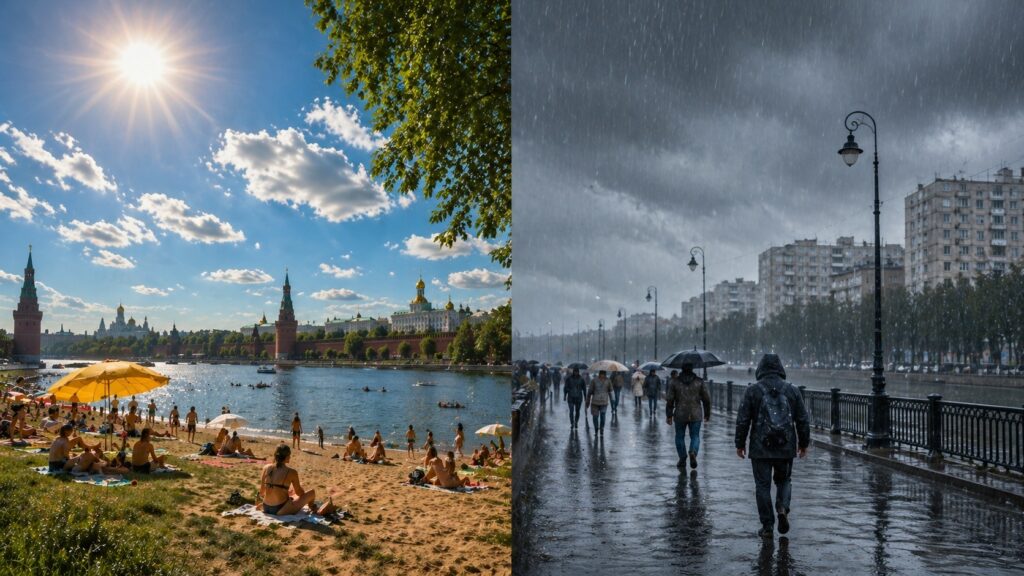
Summer weather in Russia may turn out to be unpredictable
If you’re already planning your vacation or dacha season for summer 2026, first take a look at the weather forecast. This season promises to be one of the hottest in recent decades. According to long-term forecasts from meteorologists, temperatures in many regions of Russia will exceed the average monthly norm, in some places by four to five degrees. But behind the warm numbers lie serious risks: drought, exhausting heat waves, and increased ultraviolet radiation. We were previously told that 40-degree heat in Russia would become the norm. It seems that’s true.
Summer 2026 Weather in Moscow and the Moscow Region
According to meteorologists, the hottest month of summer will be June. According to RIA Novosti, in the European part of Russia, the temperature background will consistently exceed the norm by an average of two to four degrees. However, in a number of regions, including Moscow, the deviation from the climate norm could reach four to five degrees. Prolonged periods without rain are possible in some areas — essentially drought.
In July, the heat won’t go anywhere, but will be slightly closer to average values. However, in August, cooling will begin in the European part — by the end of the month, daytime temperatures could drop to a modest 16 degrees. Forecasters are already warning about “weather swings”: sharp fluctuations between scorching heat and cold spells, prolonged thunderstorms after hot periods.
According to climatologist Vladimir Klimenko, over the past 50 years, the average summer temperature in Moscow has increased by 2.5 degrees. Summer 2026 in Central Russia, according to his forecast, won’t make it into the top five hottest on record, but could well end up in the top ten.
Summer 2026 Weather in Saint Petersburg
In Saint Petersburg, June is expected to be relatively dry, with daytime temperatures around 21 degrees. This is above normal but without extreme values. July will bring warm nights: the thermometer won’t drop below +17.
However, “bring joy” is a conditional word. For a city where many apartments aren’t equipped with air conditioning, even warm nights can become a problem. When the temperature doesn’t drop to comfortable levels, the body doesn’t have time to recover overnight, and the cumulative effect of heat starts to take its toll.
Weather in the Volga Region, Siberia, and the Far East
In southern Russia — Krasnodar Krai, Sochi, and Volgograd — the swimming season will start earlier than usual. In July-August, heat up to 35 degrees is possible on certain days, and drought cannot be ruled out in the central districts of Krasnodar Krai.
In the Volga region and the Urals, stable warmth is forecast: +28–30 degrees in July and the first half of August, without sharp fluctuations or prolonged rains. For these regions, summer 2026 looks the most classic — hot but predictable.
In Siberia, particularly in Novosibirsk and Irkutsk, temperatures will be above normal by three to four degrees. However, the situation in the Far East is different: by August, the influence of monsoons will intensify, bringing frequent thunderstorms, increased humidity, and heavy precipitation.
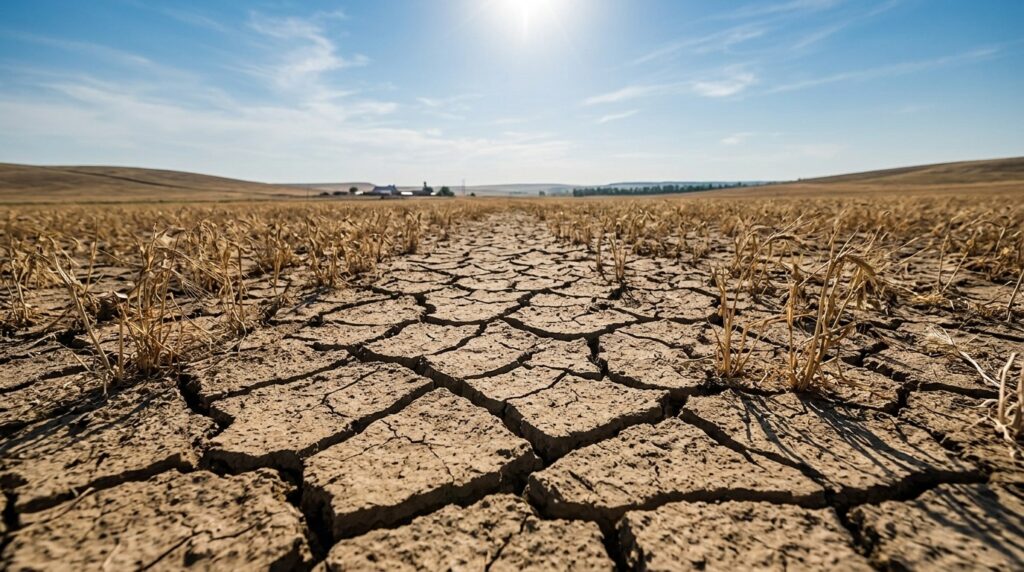
Drought on agricultural fields in southern Russia
In short, here’s the overall picture:
- European part — hot June, moderate July, cool end of August;
- South — early swimming season, up to +35, risk of drought;
- Volga region and Urals — stable +28–30 without sharp surprises;
- Siberia — 3–4 degrees above normal;
- Far East — monsoons, thunderstorms, and humidity toward the end of summer.
Hurricanes in Russia in Summer 2026
President of the Russian Academy of Sciences Gennady Krasnikov, in an interview with RIA Novosti, directly linked what is happening to global warming. According to him, Russia’s climate has become sharply continental: typhoons, hurricanes, and storms have become more frequent, and the cooling zone in the north of the country has already shifted approximately 500 kilometers northward.
What does a sharply continental climate mean in everyday terms? It means temperature swings become even more dramatic: today it’s +35, three days later — a thunderstorm and +18. There is generally less precipitation overall, but when rains do come, they tend to be intense and short-lived.
Historically, Russia has always lived in a continental climate, but now the situation is worsening. Warming itself doesn’t just make things warmer — it destabilizes the system, increasing the amplitude of fluctuations. Imagine a swing: it used to move smoothly, but now it’s been pushed much harder.
Heat Waves in Summer 2026
Forecasters separately warn about heat waves — prolonged periods of abnormal heat when the temperature significantly exceeds the norm for several consecutive days. A heat wave isn’t just a hot week. Its insidiousness lies in the fact that each successive day can be hotter than the previous one, and the body doesn’t have time to cool down.
A heat wave lasts at least five days. The record wave of 2010 lasted 56 days. According to other scientific estimates, the heat in Moscow that summer lasted about 44 consecutive days. In any case, the events of 2010 were catastrophic: the scale of consequences was unprecedented in the entire history of observations.
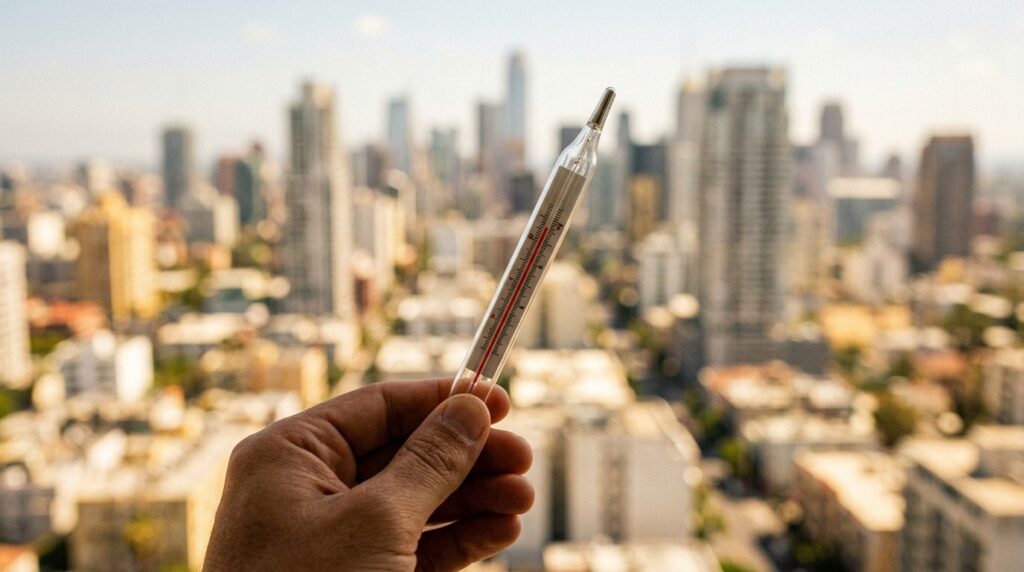
A thermometer showing extremely high temperature in the city
How to Protect Yourself from Heat and Ultraviolet Radiation
With each passing day, the sun rises higher, and along with it, the ultraviolet index increases. This applies to everyone: gardeners, city dwellers, and beachgoers alike.
Extra caution is needed not only for those who sunburn easily: ultraviolet radiation is also dangerous for the eyes. In summer, it’s essential to consider the UV index when planning time spent outdoors.
A few simple rules for an abnormally hot summer:
- Monitor the forecast and UV index — it is often displayed in weather apps;
- During peak heat hours (12 PM to 4 PM), try to stay in the shade or indoors;
- Drink water regularly, without waiting until you feel thirsty;
- Wear a hat and sunglasses;
- Pay attention to elderly relatives and small children — they tolerate heat worse.
Summer 2026, judging by forecasts, will require a certain degree of adaptation from Russia’s residents. Sharp temperature swings, prolonged heat waves, the northward shift of climate zones — all of this is not a one-time anomaly but part of a long-term trend. Scientists are saying directly that people will have to get used to weather swings. This means it’s worth treating heat not as a pleasant summer bonus but as a factor that requires attention.