The Bluetooth SIG, the organization that develops the Bluetooth standard, has officially introduced Bluetooth 7.0. Its headline feature, High Data Throughput (HDT), raises the maximum radio data rate of Bluetooth Low Energy from 2 Mbps to as much as 7.5 Mbps. That could matter for wireless headphones, smartwatches, and other accessories. However, a regular software update will not give existing phones full HDT support. HDT is also optional even for Bluetooth 7.0 devices, so there is no reason to replace your hardware just yet.
What you need to know
- Bluetooth 7.0 introduces High Data Throughput (HDT), which raises the maximum Bluetooth LE radio data rate from 2 Mbps to 7.5 Mbps.
- HDT requires hardware support. A regular Android update will not turn an existing phone with Bluetooth 5 or 6 into a fully HDT-capable device, and manufacturers can ship Bluetooth 7.0 devices without HDT.
- Devices with HDT must support modes up to 4 Mbps. The 6 Mbps mode is optional, and 7.5 Mbps requires separate support.
- The Bluetooth SIG expects a new standardized wireless audio solution in 2027. Qualcomm has announced HDT support in its FastConnect 8800 platform.
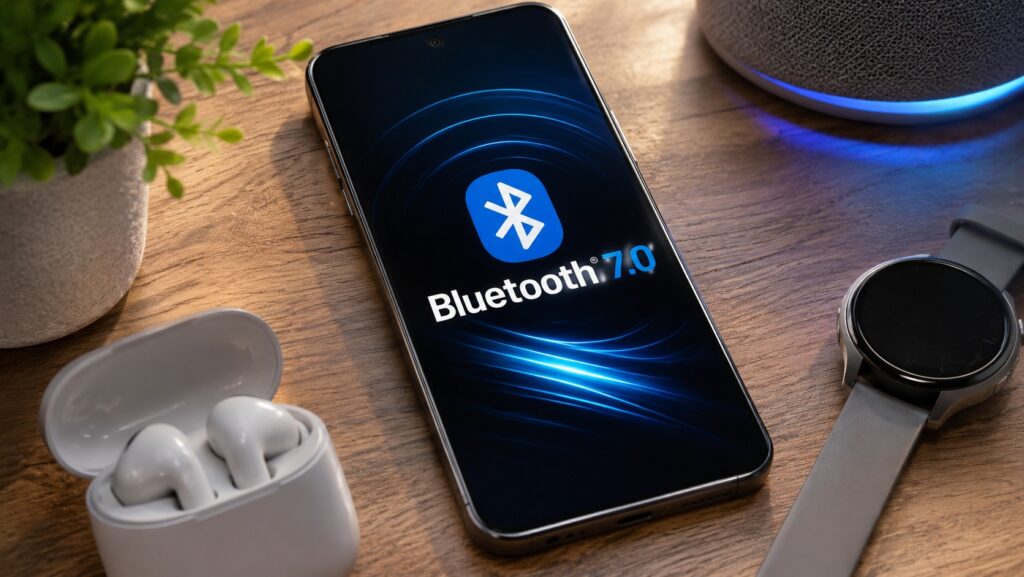
Bluetooth 7.0 on an Android phone
A big jump in Bluetooth LE speed
The Bluetooth SIG officially introduced Bluetooth 7.0, and its main new feature is High Data Throughput. HDT lets devices send much more data in the same amount of time.
The previous version of Bluetooth LE had a maximum radio data rate of 2 Mbps. With HDT, that figure rises to 7.5 Mbps, an increase of nearly four times and one of the most noticeable improvements to the standard in recent years.
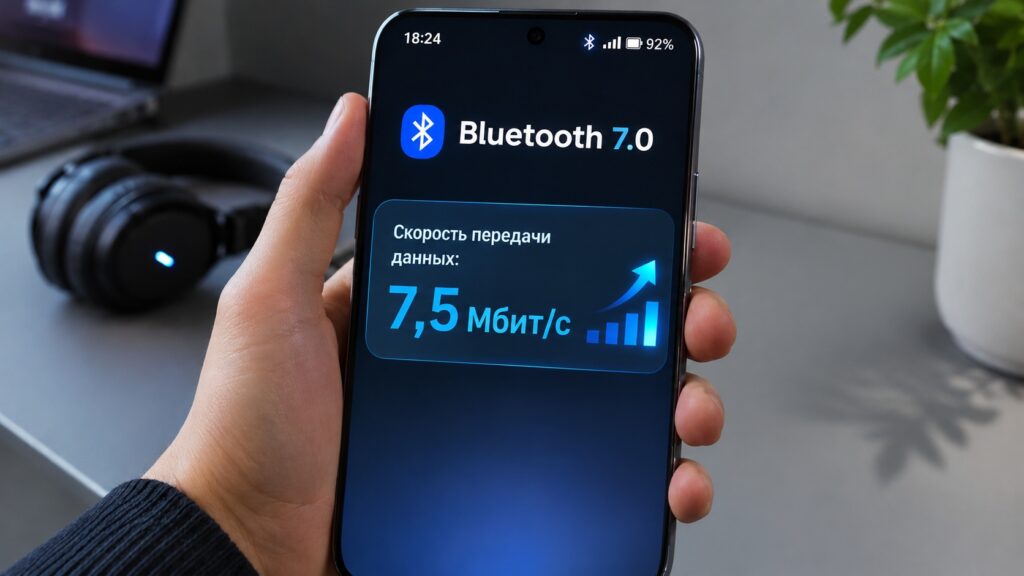
Data transfer speeds with Bluetooth 7.0
This change applies specifically to Bluetooth Low Energy. Bluetooth LE is the power-efficient form of the wireless standard used by headphones, watches, and other accessories. It does not mean every file transfer will become four times faster.

The more important change is that devices can move more data without placing constant load on the wireless module. The developers also improved connection stability, and the standard can automatically choose a suitable speed based on signal quality.
What it could mean for wireless headphones
The main practical benefit of Bluetooth 7.0 is expected to be for music. Today, most wireless headphones compress audio sent from a smartphone, even when the original track is available in high quality. For example, the widely used LDAC codec supports bitrates of up to 990 kbps.
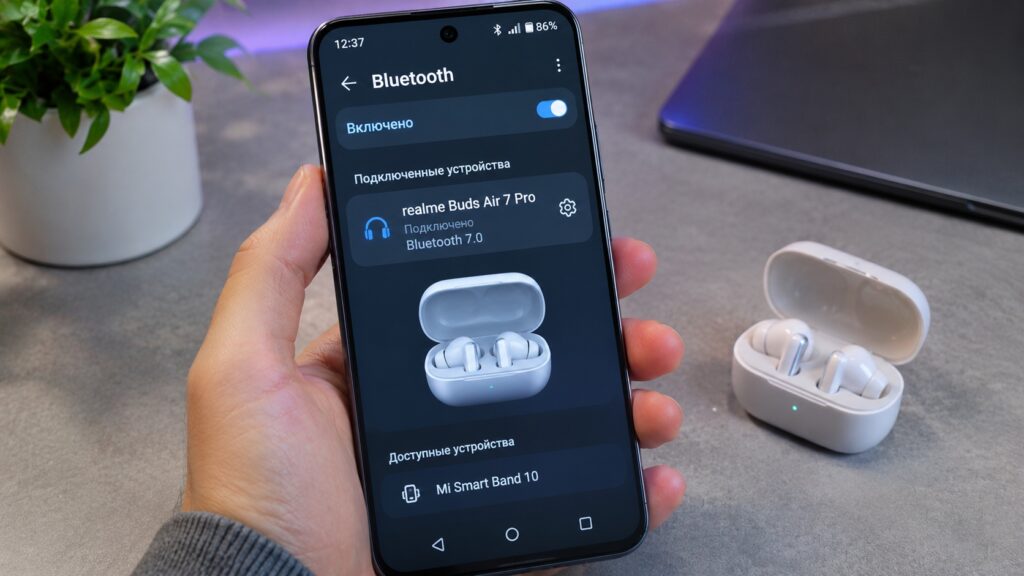
Wireless headphones connected to a smartphone via Bluetooth 7.0
The new standard lays the groundwork for lossless audio, meaning music is transmitted without discarding sound information to reduce the amount of data. The Bluetooth SIG expects to use HDT for several improvements:
- lossless and high-resolution music streaming;
- better spatial and multichannel audio;
- stable streaming of high-bitrate audio without frequent quality drops;
- more flexible adjustment of audio transmission without dropping the connection.
Still, Bluetooth 7.0 will not automatically improve every pair of headphones. Lossless playback will require a compatible smartphone, a compatible headset, and a supporting audio transmission technology. Sound quality also depends on the speakers and the original recording. Over time, though, Bluetooth 7.0 should make it easier to listen to lossless tracks without wires.

Faster syncing for smartwatches and other accessories
The improvements are not limited to headphones. Bluetooth 7.0 is designed for devices that regularly exchange data with a smartphone while using as little power as possible. For example, smartwatches could sync workouts and activity data more quickly. The faster a transfer finishes, the sooner the wireless module can switch to a low-power mode.
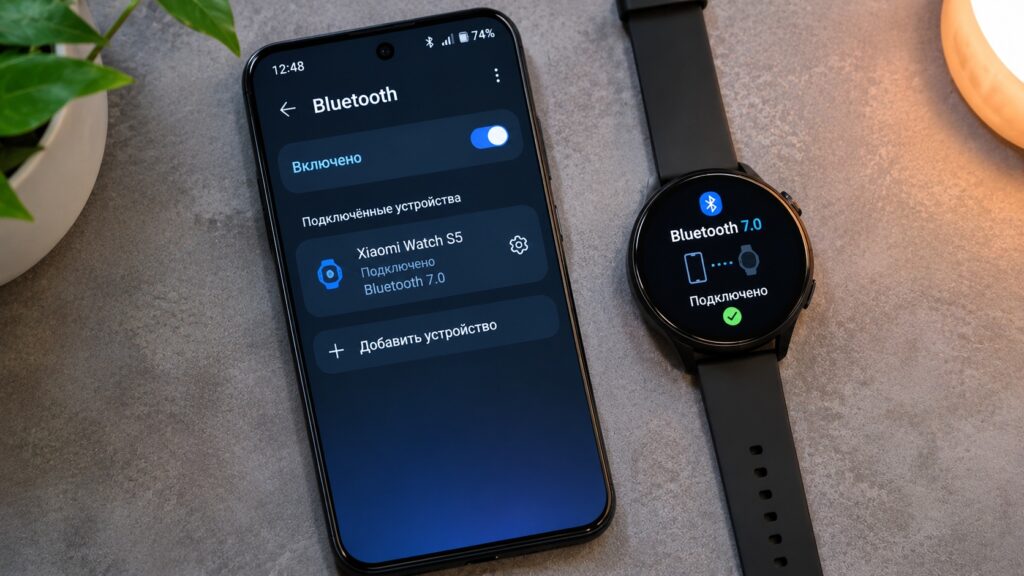
A smartwatch connected to a phone via Bluetooth 7.0
The developers highlight several benefits:
- faster data syncing between watches and smartphones;
- shorter update download times for compatible accessories;
- more efficient battery use during data transfers;
- better connection stability in difficult conditions;
- expanded capabilities for smart glasses and other AI-powered devices.
Changes to connection security
Bluetooth 7.0 also changes how connections are protected. A new mechanism enables more secure management of encryption keys. In some scenarios, it can also support secure data exchange without the usual prior pairing step. For everyday users, this could make connecting accessories more convenient. However, the actual implementation will depend on device manufacturers.
The new version will not eliminate every connectivity problem. Some causes of poor Bluetooth headphone audio are unrelated to the standard itself, including settings, interference, and the design of the devices.
Older smartphones will stay at their current speeds
Compatibility is the biggest caveat. HDT requires hardware support, so a regular Android update will not turn an existing smartphone with Bluetooth 5 or 6 into a fully HDT-capable device. In addition, HDT is optional even for Bluetooth 7.0. Manufacturers will be able to use the new version of the standard without supporting the high-speed mode.

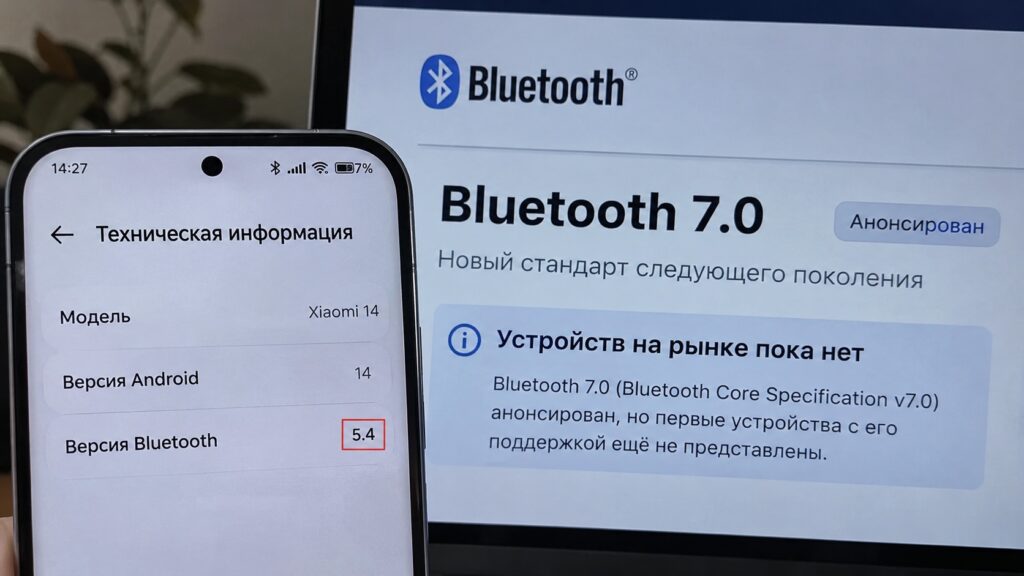
An older Bluetooth version listed in a smartphone’s specifications
The official documentation also defines several speed tiers:
- up to 4 Mbps: required modes for devices that support HDT;
- 6 Mbps: an optional high-speed mode;
- 7.5 Mbps: the maximum speed, available only with separate support.
This means two Bluetooth 7.0 devices may offer different capabilities. When buying, it will be important to check more than the version number: look for HDT support, the supported speed, and the audio features. Both connected devices must be compatible to get the benefits. If a new smartphone is paired with older headphones, they will keep working but will not automatically gain HDT capabilities.
When to expect Bluetooth 7.0 devices
The Bluetooth SIG expects a new standardized wireless audio solution to arrive in 2027. Qualcomm has already announced HDT support in its FastConnect 8800 platform. However, no specific smartphones or headphones with the new capabilities have been announced yet.
For that reason, there is no need to replace a phone or headphones now just for Bluetooth 7.0. Buyers considering future flagship devices should check whether they support HDT. HDT support, rather than the version number on a spec sheet, will determine how noticeable the gains in speed and wireless audio quality will be.