Apple’s A20 Pro, unveiled on 9 September at the company’s “Surprise and Shine” event for the iPhone 18 Pro and iPhone 18 Pro Max, is the first Apple smartphone chip built on a 2-nanometer process. According to Apple’s presentation, the move from TSMC’s second-generation 3nm node to its 2nm N2 node brings 20% faster CPU performance cores, a seven-core GPU that is 40% faster, a 32-core Neural Engine with double the compute, 50% more memory bandwidth, and a redesigned cooling package that Apple says delivers 40% better sustained performance than the A19 Pro. This explainer breaks down what those numbers mean, how the chip compares with last year’s A19 Pro, and whether the processor alone justifies an upgrade.
What you need to know
- The A20 Pro is Apple’s first 2nm smartphone chip, built on TSMC’s N2 node in partnership with TSMC, after the A19 Pro used second-generation 3nm.
- Apple claims 20% faster performance cores, a 7-core GPU with +40% graphics performance and doubled FP8 throughput, and a 32-core Neural Engine that is twice as fast as the A19 Pro’s.
- A new package inspired by the Mac’s M-series connects the chip and memory directly to a vapor chamber whose evaporator area is three times larger, for a claimed +40% sustained performance versus the A19 Pro.
- All figures are Apple’s own claims from the launch presentation; independent tests have not yet confirmed them.
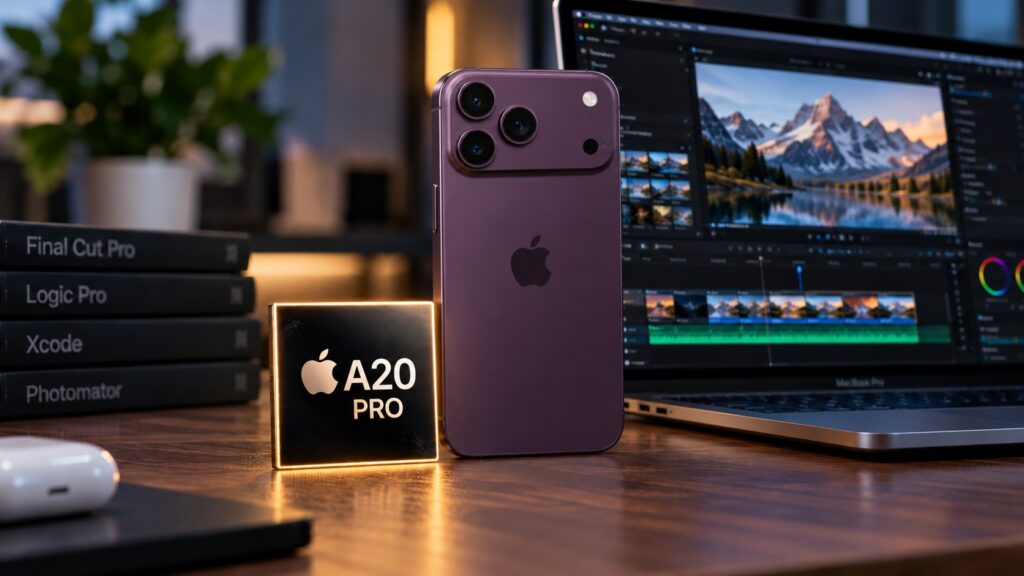
iPhone 18 Pro with the Apple A20 Pro processor next to a MacBook
What 2nm means and why it matters for the iPhone
The process node refers to the size of the transistors inside a chip. Smaller transistors mean more of them fit on the same die, which makes the chip more efficient and lets it generate less heat. Last year’s A19 Pro used TSMC’s second-generation 3nm process, which was already advanced. The A20 Pro moves to TSMC’s 2nm N2 node.
According to the source, this allows Apple to fit more compute cores, substantially enlarge the Neural Engine, and still improve energy efficiency over the previous generation. For users, 2nm primarily promises two things: more performance at the same or lower battery cost, and the ability to run more complex AI models directly on the device without overheating.
CPU, GPU and Neural Engine: what changed
The A20 Pro’s architecture is more complex than its predecessor’s in every block. Here is the breakdown as presented by Apple.
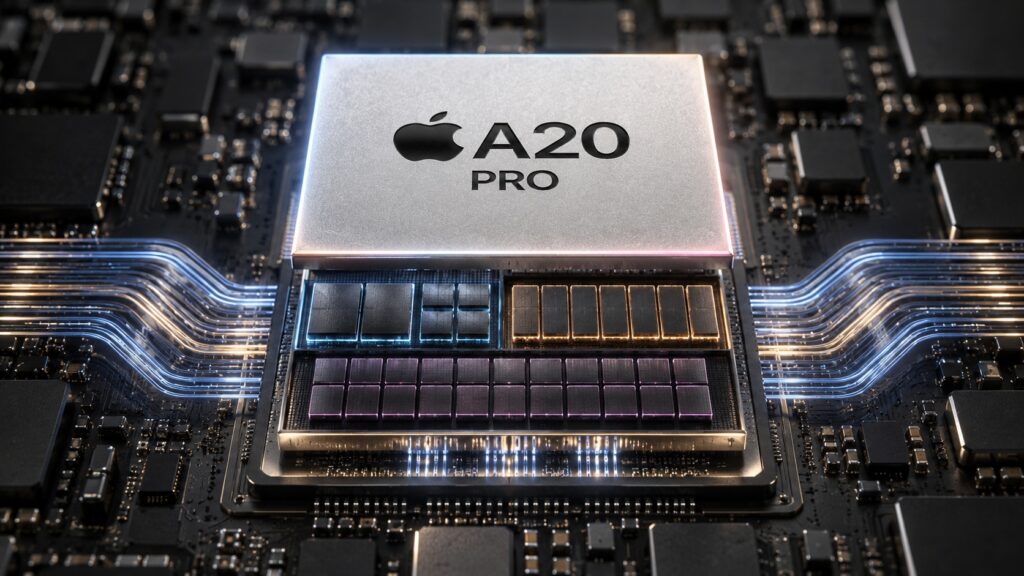
The Apple A20 Pro processor inside a smartphone
CPU
- 6 cores: 2 “super cores” and 4 efficiency cores;
- the performance cores are 20% faster than in the A19 Pro (Apple describes them as “desktop-class,” drawing a comparison with the Mac);
- the efficiency cores gain built-in neural accelerators, a first for the iPhone line.
GPU
- 7 cores versus 6 in the A19 Pro;
- a claimed +40% in graphics performance;
- each core gets an updated neural accelerator for AI tasks inside the GPU itself;
- FP8 performance is doubled, which matters for running language models locally.
Neural Engine
- 32 cores, twice as many as in previous Apple generations;
- support for 8-bit floating-point math, the standard for current AI models;
- compute performance 2x that of the A19 Pro.
Memory bandwidth is up 50%, which Apple calls “the widest memory interface in iPhone history.” The company says this should let the new phones keep apps in the background longer and more efficiently.
How Apple addressed heat
A powerful chip produces heat, and Apple openly acknowledged that effective cooling is critical to unlocking the A20 Pro’s full potential. Without it, performance would drop because of thermal throttling.
The solution is a new chip package inspired by the M-series used in Macs. The die and memory are connected directly to a vapor chamber. The evaporator area has grown threefold compared with the previous generation and now covers not only the chip but also the memory modules. The result, according to Apple: +40% sustained performance under load compared with the A19 Pro in the iPhone 17 Pro, and twice the sustained performance of the A18 Pro in the iPhone 16 Pro. Sustained performance is not a peak burst but what the chip delivers under prolonged load, which is the figure that matters most in real-world use.
A20 Pro vs A19 Pro: side by side
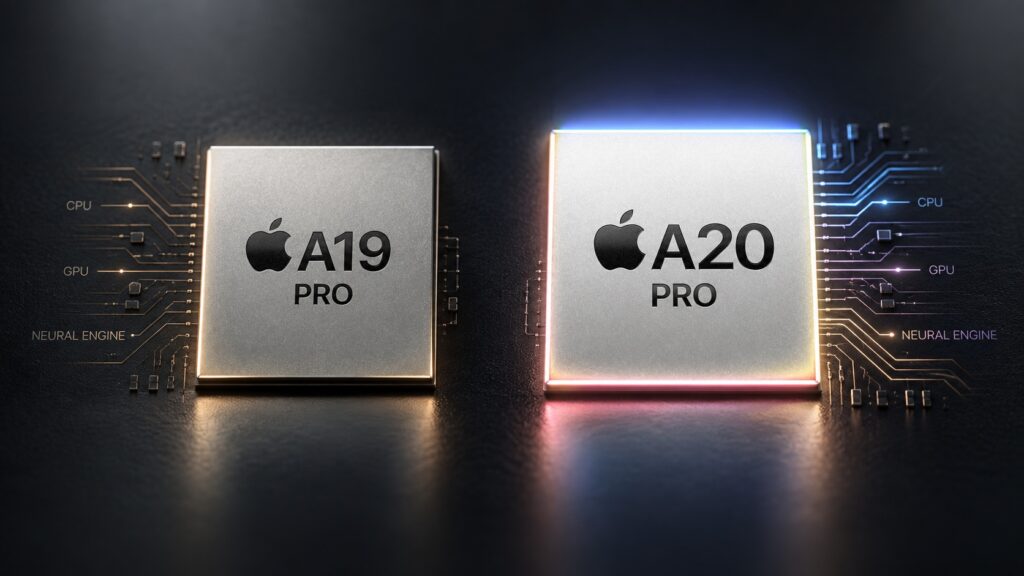
The Apple A19 Pro and A20 Pro processors
| Parameter | A19 Pro (iPhone 17 Pro) | A20 Pro (iPhone 18 Pro) |
|---|---|---|
| Process | 3nm (TSMC 2nd generation) | 2nm (TSMC N2) |
| CPU | 6 cores (2+4) | 6 cores (2+4), Super Core +20% |
| GPU | 6 cores | 7 cores, +40% |
| Neural Engine | 16 cores | 32 cores, 2x faster |
| Memory | baseline bandwidth | +50% bandwidth |
| Sustained performance | baseline | +40% vs A19 Pro |
| Cooling | standard evaporator | 3x area, covers memory |
What the changes mean in practice
Games and heavy apps. A 40% faster GPU combined with improved cooling should translate into steadier performance during long gaming sessions. If earlier iPhones began to heat up and slow down after around 30 minutes of intensive play, the tripled evaporator area should, according to the source, make that noticeably less frequent.
Apple Intelligence and AI. A 32-core Neural Engine with FP8 support allows larger language models to run on the device itself, without sending data to the cloud, which is both faster and more private. Apple positions this as making Siri smarter and generative features more accurate.
Camera. A larger neural engine directly affects photo and video processing. Computational photography, night mode and ProRAW processing are expected to be faster and higher quality.
Is the A20 Pro worth upgrading for?

iPhone 18 Pro in the hands of John Ternus
The source author’s answer depends on which iPhone you are coming from:
- iPhone 15 Pro or older — the difference should be noticeable in performance, AI features and the camera. The jump is substantial.
- iPhone 16 Pro — there is a gain, but the A18 Pro was already powerful. A claimed +40% in sustained performance is impressive on paper; whether it is felt in everyday use will only become clear once real-world tests are available.
- iPhone 17 Pro — think twice. The A19 Pro is far from outdated. If you are satisfied with a camera without a variable aperture and AI features are not a priority, the author suggests waiting for the next generation.
Overall, the source author concludes there are few reasons to buy the iPhone 18 Pro for the processor alone. Performance has grown noticeably, but it was already high. The author also notes a regional caveat: the 32-core Neural Engine cannot be fully exploited where most Apple Intelligence features are unavailable, as is the case in the author’s market. It is worth stressing that every performance figure above comes from Apple’s launch presentation and has not yet been verified by independent benchmarks.