This fall, Apple will introduce a new A-series chip, and along with it — new iPhones. Surprisingly, this year only the A20 Pro will be released, which will become Apple’s first 2-nanometer processor and will most likely power the iPhone 18 Pro and the foldable iPhone Ultra. The base A18 will be saved until next spring. That makes it all the more interesting to find out what capabilities the new generation chipset will bring, how it will be structured, and how it will differ from last year’s A19 Pro.
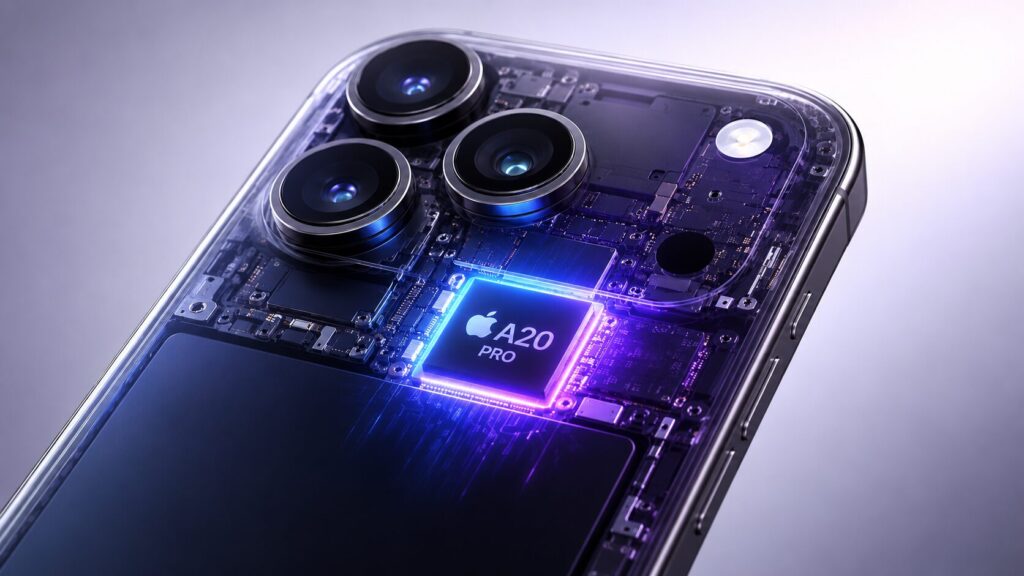
A20 Pro will be Apple’s first processor on a 2nm process
A20 Pro — the First 2-Nanometer Chip for iPhone
The A19 Pro processor, if you recall, was built on TSMC’s 3-nanometer technology. The A20 Pro, however, is expected to move to a 2-nanometer process and will be the first such product in Apple’s processor lineup. In simple terms, the smaller the nanometers, the more densely transistors are packed, meaning more computing power can be achieved with the same energy consumption.
According to expert estimates, the new process will deliver approximately 15% higher transistor density along with similar improvements in speed and energy efficiency. In practice, this provides headroom for more cores and faster internals without overheating the smartphone, but the real performance gain depends on how Apple utilizes this headroom.
There is also a separate mention of a new chip assembly method — placing RAM to the side rather than on top of the processor. This layout should improve cooling of both the processor and memory without sacrificing speed. For users, this potentially means more stable performance under load — for example, during gaming or video recording.
Differences Between A20 Pro and A19 Pro Processors
Apple has been increasing processor performance almost linearly for years, making predictions here fairly reliable. A 6-core processor is expected once again — two performance cores and four energy-efficient ones. Don’t be surprised if the performance cores are called “Super Cores”: Apple introduced this name with the M5 chip, and it’s essentially a marketing move.
| Specification | A19 Pro | A20 Pro |
|---|---|---|
| Process | TSMC 3nm (N3P) | TSMC 2nm (N2) — Apple’s first 2nm chip |
| Chip Packaging | Standard (InFO) | WMCM — memory on the same substrate as the processor |
| CPU | 6 cores (2 performance + 4 efficiency) | 6 cores (2 + 4); possible “super cores” similar to M5 |
| P-core Frequency | up to 4.26 GHz | expected above 4.26 GHz |
| GPU | 6 cores, Neural Accelerators in each core, hardware ray tracing | 6 cores, improved graphics for gaming and AI |
| Neural Engine | 16 cores | improved, rumored over 35 trillion operations/s |
| RAM | 12 GB LPDDR5X (9600 MT/s) | 12 GB LPDDR6 (possibly up to 16 GB) |
| Memory Bandwidth | up to 76.8 GB/s | higher thanks to WMCM and 2nm process |
| Modem | Snapdragon (17 Pro / Pro Max), Apple C1X (iPhone Air) | Apple C2 (in-house), mmWave + satellite connectivity |
| Performance Gain | — | approximately +15% over A19 Pro |
| Energy Efficiency | — | up to +30% over A19 Pro |
| Geekbench 6 (single / multi) | ~3,895 / ~9,746 | projected ~4,200 / over 10,000 |
| Devices | iPhone 17 Pro, 17 Pro Max, iPhone Air | iPhone 18 Pro, 18 Pro Max, foldable iPhone |
A score of around 4,200 points in single-core tests would put the A20 Pro on par with the M5 chip from Mac computers. In single-core speed, Apple is so far ahead of any Android smartphone processors and even desktop Intel and AMD chips that there’s almost no one to compare with.
Multi-core performance is a different story. The A20 Pro will likely surpass the 10,000-point mark, but some Android devices are already reaching this level — simply due to having more cores. Nevertheless, in overall processor performance, no smartphone has yet caught up with Apple, and the A20 Pro will retain that crown.
Graphics and Gaming on the New iPhone 18 Pro
The graphics portion of the chip is responsible not only for games but also for artificial intelligence tasks. Last year, the A19 Pro received a significantly redesigned graphics architecture, so this time a dramatic leap shouldn’t be expected — a gain of more than 10% is predicted.
In gaming benchmarks, the forecasts are as follows: more than 50 frames per second in the 3DMark Solar Bay Unlimited benchmark — that’s twice the real graphics performance in just three years. In the less demanding Wild Life Unlimited, a result above 150 frames is possible, representing approximately 65% improvement over three years.

Powerful graphics are important for both games and local AI tasks
Graphics is precisely the area where Apple doesn’t dominate as strongly as in CPU performance. At the same time, it’s critical for on-device AI, which is a priority for Apple. So if the company invests in graphics for AI purposes, gamers will automatically benefit from this as well.
Artificial Intelligence in iPhone 18 Pro
The Neural Engine is a dedicated chip block for AI tasks (Apple has been including it in iPhones since 2017). The first Neural Engine performed 600 billion operations per second, while current chips handle over 35 trillion. It’s needed not only for Siri and Apple Intelligence.
This block operates in dozens of everyday scenarios, often unnoticed by the user. It’s involved in photo capture, audio recording without background noise, and text recognition in images. In other words, its benefits are felt even if you never specifically open AI features.
According to rumors, in the A20 Pro this block takes up a noticeably larger area of the chip. If this is true and Apple provides sufficient memory bandwidth, we could see a particularly large leap in AI task speed — comparable to the jump between the A17 and A18. But it’s worth remembering: this is still a rumor, not a confirmed fact.
How Much Memory Will iPhone 18 Pro Get
RAM capacity is the most debated aspect of the forecast. The A19 Pro has 12 GB of memory, while the standard A19 has only 8 GB, and the difference already affects features: improved dictation and a more expressive Siri voice in iOS 27 require devices with additional memory.
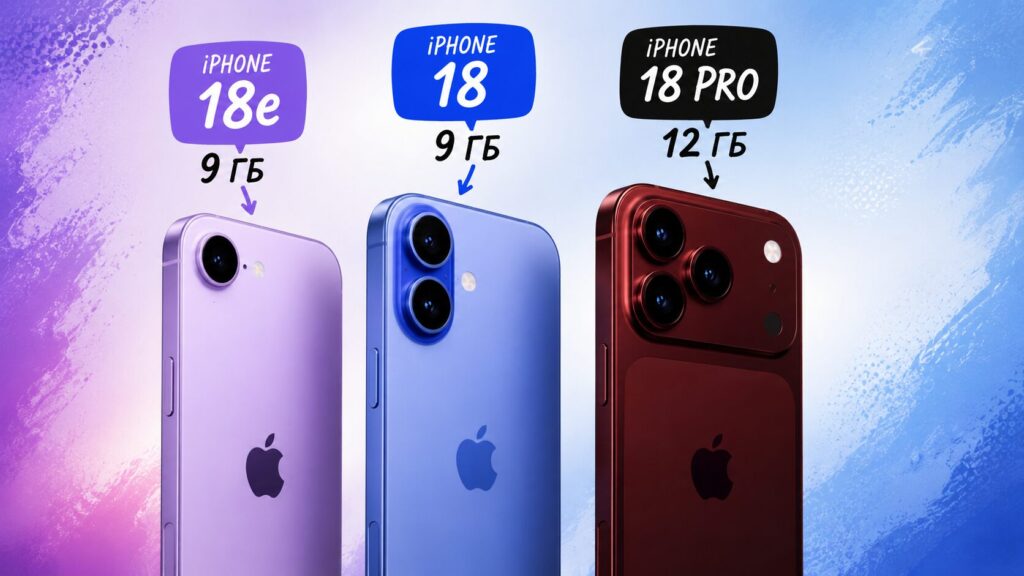
iPhone 18 and 18e will each get 9 GB of RAM and the A20 processor. The exact RAM amount for iPhone 18 Pro remains a secret for now
Apple would likely want to include 16 GB of memory in the A20 Pro, but there’s a catch. Memory prices have risen more than 5x over the past year, so it’s possible that Apple will again settle for 12 GB simply due to the market situation. For buyers, this matters: the amount of memory determines how long an iPhone will continue to receive the most demanding AI features.
There are other components as well. Apple is developing its own cellular modems — a new C2 modem is expected with improved speeds, mmWave (ultra-fast 5G) support in some countries, and better battery life. However, Apple’s Pro models have always used Qualcomm modems so far, so the transition to an in-house chip in this segment is still uncertain. There’s no reason to change the proprietary Wi-Fi and Bluetooth N1 chip yet — it already supports Bluetooth 6 and Wi-Fi 7.