
A chest of gold was found in an old house in Vienna
During a basement renovation in a Viennese villa, a plumber discovered a rusty metal chest containing 30 kilograms of gold coins embedded in the concrete floor. The find is estimated to be worth approximately $2.4 million (over 180,000,000 rubles). It all started with an ordinary rope sticking out of the floor and the decision not to walk past it.
The Story of the Ancient Treasure Discovery
According to Daily Galaxy, the events took place in the Penzing district, one of Vienna’s quiet residential neighborhoods. The plumber arrived at the site for a routine basement renovation of an old villa. While working, he noticed a rope sticking out of the concrete floor. He tried to pull it out, but it wouldn’t budge.
He then grabbed a shovel, broke through the concrete, and discovered a rust-covered metal chest beneath it. Inside were approximately 30 kilograms of gold coins bearing the image of composer Wolfgang Amadeus Mozart, with a total value of roughly 2.3 million euros.
The story became one of the most high-profile accidental discoveries in recent Austrian memory. It was first reported by the Austrian publication Heute, and the news quickly attracted international attention.
How the Gold Chest Was Hidden
One particularly intriguing detail makes this story almost cinematic. The day before the plumber arrived, a construction worker named Tobias had been working in the same basement. He too noticed the rope sticking out of the floor, but paid no attention to it and continued working.
His longtime friend Armin, commenting on what happened, said bluntly:
That decision cost Tobias dearly, because under Austrian law, the finder’s rights passed to the plumber.
The difference between a million-dollar treasure and an ordinary workday came down to a single decision made in a matter of seconds.
When the plumber saw the same rope the next day, he first tried to pull it out. When it wouldn’t give, he grabbed a shovel, broke open the concrete, and discovered a metal chest attached to it. The chest was physically built into the floor, meaning it had clearly been hidden for the long term. Inside lay gold coins bearing Mozart’s profile.

The gold chest found by the workers
Mozart Coins from the World War II Era
The coins bearing Mozart’s image provide the main clue about when the treasure was buried. The composer’s portrait was minted on Austrian schilling and commemorative coins, production of which ceased after the Anschluss — Austria’s annexation by Nazi Germany in 1938.
Austrian schillings in the form of commemorative coins were issued in limited runs from 1928 to 1938, while gold schillings were minted only during the period from 1926 to 1938. After Austria’s occupation, the Reichsmark replaced the national currency, and coins of this type were no longer produced.
This indicates that the treasure was hidden shortly before or during World War II, a period when wealthy Austrians concealed valuables amid the deteriorating political situation. Experts believe the gold was hidden by a family living in the villa to avoid confiscation or looting.
The coins were not simply left in a corner. They were sealed inside a chest, which was then embedded into the floor structure — a level of effort that speaks to deliberate and long-term concealment. By estimates, the chest lay untouched for at least 85 years, surviving several changes of villa ownership and multiple renovations.
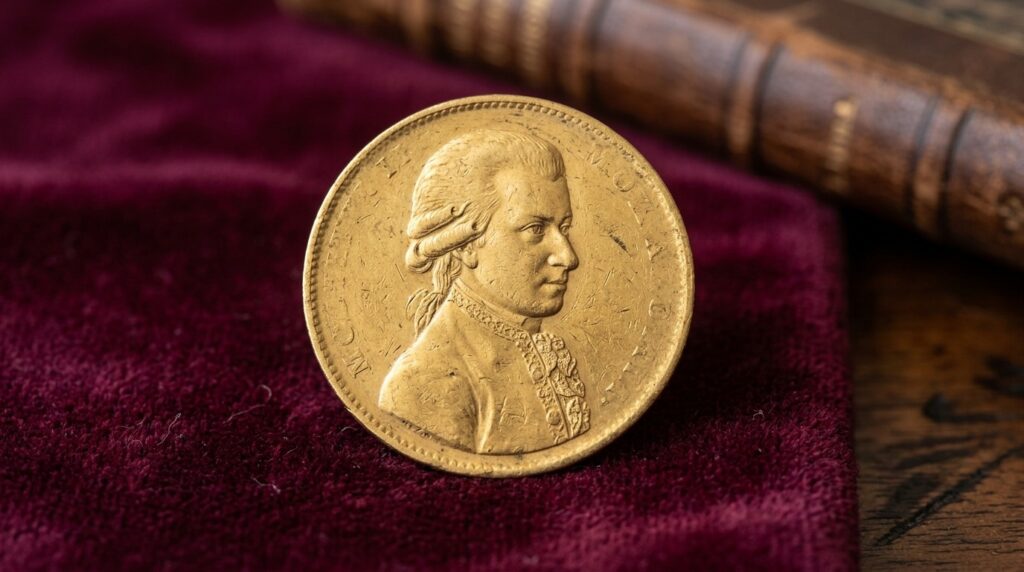
A gold coin with Mozart’s portrait — similar ones were minted in Austria until 1938
Austrian Treasure Law
Finding a treasure is one thing. Actually getting to keep it is an entirely different story. Under the Austrian Civil Code, the discovery of hidden valuables is considered a legal treasure if the original owner cannot be identified.
In such cases, ownership is split: half goes to the finder, and the other half to the owner of the land or building. The law does not automatically transfer everything to the state, meaning the plumber could walk away with over a million euros.
However, the procedure is not as simple as it seems. By law, the finder is obligated to immediately report the discovery to the district administrative office or police. They, in turn, notify the Federal Monuments Authority, which assesses whether the items constitute protected cultural heritage. As of the latest reports, the villa’s owner has not filed any legal objections. The gold remains in the custody of Austrian authorities while the review is ongoing.
This fundamentally distinguishes Austrian law from practices in many other countries. For example, in several nations all archaeological finds automatically become state property. In Austria, however, the law creates an incentive to report finds rather than hide them — because the finder is guaranteed their share.
The Fate of the Vienna Treasure
The Federal Monuments Authority must determine whether the “Mozart gold treasure” falls under Austria’s cultural heritage protection system. But even if the coins are deemed historically significant, they are unlikely to be fully seized by the state, because the law was originally designed for situations where valuables surface from an era whose owners cannot be identified.
Neither the plumber’s name nor the villa owner’s name have been made public. The specific denominations and minting years of the coins have also not been disclosed, leaving part of the treasure’s historical profile unresolved.
The story of the Vienna treasure serves as a reminder of a simple but important truth: there is sometimes more beneath our feet than we realize — in the most literal sense. One worker walked past the rope; another pulled on it. The difference between them was attentiveness and the willingness to investigate something that seemed insignificant. And while the gold bearing Mozart’s profile awaits a legal decision, the discovery itself has already become one of the most remarkable accidental archaeological stories in modern Europe.