Surprisingly, people in the cloudiest places on Earth feel quite happy
Have you ever cursed the rain after getting soaked on your way to work? Well, there are places on Earth where it rains around the clock. In one of the wettest places on Earth, so much water accumulates in a year that it would cover you head to toe with a three-story-deep layer. It would be nice if nobody lived in these places, but that’s not the case. Five settlements on the planet defy common sense: people there live, work, enjoy life, and even joke about the local weather.
Mawsynram Village, the Rainiest Place on Earth
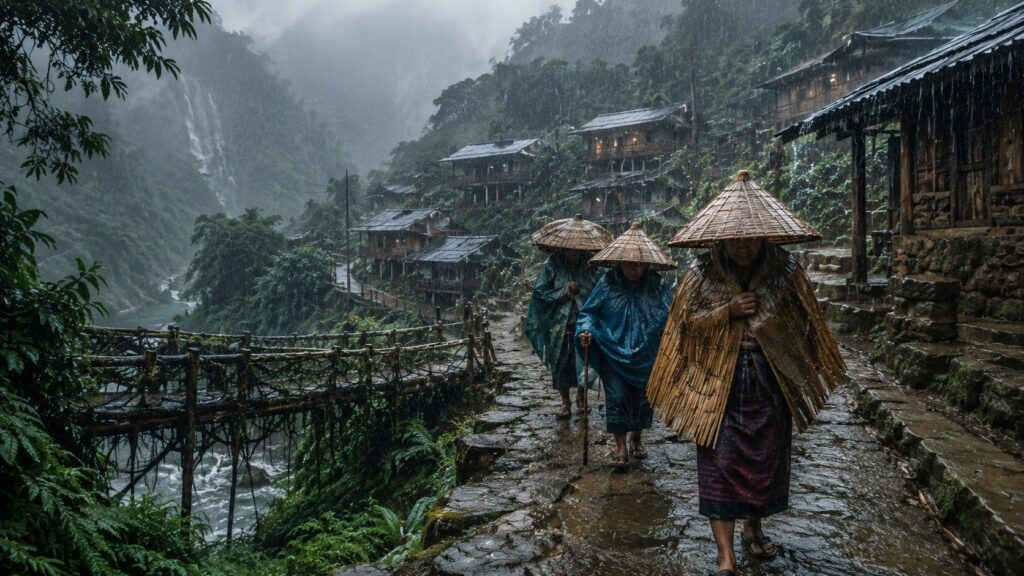
Mawsynram village is located in the state of Meghalaya in northeastern India. The state’s name translates from Sanskrit as “abode of clouds,” and that’s no exaggeration. The average annual rainfall here is about 11,872 mm — nearly 12 meters of water falling from the sky per year. Most of the rain falls during the monsoon season, from June to September, when downpours occur daily.
According to Indian Panorama, the reason for such enormous rainfall lies in geography. Warm, moist air from the Bay of Bengal moves northward and hits the steep slopes of the Khasi Hills. The air rises, cools, and all the accumulated moisture condenses and falls as rain. This process is known as orographic precipitation — essentially, the mountains act as a giant condenser for clouds.
Local residents have found remarkable ways to live with constant rain. Instead of ordinary umbrellas, they wear cone-shaped capes made of bamboo and banana leaves that cover the entire body. The region also features bridges built from living roots of rubber trees: the roots are guided across rivers and gorges, and over 10–15 years they grow into fully functional crossings. These bridges last for centuries and don’t rot, unlike wooden structures that deteriorate too quickly in this climate.
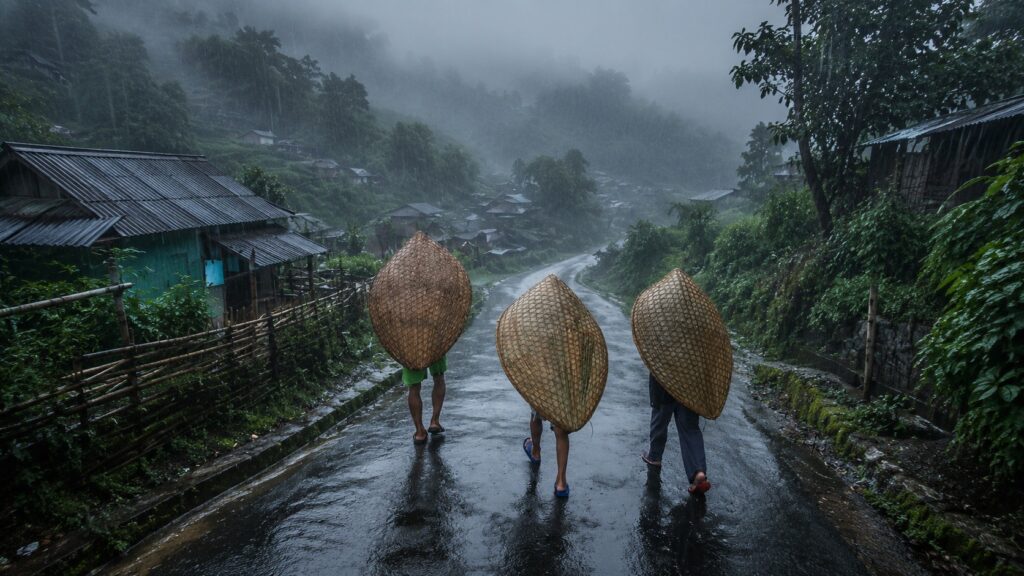
Residents of Mawsynram village wearing rain capes
Cherrapunji, Where the Most Rain Falls in a Year
Just a few kilometers from Mawsynram lies the town of Cherrapunji. The average annual rainfall here is slightly less — about 11,777 mm — but this place holds the absolute world rainfall record. From August 1860 to July 1861, 26,461 mm of precipitation fell here — more than 26 meters of rain in 12 months. And in July 1861 alone — 9,300 mm. Both of these figures remain world records to this day, documented in the Guinness Book of World Records.
The precipitation mechanism is the same as in Mawsynram: monsoon clouds from the Bay of Bengal travel about 400 km over the plains of Bangladesh and then abruptly hit the Khasi Hills, which rise to an altitude of about 1,370 meters within just a few kilometers. The clouds are compressed in narrow valleys and pushed upward along steep slopes, and all the moisture pours down.
As in neighboring Mawsynram, living bridges made from tree roots are built here. Cherrapunji is also famous for its impressive waterfalls and lush greenery, and the settlement remains a trading center for surrounding communities — oranges, pineapples, and other fruits are sold here. The Khasi people who live in these parts have a matrilineal society — children receive their surname and clan affiliation from their mother.
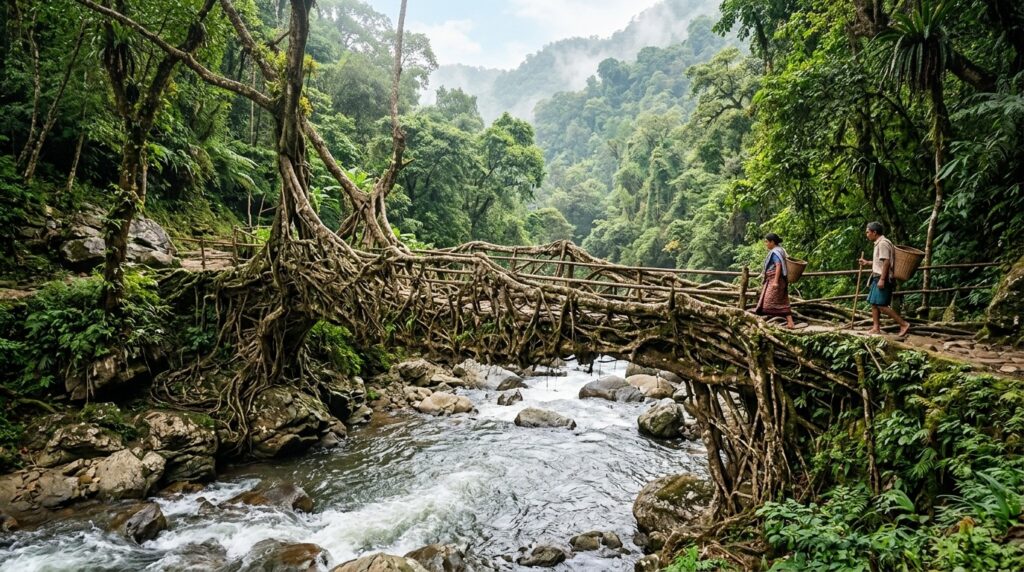
A living bridge made from tree roots near Cherrapunji
Tutunendo, Where There Are Two Rainy Seasons a Year
If India dominates the top of the list, South America is represented by Tutunendo — a tiny settlement in the Chocó department on the Pacific coast of Colombia. The average annual rainfall here is about 11,770 mm, which puts Tutunendo roughly on par with Cherrapunji.
The main difference from the Indian record holders is that Tutunendo has not one but two rainy seasons. Rain falls here almost every day, and the sun after sunrise rarely lasts more than a few hours. Meanwhile, fewer than a thousand people live in the settlement, and they must cope not only with downpours but also with intense heat and thick humidity.
The precipitation mechanism here is also related to terrain: warm, moist air from the Pacific Ocean is driven by wind toward the Andes, the air masses rise along the slopes and release all their moisture. Proximity to the equator adds constant solar heating, which intensifies evaporation from the ocean surface.
The flip side of endless rain is incredible biodiversity. The Chocó-Darién region, where Tutunendo is located, is considered one of the most biologically rich places on the planet. Here, the extreme climate doesn’t hinder but helps life flourish — though sometimes at the cost of landslides and flooded roads.
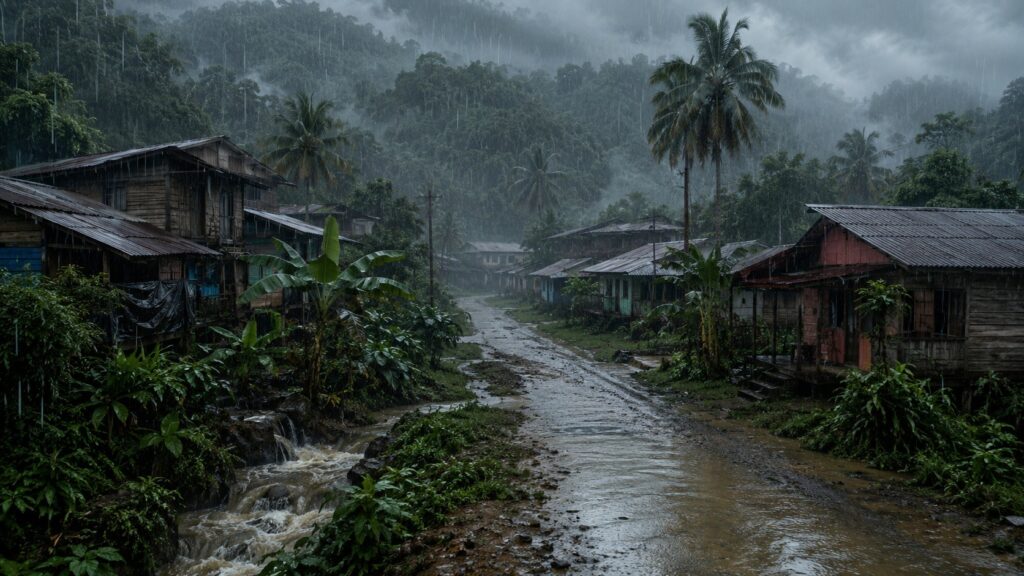
Tutunendo in Colombia
Ureka on Bioko Island, the Wettest Place in Africa
Bioko Island is located in the Gulf of Guinea off the coast of Cameroon and belongs to Equatorial Guinea. At its southern tip stands the village of Ureka, where an average of about 10,450 mm of precipitation falls per year, making it the rainiest place on the entire African continent.
Ureka is known for its beach with black volcanic sand, surrounded by waterfalls, and a tropical rainforest that is home to animal species found nowhere else on the planet. Among them are nine endemic primate subspecies, some of which are on the brink of extinction. According to Atlas Guide, there are also many sea turtles. The rainy season formally lasts from April to October, but cloud cover, humidity, and precipitation can accompany residents year-round.
The island has a rich and complex history. The Portuguese colonized it in 1472, and in the 18th century it became a center of the slave trade. Later, cocoa, coffee, and oil palm plantations developed here. Today, Bioko attracts ecotourists — the rainforests, waterfalls, and unique fauna are the main reasons to visit. However, rubber boots should be the first thing you pack in your suitcase.
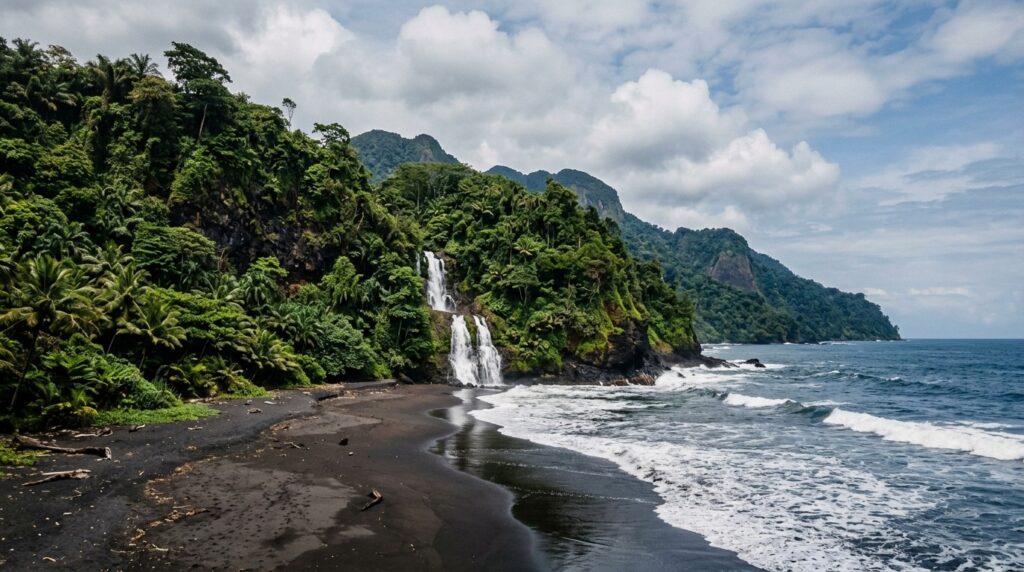
Black volcanic beach on Bioko Island surrounded by tropical forest
Debundscha, Cameroon — Rains at the Foot of Mount Cameroon
Not far from Bioko, already on the African mainland, lies the Cameroonian village of Debundscha. It receives approximately 10,300 mm of precipitation per year and is located at the foot of Mount Cameroon — the highest peak in Central and West Africa at about 4,100 meters.
The rain mechanism here is the same orographic effect. As in the examples above, the wind drives hot, moist air from the Gulf of Guinea toward the mountain, the air rises along the slopes, cools, and all the moisture crashes down in torrential rains on the village below. Peak rainfall occurs from May to October, but it remains quite damp the rest of the year as well.