A scam call is not identified by the number on your screen or by who the caller claims to be. What gives it away is what the caller is trying to make you do. According to the source article, every fraudulent call follows the same pattern: an unexpected contact, an alarming story, artificial urgency, and a demand for a specific action. Recognizing that pattern, and hanging up as soon as it appears, is the single most reliable defense.
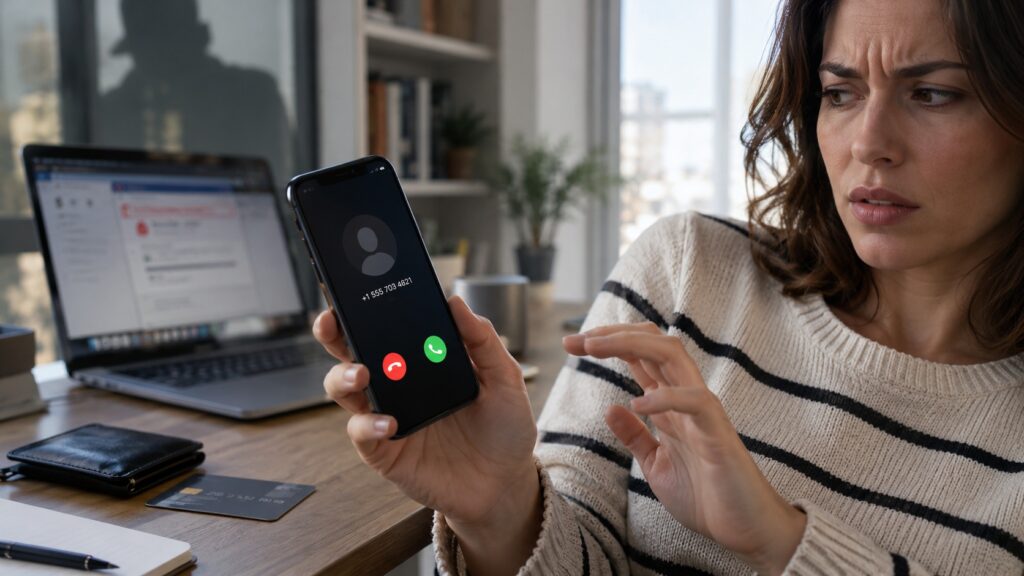
The fright of a call from an unknown number
What you need to know
- Every scam call follows one formula: unexpected contact, a frightening story, urgency, and a demand to transfer money, read out a code, or install an app.
- A caller knowing your name, bank, address, or card digits proves nothing; such data is routinely leaked, scraped from public sources, or bought in bulk.
- The correct response is to hang up and call the organization back yourself using a number you find in its official app or website, never one supplied by the caller or a text message.
- In Russia, mandatory call labeling for businesses has been in force since September 1, 2025, but a label is only a supporting signal, since scammers can spoof numbers.
The rule that always applies
The source article boils every fraudulent call down to one chain of events:
Unexpected contact → alarming story → urgency → a demand to do something.
You receive a call you were not expecting. The caller tells you something frightening: a loan is being taken out in your name, your account is about to be blocked, your data has leaked. They insist you must act right now, because waiting will make things worse. Finally, they propose a concrete step: transfer money, read out a code, or install an application.
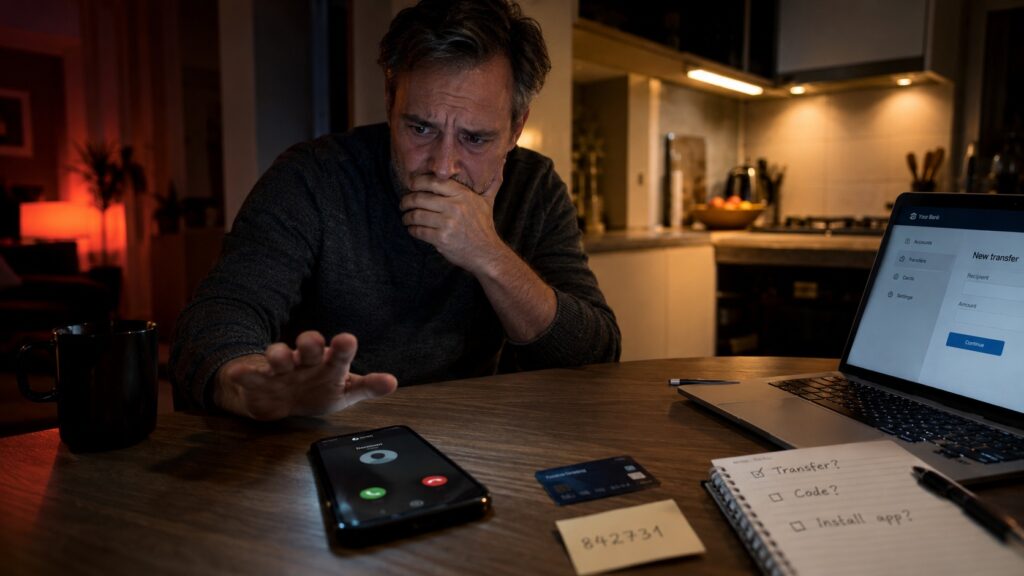
The anxiety a scam call is designed to create
Pressure, intimidation, and demands for immediate action are the defining features of a fraudulent conversation. As the source puts it, no genuine bank and no government agency will demand that you take immediate action over the phone.
10 phrases that give the scam away
Each of the following phrases is, on its own, a reason to end the call. The source advises against arguing, trying to catch the caller in a contradiction, or explaining why you will not comply. Simply hang up when you hear:
- “Read out the code from the text message” — no real bank employee ever asks for this code.
- “Transfer your money to a safe / reserve / special account” — no such accounts exist for ordinary customers.
- “Withdraw the cash and hand it to a courier” — a classic scheme after which the money is gone for good.
- “Someone is taking out a loan in your name right now” — manufactured panic so you have no time to think.
- “Don’t hang up” — an attempt to stop you from calling your real bank.
- “Don’t tell anyone about this conversation” — a request for secrecy from a stranger should always raise alarm.
- “Install this app for your protection” — most likely a remote-access tool for your smartphone.
- “Give me your card details / CVV / password” — genuine bank staff never ask for a CVV.
- “Enter this combination on your phone” — most likely a code that forwards your calls and messages to the scammer’s number.
- “I’ll transfer you now to the central bank / the police / the security service” — being handed between different agencies within a single call is not possible, and the claim is a hallmark of fraud.
A list this long can create its own anxiety, and not every unknown call is a scam. The rest of this article explains how to judge a call without becoming paranoid.
Why “but they knew my name and details” proves nothing
The most common explanation people give for trusting a scammer is some version of this:
They knew my bank, my address, my name, and even the last digits of my card.
It sounds convincing, but it means nothing. Databases leak regularly. Information is gathered from open sources: classified ads, social media profiles, old online-store orders, and hacked accounts. According to the source, buying a database that contains names, phone numbers, banks, and approximate balances is not a difficult task for a fraudster.
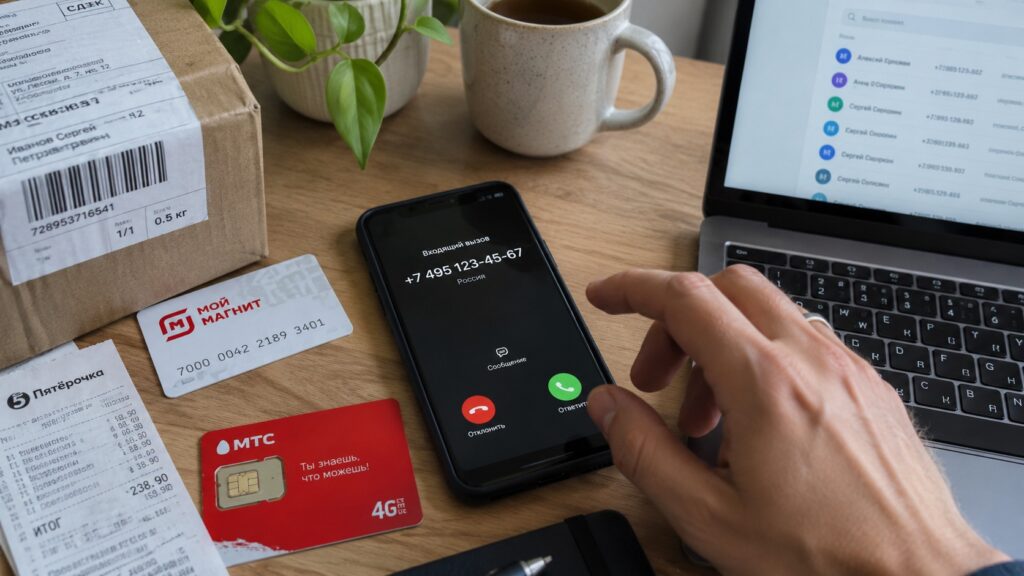
Leaked databases feed scam call operations

The source offers a rule that sounds paradoxical but holds up:
Genuine information inside a conversation does not make the conversation genuine.
A caller who says “Mr. Smith, we’re calling about your card at your bank” has not proven they work for that bank. They have proven only that they have your data, and nothing more.
The one-minute fix
There is no need to argue with a scammer, try to expose them, or ask trick questions. The source recommends a single procedure:
- End the call.
- Do not press anything and do not open any links from text messages.
- Open the official app of your bank, mobile carrier, or government services portal yourself.
- Find the official support number there.
- Call it yourself and ask whether there is really a problem.
The key word is yourself. Do not call back a number sent to you by text. Do not call a number the caller dictated. Use only a number you found in the official app or on the official website.
Can a scammer be identified by their phone number?
This section describes a Russia-specific measure. According to the source, since September 1, 2025, Russia has required mandatory labeling of calls from companies and sole proprietors: the carrier must display the organization’s name and a call category such as “bank,” “telecom services,” or “advertising.” If an ordinary mobile number appears on screen instead of a bank’s name while the caller claims to be from the bank’s security department, that is a strong reason to end the call.
Interpretation matters, though. An on-screen label is a supporting signal, not permission to follow the caller’s instructions. Even a convincing bank name on the display does not mean it is safe to read out text-message codes or transfer money, because scammers have learned to spoof numbers. The source’s rule is simple: the absence of a “scam” warning does not make a call safe, and if a warning does appear, it is better not to answer at all.
How Android tools help filter scam calls
Android smartphones offer built-in and third-party tools for filtering unwanted calls. The source gives the following general path to the spam-protection settings (exact menu names differ between manufacturers, as the examples below show):
- Open the Phone app.
- Tap the three-dot menu in the top-right corner.
- Go to Settings and look for a section such as “Caller ID and spam protection” or “Call filtering.”
- Enable identification of unknown callers and spam filtering.
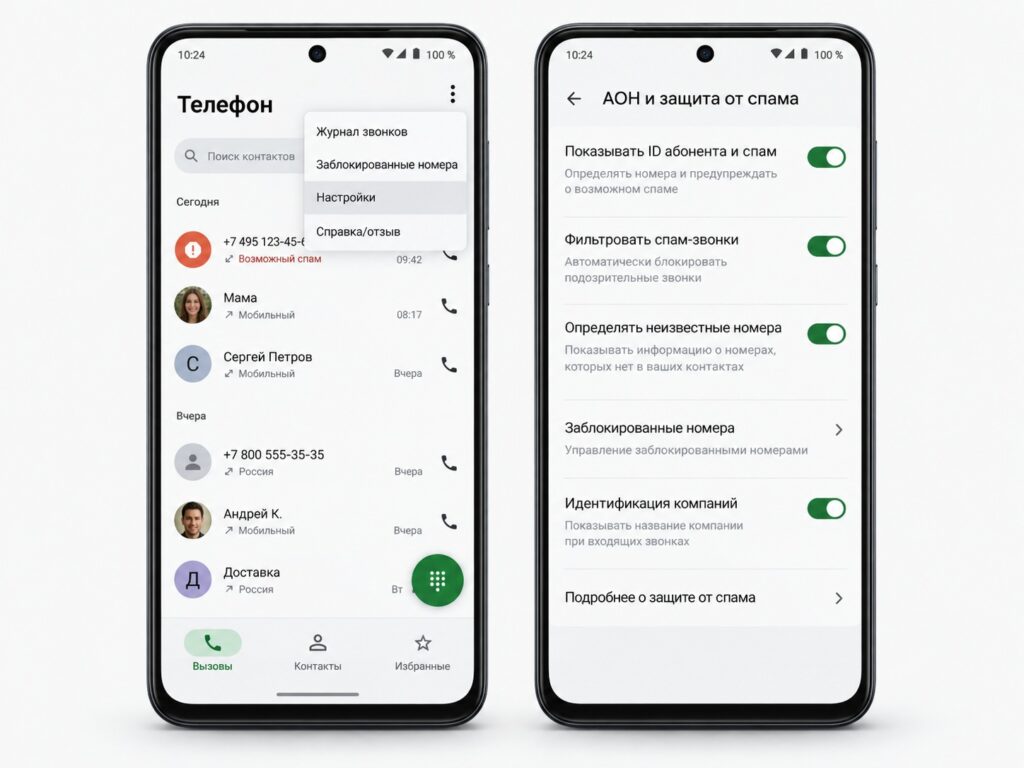
Scam protection settings in a phone app
On Samsung devices the path is Phone → three-dot menu → Settings → Call protection. On Xiaomi and Redmi phones it is Phone → three-dot menu → Settings → Blocking and filtering. The source also mentions a third-party caller-ID app available in its region that can identify unknown numbers and block entire categories, including “unwanted” numbers where scam callers are placed. That app offers a “trusted contact” feature: a person you choose is notified if you have spoken with a number flagged as fraudulent. The source stresses that setting this up for elderly relatives is especially important, as they are more often targeted by phone schemes.
What to do if you realized too late
Sometimes the realization comes only after the call has ended. The source’s recommended actions depend on what was shared:
- You gave only your name or other non-secret details — stop all contact and be especially alert going forward. You have most likely been added to a list of “live” numbers and will be called again.
- You read out a text-message code or password — immediately change the password for the relevant service and contact your bank via its official number.
- You provided bank card details — block the card through the official app or by calling the bank.
- You installed an APK or a remote-access app — immediately disconnect from the internet, delete the suspicious app, and review the permissions of all apps. From a different, secure device, change your critical passwords.
- You already transferred money — contact your bank immediately and file a police report. Keep the caller’s number, any messages, and the transfer details; all of it will be needed as evidence. Do not delete the scammer’s messages or numbers in this case.
The rule to remember is simple: if a stranger calls you and demands that you urgently do something with your money, your account, or your smartphone, hang up first and then contact the organization yourself. Never the other way around.