A new version of Yandex Browser’s license agreement, dated October 1, 2026, no longer describes the information the browser handles as anonymous or depersonalized. It now speaks directly of processing personal data and lists the categories involved in more detail. Yandex says the changes are technical and that the browser has not started collecting more information or linking more of it to specific people. According to the source, many iPhone owners use the Russian browser to reach Russian websites and banking services. For them, the practical step is to read the updated terms and review the app’s permissions and sync settings. The source author also points to similarities with the privacy policy of MAX, a Russian messenger whose data practices drew close scrutiny when it launched.
What you need to know
- The previous agreement, dated February 27, 2026, mentioned data anonymity five times and depersonalization twice. The October 1, 2026 version contains none of these references and refers to personal data processing instead.
- Clause 5.1.1 of the new agreement lists the data involved, including IP address, cookies and browser identifiers, device and software details, visited sites and pages, interactions with page elements, downloaded files and use of browser features.
- Yandex says the change is technical. It says the browser does not collect more information or tie more of it to specific people. The source describes this as a change in legal wording, not proof of new tracking mechanisms.
- Section 7 of Yandex’s general privacy policy permits sharing personal information with partners, advertising services, banks, law enforcement, and courts or other government bodies on lawful request. These provisions existed before the browser agreement was updated.

Yandex Browser open on an iPhone, with the browser and MAX logos visible on a MacBook
The agreement no longer calls the data anonymous
The new edition of the Yandex Browser license agreement is dated October 1, 2026. The changes drew wide attention only in the second half of November. According to the source, the previous version from February 27, 2026 is still available on Yandex’s website, so anyone can compare the two. The source author focuses on section 5 of the document, which describes how the browser handles user information.
The previous edition mentioned data anonymity five times and depersonalization twice. For example, when describing information about visited websites and downloaded files, Yandex used the phrase “anonymous (not linked to the User) information.” The new version drops these qualifications. Instead, the company refers directly to the processing of personal data, and the new clause 5.1.1 sets out in some detail which information is covered.
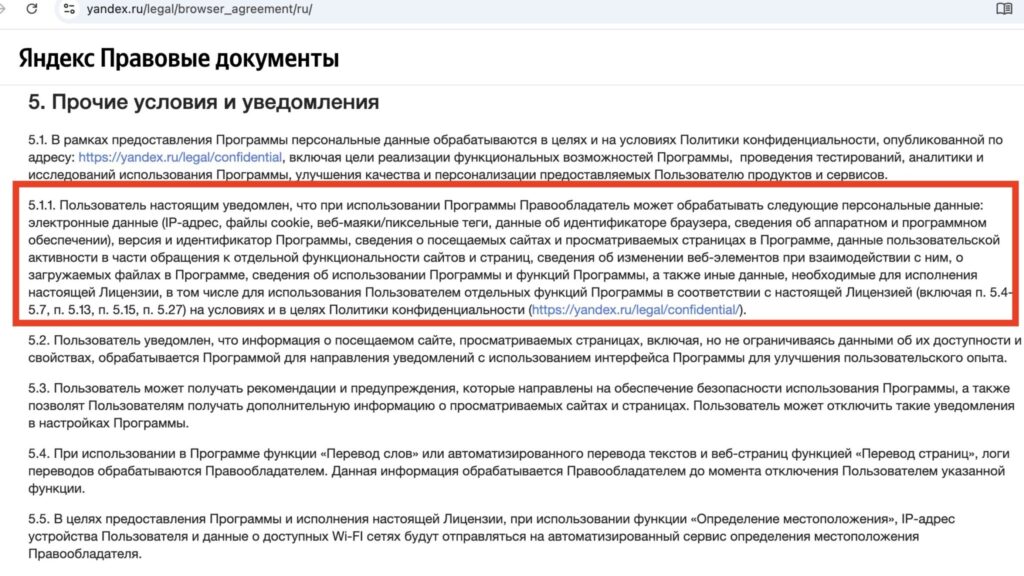
Clause 5.1.1 lists the data Yandex may process
The main changes
The source author highlights these differences between the two versions:
- references to the anonymity and depersonalization of information have been removed;
- the categories of personal data being processed are described in more detail;
- the wording on syncing the browser between devices has changed;
- a general statement that users could opt out of data transfer by turning off the relevant features is gone;
- an additional requirement has been added for users who give the browser access to their phone contacts.
What Yandex says
Yandex maintains that the changes are technical. According to company representatives, the browser has not started collecting more information or linking it more closely to specific individuals. They note that some technical data can count as personal data even if it contains no user name. The source therefore treats this as a change in legal wording, not proof of new tracking mechanisms. Even so, the source author recommends that every user of the browser read the updated agreement.
The list even covers actions on web pages
When people install a messenger, they usually understand roughly why it might want access to contacts, photos or the microphone. A browser, by contrast, is often seen simply as a tool for viewing websites. Yet, as the source points out, a large amount of information about everyday life passes through it: shopping searches, news reading, banking, Russia’s Gosuslugi government services portal, and document downloads.
According to the source, the new agreement lists these categories of information that may be processed:
- the device’s IP address;
- cookies and browser identifiers;
- information about the device and its software;
- information about visited websites and opened pages;
- data on interactions with page elements;
- information about downloaded files;
- information about the use of various browser features.
A lot depends on which features you use. With sync between devices turned on, passwords, bookmarks, settings and browsing history may be processed. With search suggestions enabled, the browser may send the characters you type into the address bar. In other words, some information can be transmitted before you even press the search button.
What the agreement does not prove
The source cautions that the mention of downloaded files does not mean Yandex automatically receives the contents of all your documents. The agreement itself does not establish that. At the same time, you should not count on Incognito mode to stop all data transfer. According to the source, it is mainly designed to limit the storage of browsing history and other data on the device itself, and it does not make you fully anonymous online.
Government bodies can request data from both Yandex and MAX
When the MAX messenger launched in Russia, many users studied its privacy policy closely. Most of their concerns involved the collection of personal data and the possibility of passing it to third parties. The source argues that similar provisions appear in the documents governing Yandex Browser. With the anonymity references now gone from the browser agreement, the similarity has become more obvious.
Clause 5.1 of the new browser agreement refers to Yandex’s general privacy policy. Section 7 of that policy describes to whom the company may transfer users’ personal information:
- partners and advertising services;
- banks and other financial organizations, in cases specified in the document;
- law enforcement agencies;
- courts and other government bodies, on request and in accordance with the law.
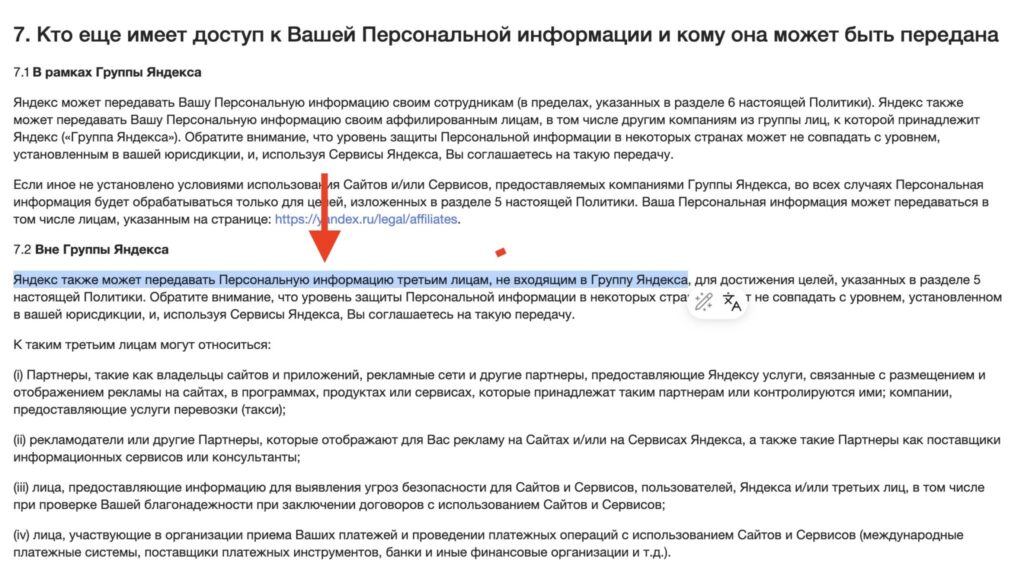
In section 7.2, Yandex describes when it may transfer data outside its group of companies
According to the source, the MAX privacy policy sets out a broadly similar principle. The service also processes information that can be linked to a specific user and allows it to be transferred to outside organizations. Clause 3.2.2 explicitly mentions providing information to government bodies when there are legal grounds. The MAX developers add that they check whether such requests are justified and provide the minimum necessary amount of data.
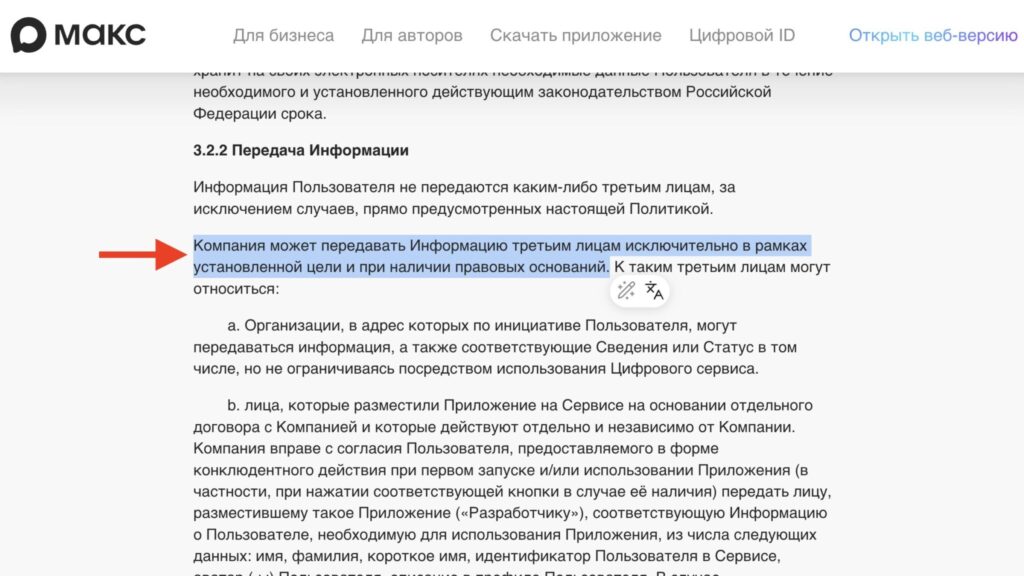
The MAX policy’s condition for transferring data to third parties is highlighted
Why this matters, and what it does not mean
The source stresses that the ability to share information on lawful request does not mean anyone is watching your browser activity in real time or reading every message in a messenger. The relevant provisions were also in Yandex’s privacy policy before the browser agreement was updated. What has changed is that the agreement itself no longer contains its earlier statements about the anonymity of collected information.
The source author asks why many users carefully examine MAX’s permissions and worry about their personal data, while few give the same thought to Yandex Browser. People use browsers to look up health information, compare products, visit banking sites and sign in to personal accounts. In some cases, browsing and search history can reveal as much about a person as their messenger activity. For that reason, the author argues that browser privacy deserves the same attention as messenger privacy.
What to check on iPhone
The source author does not recommend deleting Yandex Browser from every device just because of the new agreement, since many Apple users rely on it for Russian websites and banking services. Instead, the author suggests spending a few minutes reviewing the permissions granted to the app. This is especially relevant if you installed the browser only to view websites and do not use most of its extra features.
The source describes these steps on an iPhone:
- Open the iPhone’s Settings and go to the Apps section.
- Find Yandex Browser in the list.
- Restrict access to location, photos, camera and microphone if you do not use the related features.
- Under Privacy & Security → Tracking, prevent the browser from tracking your activity across other companies’ apps and websites, if that toggle is available.
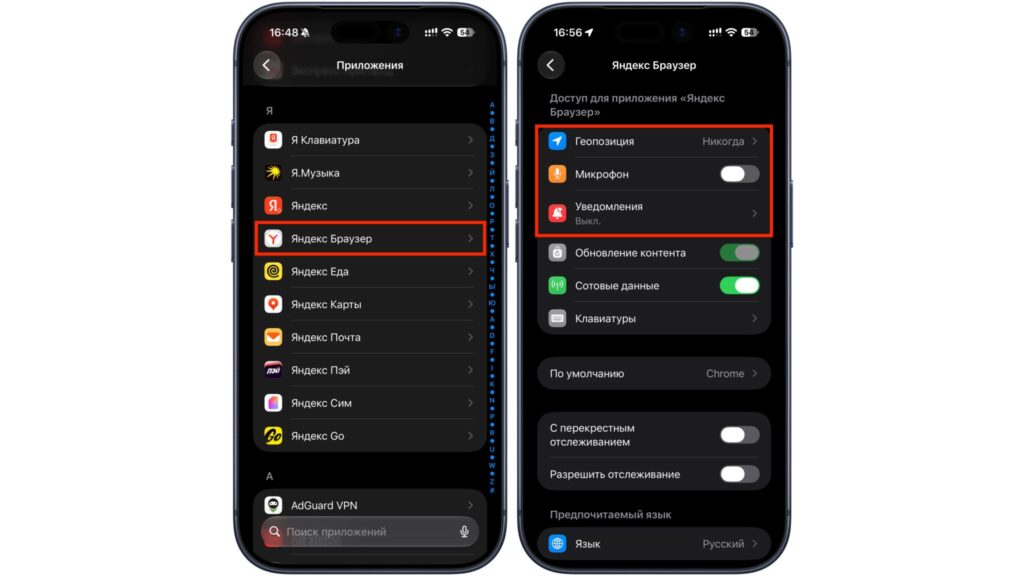
Yandex Browser’s location, microphone and notification permissions are highlighted in the iPhone’s settings
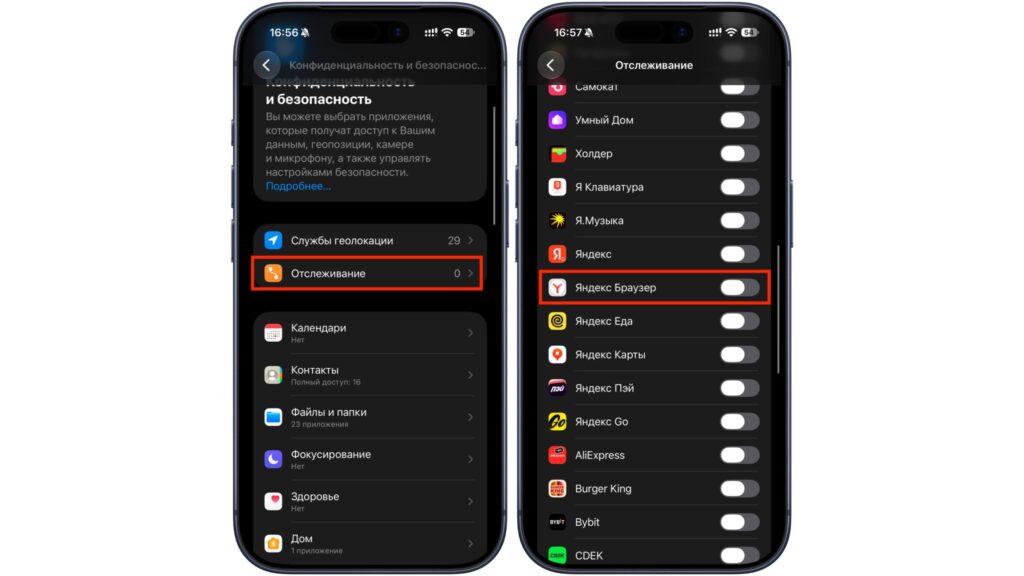
This is where tracking permission for Yandex Browser is turned off
Settings inside the browser
The source also recommends checking the browser’s own settings. In the desktop version, to turn off sending statistics, open the settings, go to the System section and find the options for personal data processing. If you do not want browsing history, passwords and other data carried across devices, the source suggests reviewing the sync settings as well.
The source author’s approach
The source author says they would keep Safari as the main browser on iPhone and Mac. They would use Yandex Browser only for Russian websites that, for whatever reason, do not work well in Apple’s browser. They would also avoid granting it unnecessary permissions and would not turn on sync without a real need. The author acknowledges that it is hard to find a popular browser that is fully anonymous and guaranteed to send no information about you. In their view, though, that is no reason to agree to personal data processing without thinking or to give apps access to everything on your phone.