
Scientists identify three reasons for the disappearance of serial killers
You’ve surely heard the terrifying stories about serial killers of the 1970s and 80s: Ted Bundy, Andrei Chikatilo, John Wayne Gacy. It seemed like they existed in every corner of the world. Today, however, a serial killer is more of a character in a crime show or TV series than an actual threat. So what happened? Did people simply stop being drawn to terrible deeds? Criminologists at universities found the answer. It turns out that the disappearance of serial killers is neither a triumph of policing nor a victory of psychotherapy.
The Largest Serial Killer Database
In the 1990s, forensic psychology professor Michael Aamodt began giving his students an unusual assignment: compile a detailed profile of a serial killer. They had to gather a chronology of crimes, biography, demographic data, and details of each case. At first, the papers were simply filed away in a desk drawer, then they made it onto the course website, and over time they evolved into a full-fledged database that is maintained and updated to this day on ResearchGate.
The researchers use the FBI’s definition that a serial killer is a person who has unlawfully killed two or more people in separate incidents. By 2018, the database covered thousands of offenders from around the world and revealed several striking patterns.
The USA — World Leader in Number of Serial Killers
The database statistics look both impressive and alarming. Since 1900, the United States has recorded 3,613 serial killers, accounting for 67% of all serial killers worldwide. What’s even more frightening is that the country’s population makes up only about 4.35% of the world’s total. England is also striking with 176 offenders. Next come Japan (137), South Africa (123), India (121), and Canada (119).
Approximately 11% of serial killers throughout recorded history have been women. However, their share has changed noticeably over time: before the 1930s, women made up about a third of all serial killers, but after 1980 — only about 6%. Female serial killers more often used poison and committed crimes for financial gain, with their victims more frequently being family members. Men, on the other hand, more often killed for pleasure, using firearms or strangulation, and chose victims among strangers.
When Serial Killings Were at Their Peak
The most intriguing finding in the database is the trend over time. In the 1980s, 150 serial killers who had murdered two or more people were active in the US, along with 104 who had killed three or more. This was the absolute peak of serial killer activity.
After that, a rapid decline began:
- 1990s: 138 serial killers (2+ victims), 89 (3+ victims);
- 2000s: a noticeable continuation of the decline;
- 2010–2018: only 43 serial killers (2+ victims), 23 (3+ victims).
In other words, over three decades, the number of serial killers in the US dropped by approximately 3.5 times. So what changed?

Graph showing the decline in serial killers from the 1980s to the 2010s
Why the Number of Serial Killers Has Decreased
Researchers identified several key factors in their 2020 report. No single factor explains the decline on its own, but together they form a convincing picture.
The first factor is improved law enforcement. Advances in forensic science, including DNA analysis and digital surveillance, allow criminals to be identified at earlier stages. For example, serial killers with financial motives (insurance fraud and similar schemes) are now caught more quickly, often before they manage to accumulate “enough” victims to meet the definition of a serial killer.
The second factor is stricter criminal sentencing. According to the database, 79% of serial killers in the US had been to prison before their first murder. And 16.8% of serial killers since 1950 committed repeat murders after being released from prison for a previous one. Tightened parole conditions, as the authors note, simply prevent potential serial killers from returning to the streets.
The Role of Hitchhiking and Potential Victims’ Lifestyles
The third factor may seem surprising — it’s the change in people’s everyday behavior. The researchers directly point out that the decline in hitchhiking, the habit of giving rides to strangers, and the practice of walking to school deprived serial killers of a significant portion of potential victims.
Among the categories of victims that decreased most sharply from 1980–1999 to 2000–2017, the authors highlight hitchhikers, victims of abductions from shopping malls, as well as drivers of broken-down cars and “good Samaritans” who stopped to help strangers on the road.
Simply put, the modern lifestyle — with GPS navigation, mobile phones, surveillance cameras, and ride-hailing apps — makes people less vulnerable to random attacks. Society has become less trusting of strangers, and this, paradoxically, saves lives.
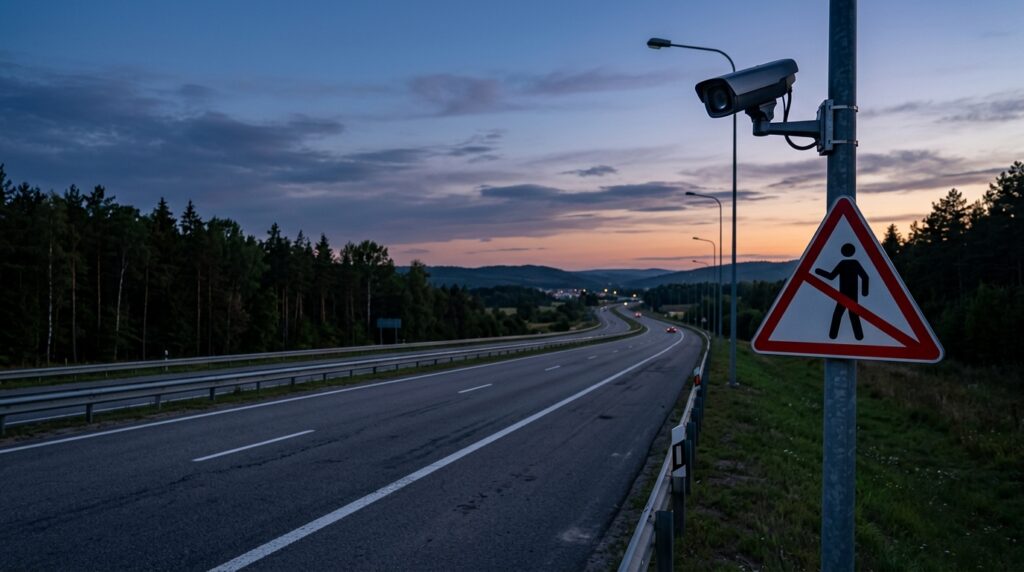
An empty highway with a surveillance camera — hitchhiking has become rare
What We Don’t Know About Serial Killers
It’s important to understand that the serial killer database, despite its massive scope, reflects only identified serial killers. Part of the decline may be explained by the fact that some crimes simply aren’t linked to each other, and some serial killers remain unsolved. Another nuance is that data after 2018 was incomplete in the database at the time of the last update, so trends in recent years may be refined.
Nevertheless, the overall trend appears stable and is confirmed by multiple sources. Changes in technology and society over the past 40 years have created an environment in which it is much harder for a serial killer to remain undetected and find victims. This doesn’t mean the problem has disappeared, but the scale of the phenomenon has genuinely changed. And while the 1980s are commonly associated with the golden age of rock music and video games, for criminologists that era evokes entirely different associations.