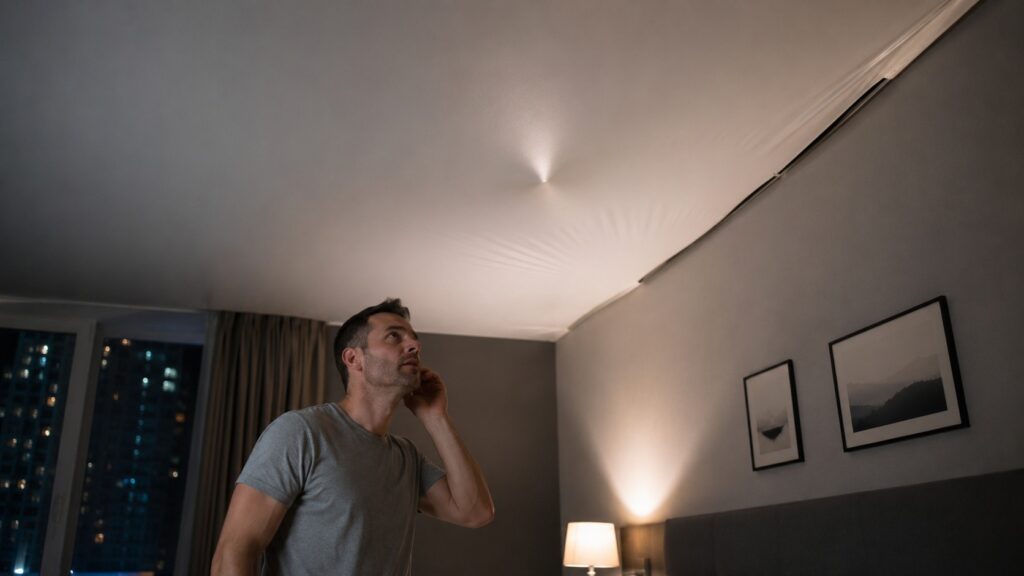
Insects aren’t always to blame for stretch ceiling cracking — there are other causes too
Have you also heard your stretch ceiling cracking? It happens to me regularly, and I even feel like insects are running around under it. The stretch ceiling rustling happens especially often in summer, and this pattern recently got me seriously puzzled. What if it’s wasps building a nest? It turns out there can be many reasons for this. Let’s look at all the causes of stretch ceiling cracking and figure out which one is bothering me and you.
What Stretch Ceilings Are Made Of
To understand the nature of the cracking, it’s worth recalling how a stretch ceiling works. Essentially, it’s a thin polyvinyl chloride (PVC) film or fabric sheet that is stretched over a special profile (baguette) secured around the perimeter of the room. An air gap remains between the film and the main ceiling, and this gap often becomes the source of unpleasant sounds.
The PVC film itself is an elastic and fairly durable material. As Denis Runtov, head of sales at a stretch ceiling manufacturing company, noted in a conversation with AiF, the polyvinyl chloride sheet cannot crack on its own. The sounds originate either in the mounting elements or in the space behind the ceiling.
If the ceiling is installed correctly and used under normal conditions, it should not produce cracking sounds. The appearance of noises is a signal that something has gone wrong. The mistake could have been made during installation, during use, or in the room itself.
Temperature and Humidity Fluctuations
The most common and at the same time least dangerous cause is sudden changes in temperature and humidity in the room. PVC film reacts to heat: when heated, it slightly expands and sags; when cooled, it contracts and becomes tighter. These micro-movements produce characteristic clicking sounds. Installers usually don’t warn about this, but they should.
There’s another reason why a stretch ceiling cracks at night. In the evening, the heating runs at full capacity and the air in the room is warm. By night, the temperature gradually drops, the film begins to tighten, and quiet clicks can be heard at the mounting points. It’s roughly the same as a cooling kettle on the stove — the metal contracts and produces sounds.
This effect is especially noticeable in several situations:
- in winter, when the difference between daytime and nighttime temperatures in the apartment is significant;
- during sudden ventilation — cold air from outside quickly cools the film;
- during transitional seasons, when heating is turned on and off intermittently.
PVC ceilings should not be installed in unheated spaces. In freezing temperatures, the film loses elasticity and can crack — not figuratively, but literally. For country houses, balconies, and verandas, fabric stretch ceilings are better suited because they are less sensitive to cold.
A Sign of Improper Stretch Ceiling Installation
If the ceiling cracks not occasionally but regularly and noticeably, the cause may be more serious — poor-quality stretch ceiling installation. The baguette rail should be secured with screws every 10–15 centimeters. If the installer saved time and placed fasteners less frequently, the profile starts pulling away from the wall in some spots. Every time the film tightens or loosens, it pulls the poorly secured baguette along with it, and it clicks.
This problem is usually noticeable not just by ear but also by eye. Where the baguette has pulled away, a visible gap appears between the profile and the wall. If you’ve found such a defect, it’s a reason to call the stretch ceiling installer again under warranty.
Another installation-related cause of noise in stretch ceilings is poorly secured mounting platforms for chandeliers or light fixtures. A mounting platform is a rigid base hidden behind the film that supports the lighting fixture. If it’s not securely fixed, vibrations from neighbors or air fluctuations can cause the platform to tap against the concrete slab.
Air Under the Stretch Ceiling
Sometimes a stretch ceiling bulges or gets sucked in, producing a characteristic popping sound. This happens when air in the space between the film and the concrete slab starts moving.
The mechanism is simple. The stretch ceiling creates an almost airtight air cushion. When you open a window or door, the pressure in the room changes momentarily, and the film reacts. It either presses up against the main ceiling or drops down. If the film touches mounting platforms, wiring, or uneven spots on the slab in the process, a sound is produced.
Often, air gets behind the ceiling through cracks in walls, joints between ceiling slabs, or open holes. In such cases, you need to find and seal all the gaps. And if they appeared after installation and access to them is blocked, there’s a solution: installing a small ventilation grille right in the plane of the stretch fabric. It equalizes pressure on both sides of the film and the fluctuations stop.
When Can a Stretch Ceiling Tear
The cracking itself doesn’t lead to the fabric tearing. Clicks and pops are audible manifestations of mechanical processes in the structure, but not a sign that the film will rip. PVC fabric is quite strong and elastic — it can withstand serious loads, such as dozens of liters of water during flooding from above.
However, constant ceiling cracking signals a problem that can worsen over time. A detaching baguette isn’t just a sound — it’s a weakening of the entire structure. An unsecured mounting platform can eventually fall onto the film or damage it. And regular temperature fluctuations in an unsuitable room can indeed lead to deformation and even cracking of the film, but that’s a different process unrelated to the popping sounds.
So there’s no need to panic about ceiling cracking, but you shouldn’t lose focus either. Occasional clicks during temperature changes are a normal occurrence. But regular, increasing, or loud cracking is a reason to investigate the causes.

Stretch ceiling cracking causes concern, but most often doesn’t threaten the integrity of the fabric
When You Need to Call a Stretch Ceiling Specialist
Not every crack requires a specialist’s intervention. Here’s a simple guide:
- Rare quiet clicks during temperature changes — normal, especially for PVC ceilings;
- Constant cracking that intensifies over time — possible problem with baguette fastening or mounting platforms;
- Stretch ceiling popping when doors are opened — air getting behind the ceiling, diagnostics needed;
- Visible gaps between the stretch ceiling and wall — a clear sign of poor-quality installation.
Before removing and rehinging the structure, you need to diagnose the stretch ceiling: determine where the sound is coming from and under what circumstances it occurs. Thoughtless reinstallation may not solve the problem if its source isn’t in the fabric itself but in air currents or the ceiling slab structure.
If you’re unsure about the cause, invite the installer — ideally the one who performed the stretch ceiling installation. Most companies provide a warranty on their work, and if the cracking occurred due to installation errors, fixing the defect should be free of charge.
A stretch ceiling is a perfectly reliable structure, but you can’t call it silent. Most cases of cracking are explained by physics: PVC film reacts to temperature, air behind the ceiling responds to pressure changes, and loosely secured elements respond to any vibrations. If the sounds are rare and quiet, there’s nothing to worry about. If the cracking is constant, increasing, or accompanied by visible defects, it’s better not to delay calling a specialist. Sometimes tightening a couple of screws or installing a ventilation grille is enough to silence the ceiling forever.