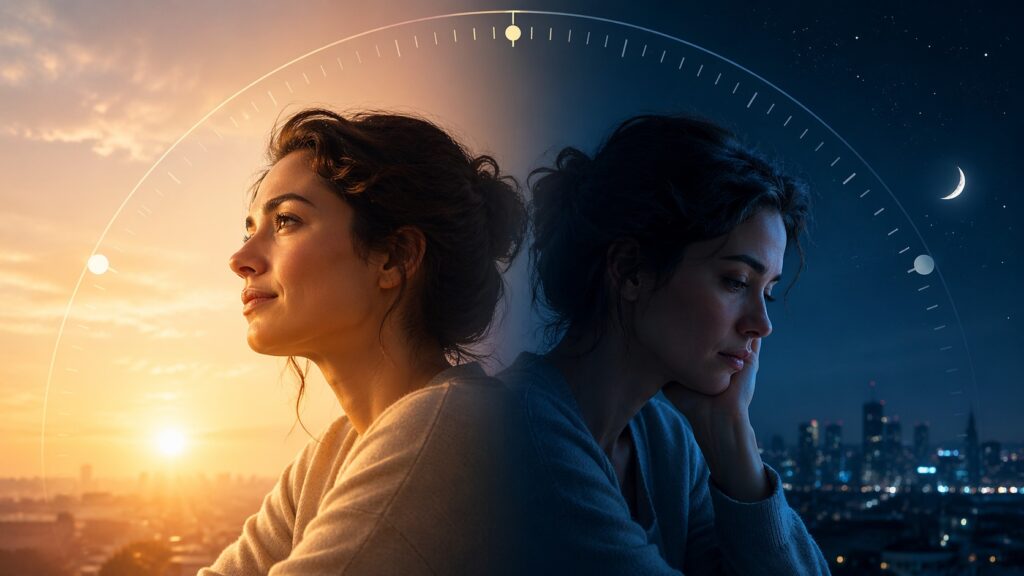
We feel happier in the morning than at night, and science has proven it
The world looks different in the morning, and this is not just folk wisdom. A large British study based on nearly one million observations confirmed that people truly feel better in the morning, while their mental state worsens toward midnight. The effect is small but consistent, and it’s driven by more than just biology.
People Are Happier in the Morning Than at Night
British scientists analyzed data from more than 49,000 adult residents of England, collected as part of a large-scale social study from March 2020 to March 2022. Over two years, participants completed nearly one million questionnaires, with each person responding approximately 18.5 times on average.
Researchers assessed six parameters: depression symptoms, anxiety symptoms, feelings of happiness, life satisfaction, sense of life’s meaningfulness, and loneliness. This is important because mental health is not a single simple scale. A person can be simultaneously anxious yet satisfied with life. Or lonely but not depressed.
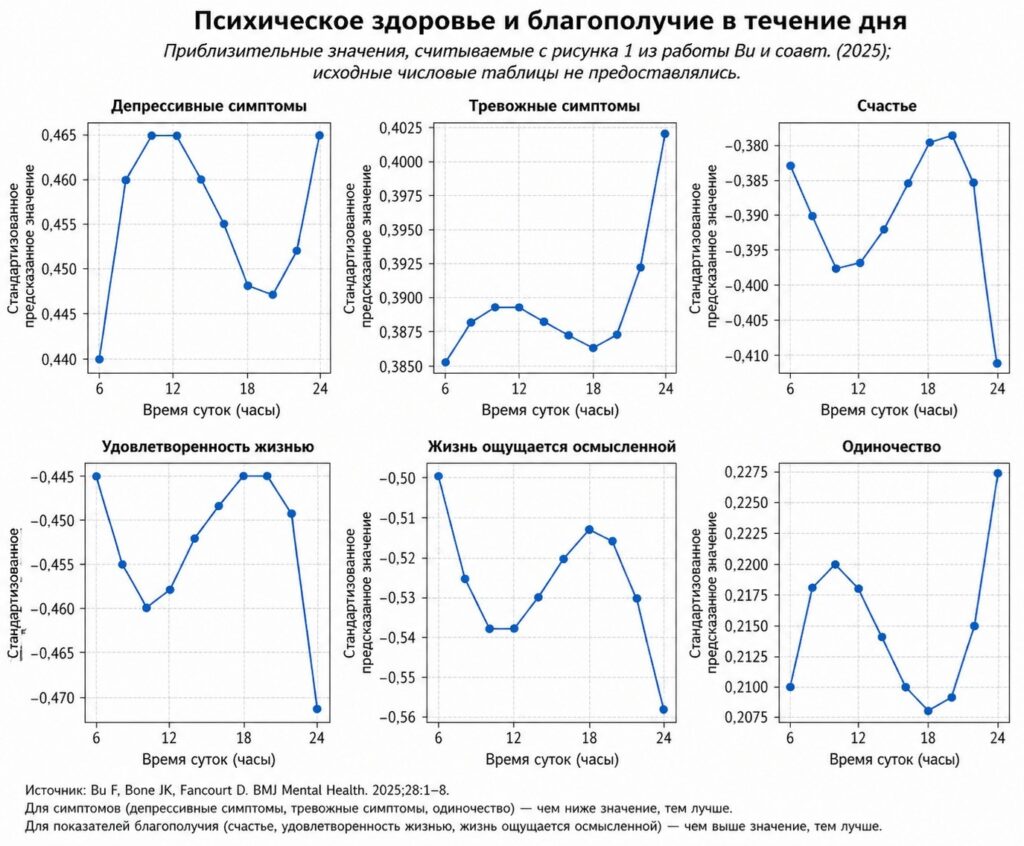
The result was consistent: people who filled out questionnaires in the morning reported the lowest levels of depression, anxiety, and loneliness, as well as the highest happiness, satisfaction, and sense of meaning. By midnight, the picture became noticeably worse. The work was published in the journal BMJ Mental Health in February 2025.
The Difference Between How We Feel in the Morning and at Night
The difference between early morning and midnight was small in statistical terms but consistent. The gap in depression and anxiety symptoms was about 10% of the standard deviation, while well-being indicators showed a gap of about 15%. This isn’t a dramatic drop — more of a quiet shift — but it persisted even after researchers adjusted the data for age, sex, ethnicity, education level, and diagnosed medical conditions.
An important detail: the original sample was uneven — 76.5% were women, 68% had higher education, and ethnic minorities represented only 6% of participants. Therefore, the scientists weighted the data to better reflect the actual population composition of England. Even after this correction, the daily pattern of deterioration toward night remained stable.
The six parameters behaved differently. Happiness and life satisfaction gradually declined toward midnight. The sense of life’s meaningfulness showed the strongest daily pattern: it peaked in the morning, dropped by midday, recovered slightly by evening, and then sharply dipped toward midnight. Loneliness, however, barely changed throughout the day or depending on the day of the week. The authors believe that loneliness behaves more like a stable personality trait rather than a fleeting experience.
Monday Is Not the Worst Day of the Week
Office folklore paints Monday as the hardest day. But the study data showed a different picture.
Happiness, life satisfaction, and sense of meaningfulness were slightly higher on Monday and Friday compared to Sunday. Depression symptoms, however, were higher on Wednesday and Thursday. Anxiety was elevated nearly every day except Friday.
But the most interesting day-of-week effect isn’t “which day is worse” — it’s how the day itself is structured. On weekends, happiness and life satisfaction fluctuated significantly: a peak in the morning, a dip by noon, a rise in the evening, and another drop toward midnight. On weekdays, the curve was flatter — work routines, obligations, and schedules seem to smooth out emotional swings.
Overall, the day of the week had a much weaker effect on well-being than time of day and season.
Mood changes throughout the day
How Seasons Affect Mood
Seasonal influence on mood turned out to be stronger than the influence of the day of the week. Compared to winter, in spring, summer, and autumn people reported less anxiety, depression, and loneliness, and greater happiness and satisfaction. People felt best in summer, across all six parameters.
This aligns with the well-studied phenomenon of seasonal affective disorder — a winter form of depression linked to shorter daylight hours. But here’s an interesting detail: the season did not change the daily pattern. Mornings were still better than nights — both in winter and summer. If everything were determined solely by daylight length, the morning-to-night difference should have varied significantly from season to season. But that didn’t happen. This suggests that something beyond the amount of light is behind the daily rhythm of mental state.
The Role of Biological Clocks and Cortisol
The most obvious candidate is circadian rhythms — the body’s internal biological clocks. They control not only sleep and wakefulness but also hormone release, body temperature, inflammation levels, and even mood.
Cortisol, a hormone involved in regulating stress, energy, and motivation, reaches its peak concentration in the morning (around 7:00–8:00 AM) and drops to its lowest levels around midnight. The morning cortisol surge helps the body mobilize: it increases alertness, provides energy, and prepares for the day’s demands. By evening, cortisol levels decline, giving way to melatonin, the sleep hormone.
But biology is only half the story. The study authors emphasize that physiological processes don’t distinguish between Wednesday and Sunday, yet daily patterns on weekdays and weekends are still different. This means social factors also influence the daily course of mood: daily routines, types of activity, and social interaction.
In other words, our biological clocks set the baseline rhythm, while schedules, work, and social life adjust its shape.
How the Pandemic Affected Our Mental Health
This is an observational study, meaning it cannot establish cause and effect. It’s possible that time of day truly affects well-being. But the reverse is also possible: people who feel better in the morning simply fill out questionnaires more often at that time, while those who feel worse postpone the survey until late evening.
Additionally, all data were collected during the COVID-19 pandemic — with lockdowns, fear, isolation, and disruption of normal life rhythms. Participants’ mental health steadily improved from 2020 to 2022, which is unsurprising: the first year of the pandemic was the hardest.
The study also did not account for data on sleep cycles, latitude of residence, and weather — all factors that can also affect well-being. The authors themselves call for the study to be replicated under normal conditions to confirm the results.
What Nighttime Pessimism Means in Practice
The easy takeaway would be: just go to sleep, it’ll be easier in the morning. And often this actually works, because sleep reduces emotional reactivity, restores cognitive resources, and morning light helps synchronize biological clocks.
But the study doesn’t reduce mental health to the advice “sleep on it and everything will pass.” Depression, anxiety, and loneliness don’t vanish at dawn. Many people wake up to the same debts, diagnoses, conflicts, and losses they fell asleep with.
The main finding is more nuanced and useful. It tells us that mental suffering has a rhythm. Midnight is the time when everything feels more acute. Midweek and winter add their own burden. The authors directly state: this information should be taken into account when planning mental health services — for example, by providing enhanced support during nighttime hours.
Understanding daily fluctuations can also suggest when support resources are needed most and when it’s important not to mistake nighttime hopelessness for a final verdict. If everything feels unbearable at midnight, it’s worth remembering: this is partly your biological clock. Morning won’t solve all your problems, but your brain will look at them from a different angle.