Elephants don’t simply walk past the remains of their own kind. Field observations consistently show that when an elephant dies, other herd members approach the body, stand beside it for extended periods, and carefully examine it with their trunks and feet. Sometimes they gently nudge the fallen animal with their tusks, as if trying to help it stand. And remarkably, some individuals return to the site days or even later, when only dry bones remain. Why they do this is still debated, but researchers already have several compelling hypotheses.
What you need to know
- In controlled experiments in Kenya’s Amboseli National Park, elephants consistently chose to examine elephant skulls over those of rhinoceroses or buffalo, but did not distinguish between the skull of a known family matriarch and those of strangers.
- Elephants have been observed guarding bodies from predators, carrying bones and tusks tens of meters away, and covering carcasses with branches, leaves, or soil.
- The popular myth of secret “elephant graveyards” has no scientific support; mass bone accumulations are explained by drought-related die-offs near dried-up water sources.
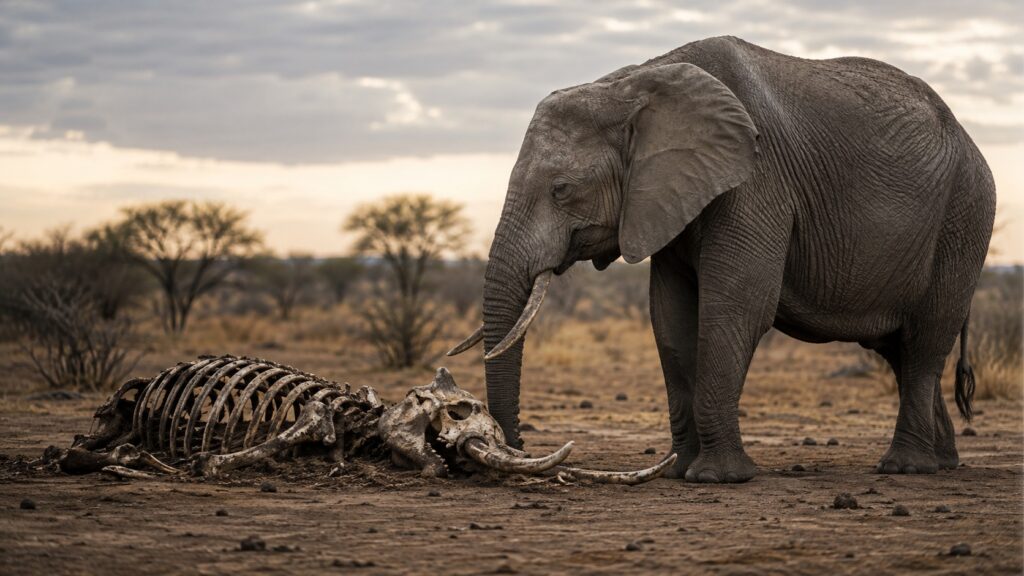
Elephants frequently examine the bodies of deceased herd members, and scientists have probable explanations for the behavior.
How elephants respond to death
Zoologists have documented dozens of cases in which elephants exhibit a recognizable set of behaviors around the dead. These include:
- Remaining near the body for prolonged periods;
- Guarding the carcass from predators;
- Carrying individual bones and tusks tens of meters from the original site;
- Covering the body with branches, leaves, or soil.
These behaviors are not limited to close relatives. One well-known case involved a matriarch named Eleanor. After she died, individuals from five different family groups visited her body over the course of a week — many of them unrelated to her. Eleanor’s daughter was observed with heavy secretion from her temporal glands, a reliable physiological indicator of intense stress and arousal in elephants.
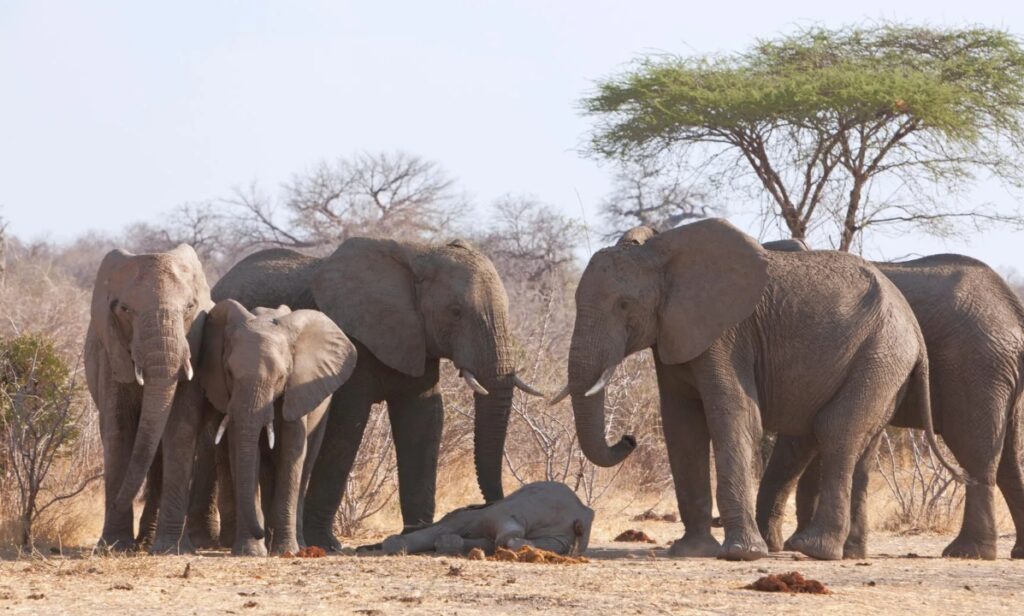
Elephants gathered around a dead member of their species. Image source: spektrum.de
The skull experiment: recognition or general interest?
Skeptics long argued that elephants were simply curious about any novel object. To test this, zoologist Karen McComb conducted a series of experiments in Kenya’s Amboseli National Park in the early 2000s.
Researchers placed three skulls — one elephant, one rhinoceros, and one buffalo — in front of several wild elephant families. The result was unambiguous: elephants deliberately approached the elephant skull, spending considerable time examining it with their trunks, while largely ignoring the rhinoceros and buffalo remains. A piece of tusk likewise attracted far more attention than an ordinary piece of wood.
The researchers then added a layer of complexity. They presented families that had recently lost their matriarch with three elephant skulls: one belonging to their own deceased leader and two from completely unfamiliar females. The expectation was that the elephants would recognize “their own.” But that did not happen — all three skulls attracted equal interest.
This was an important finding. When an elephant visits the remains of its mother, it does not necessarily mean it has identified her specific bones. Rather, the remains of any member of their species appear to trigger a compelling urge to stop and investigate.
Why skulls and tusks get special attention
Elephants pay particular attention to skulls and tusks. There is no definitive explanation yet, but the leading hypothesis is rooted in how elephants communicate during life. As highly intelligent social animals, they constantly touch one another with their trunks, faces, and tusks. These body parts are therefore strongly associated with social interaction, which may explain why they draw the most attention after death.
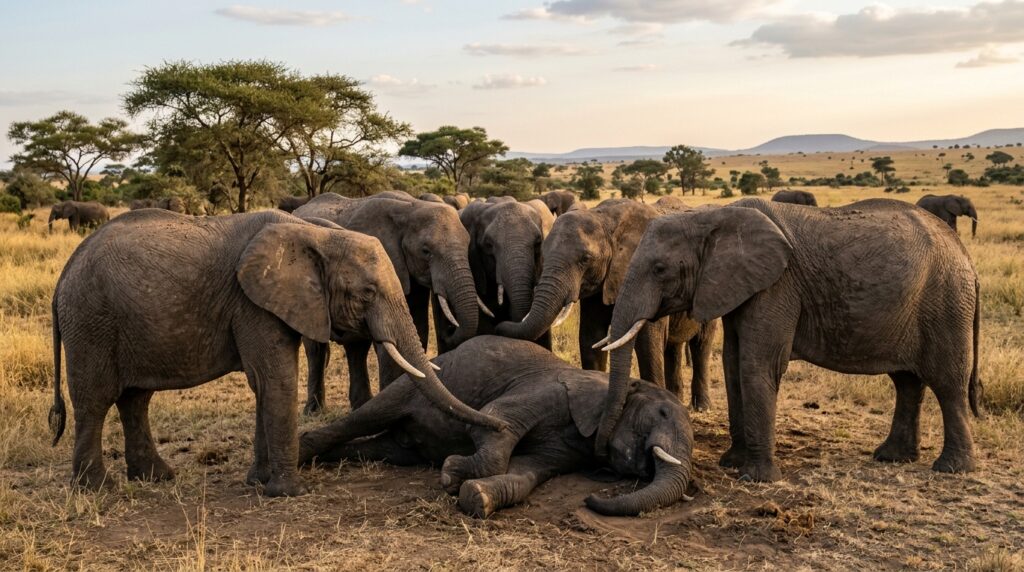
Elephants visit the bodies of their kind even when they are not relatives.
The myth of secret elephant graveyards
One of the most persistent myths holds that aging elephants sense their approaching death and retreat to secret burial grounds. No such elephant graveyards exist. Large accumulations of bones have indeed been found, but they are explained by severe droughts that kill entire herds near dried-up water sources.
Cases of elephants covering bodies with branches and soil, however, do occur regularly. In India, elephant calves have been found buried in drainage ditches. Yet herds reportedly avoided these sites afterward and did not return to them — a pattern that contradicts the popular notion of “grave visiting.”
What science can and cannot say
Ethologists remain cautious in their conclusions. Researchers prefer the term “death-related behavior” over “grief,” deliberately avoiding the attribution of distinctly human emotions to animals. Scientists cannot yet determine whether elephants understand the irreversibility of death or recall shared experiences with the deceased.
But the observable fact remains striking: even years later, when nothing but a dry skeleton is left, the sight of it can bring an entire herd to a halt.