Putting a fresh loaf in the refrigerator does slow mold, but it makes bread go stale faster than leaving it on the counter. The reason is that bread spoils through two separate processes: mold growth and starch retrogradation, the internal change that turns a soft crumb hard and dry. Standard fridge temperatures of roughly +2 to +6 °C suppress the first process while accelerating the second. For bread you plan to eat within a few days, a breathable wooden bread box or a linen or cotton bag at room temperature works best; for longer storage, slicing and freezing the loaf preserves it far better than the fridge.
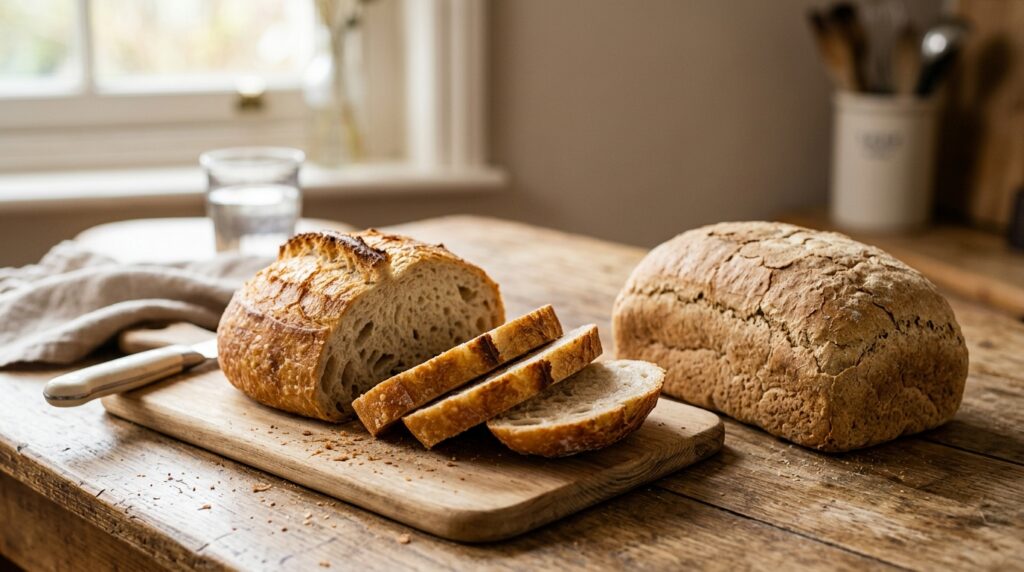
Many people store bread incorrectly, which is why it loses its taste
What you need to know
- Bread spoils in two ways: mold growth and starch retrogradation (staling). A fridge slows the first but speeds up the second.
- According to the source, starch molecules rearrange fastest at typical refrigerator temperatures of +2 to +6 °C, so refrigerated bread hardens within a couple of days.
- For 2–4 days of storage, a dark, dry spot at around 18–22 °C in a wooden bread box or a linen/cotton bag is recommended.
- For a week or longer, slice the loaf and freeze it at about -18 °C, where both staling and mold growth effectively stop.
Two ways a loaf goes bad
When people think of spoiled food, they usually picture green mold spots. For baked goods, however, mold is only the final stage. An invisible process starts much earlier: staling.
Fresh bread holds a lot of moisture. During baking, the starch in the flour is heated intensely and turns into a soft, gel-like mass, which is why a hot crumb is so tender and airy. As soon as the loaf begins to cool, the reverse begins. Starch molecules gradually rearrange into a denser structure that holds water less effectively.
Scientists call this starch retrogradation. A simple analogy: a soft sponge gradually turns into stiff rubber that has had the water squeezed out. Crucially, this happens even in a completely sterile environment with no microbes at all. Staling is not drying out in the literal sense. Even if bread is kept in a sealed space at 100 percent humidity, it will still lose its freshness over time because of changes inside the starch itself.
The paradox of low temperatures
This is where the most common household storage mistake lies. A typical refrigerator runs at +2 to +6 °C, and according to the source, that is precisely the range in which starch molecules rearrange most quickly.
The result is a paradox. At room temperature a loaf stays soft longer but molds sooner. In the fridge, microbes effectively go dormant, yet the bread rapidly hardens. The refrigerator does not freeze time for the product; it simply changes the reason you end up throwing it away.
Experts at the Russian consumer quality body Roskachestvo have pointed out that cold is not a universal way to preserve flavor. The source draws a parallel with tomatoes, which lose aroma and turn mealy in the fridge; baked goods undergo a similar transformation that destroys their original texture.
The hidden downside of plastic bags
If you leave bread on the counter, it seems logical to tie it tightly in a plastic bag to keep it from drying out. But standard store packaging poses a real problem for longer storage.
Fresh bread keeps releasing moisture even after it has fully cooled. If that water cannot evaporate, condensation forms inside the bag. A warm, humid environment with no ventilation is an ideal greenhouse for mold spores, which are always present in the air, on hands, and on kitchen surfaces.
Mold takes hold especially fast because of several typical mistakes:
- Bagging bread while it is still warm, before the moisture has had a chance to escape.
- Storing the loaf next to the stove, where temperature and humidity swing constantly.
- Slicing bread with a dirty knife that was previously used for cheese or butter.
- Using an old bread box that has not been emptied of crumbs carrying fungal spores.
Different kinds of bread also behave very differently. A classic white loaf goes stale and molds the fastest. Rye bread lasts longer because of the higher acidity of its sourdough starter; the acidic environment makes it harder for microbes to multiply. Breads with additions such as seeds, nuts, or dried fruit spoil quickly, since the fillings give microorganisms extra moisture and nutrients.
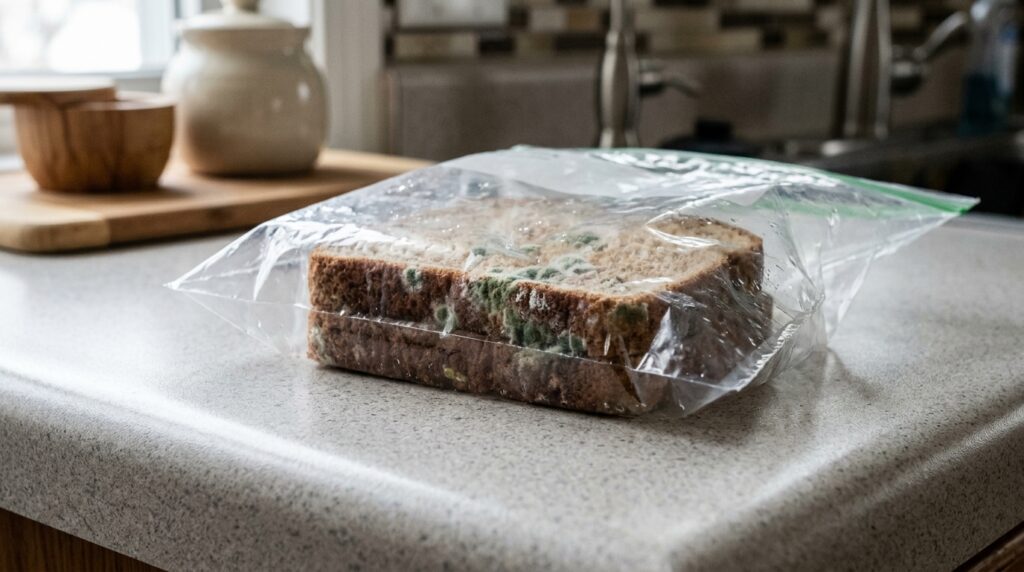
A plastic bag often creates a greenhouse effect in which mold quickly takes hold
Best conditions for a soft crumb
So where should a loaf go if you plan to eat it within 2–4 days? The bread needs to breathe without drying out.
The recommended option is a dark, dry place at room temperature, around 18–22 °C. Classic wooden bread boxes or dense fabric bags made of linen or cotton work best. Wood and natural fabric act as natural humidity regulators: they keep the crumb from turning into a rusk while letting through enough air to keep fuzzy mold from blooming on the crust.
The freezer for long-term storage
If you buy bread in advance and it sits for a week or longer, the most effective and underrated method is freezing.
At around -18 °C, starch aging virtually stops and mold spores cannot develop at all. After proper thawing, the bread will be noticeably fresher and softer than after three days in the main compartment of a refrigerator.
To make freezing convenient, the source suggests the following steps:
- Slice the fresh loaf into neat portion-sized pieces.
- Divide the slices into small batches you can eat in one sitting.
- Pack the portions tightly into containers or freezer bags, squeezing out as much excess air as possible.
- Take out slices as needed.
Slices can be thawed at room temperature or warmed briefly in a toaster or oven. A short burst of intense heat returns the starch structure toward its original state, making the crumb tender again.
When the fridge still makes sense
Storing bread in a regular refrigerator is reasonable in only one situation: if your home is very hot and humid and any baked goods reliably mold by the second day. Even then, expect the crumb to become tough, and plan to reheat it before eating.
The bottom line: the refrigerator does not extend a loaf’s youth, it simply gives it a different fate. For short-term storage, use a breathable bread box on the counter; for longer stocks, slice the loaf and put it in the freezer.