For decades, textbooks and popular science articles offered a tidy explanation for how perching birds sleep without tumbling to the ground: their tendons supposedly lock automatically around the branch, like a mechanical clamp. But experiments have shown this story is far too simple. The real answer involves foot anatomy, low center of gravity, tendon assistance, and — crucially — a brain that never fully switches off its balance systems, even during sleep.
What you need to know
- Experiments by researchers Peter Galton and Jeffrey Shepherd on European starlings found that sleeping birds do not clamp branches tightly — most toes remain extended, forming a U-shaped “saddle” around the perch.
- When starlings were fully anesthetized, they fell from their perches, and manually bending their legs did not trigger an automatic locking grip.
- Birds’ nervous systems maintain partial muscle tone during sleep, with the brain continuously making micro-adjustments to posture — unlike humans, whose muscles go largely limp during REM sleep.
- Great frigatebirds can sleep in flight during multi-day ocean crossings, logging as little as about 42 minutes of slow-wave sleep per day aloft.
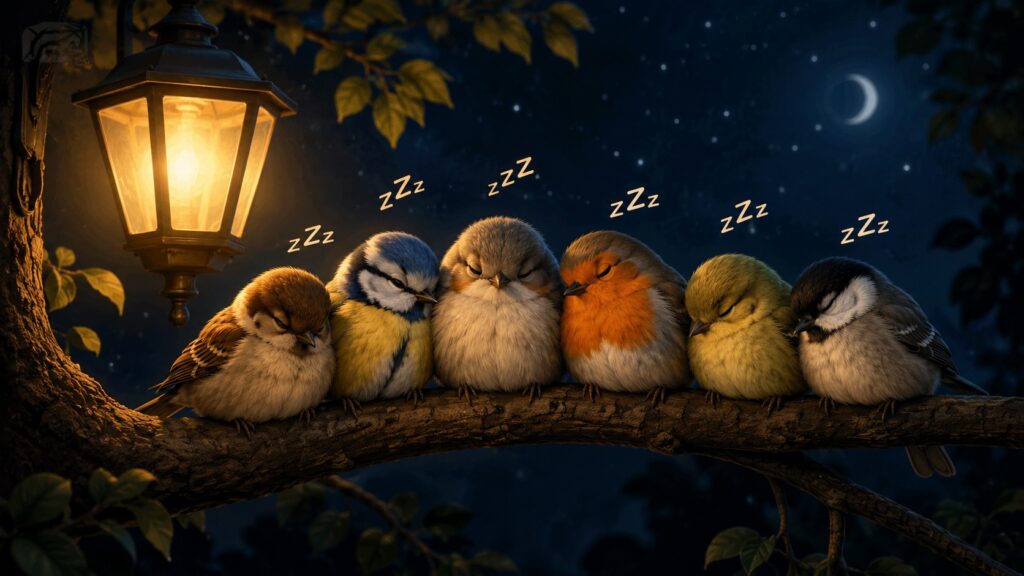
An experiment debunked some myths about how birds sleep
The bird foot works like a natural saddle, not a padlock
Most tree-dwelling birds have feet well adapted for gripping cylindrical surfaces. Typically three toes point forward and one backward, wrapping around a branch while claws hook into bark irregularities.
When a bird lands and bends its leg joints, long tendons tighten, helping the toes curl around the perch. This mechanism genuinely reduces the effort needed to stay put. But geometry matters just as much: a small bird’s body sits directly above the point of support, and its short legs minimize the risk of tipping. A well-chosen perch functions for a bird much like a deep, well-shaped armchair does for a person — little effort is needed to avoid sliding off.
The ‘automatic lock’ myth doesn’t hold up under anesthesia
Researchers Peter Galton and Jeffrey Shepherd conducted experiments with European starlings that challenged the popular lock-grip narrative. They found that sleeping starlings do not clench the branch tightly. Most of the toes actually remain extended. The foot forms an inverted U shape around the perch — essentially a saddle on which the bird balances.
The decisive test came with anesthesia. When starlings were rendered fully unconscious, they fell from their perches. Manually bending the legs of anesthetized birds also failed to produce an automatic death grip. The tendon mechanism does exist — microscopic ridges on the tendons help reinforce the hold — but it functions more as a way to reduce muscular load than as an on-off switch that replaces muscles entirely. The bird remains an active living system that requires muscle tone to control its posture.
How the avian brain keeps balance during sleep
Comparing bird sleep to human sleep is misleading. When humans enter REM sleep, muscles relax profoundly to prevent us from physically acting out dreams. In birds, REM episodes are much shorter, and the nervous system maintains partial muscle tone throughout. The brain sleeps, but the balance-control systems stay alert, automatically making microscopic corrections to muscle tension.
Some species take this further with unihemispheric sleep. Ducks roosting at the edge of a flock can literally sleep with half their brain. One hemisphere rests while the other stays awake, keeping the outward-facing eye open. This allows the birds to recover energy while simultaneously watching for predators on behalf of the group.
Sleeping on one leg and sleeping in flight
Perch-sleeping is far from the most remarkable sleep adaptation in birds. Flamingos routinely doze while standing on a single, extraordinarily long leg. Their biomechanics allow the joints to lock in that posture with minimal energy expenditure, and the center of gravity sits directly above the supporting foot. Research indicates that a sleeping flamingo actually sways in the wind less than an awake one. By tucking the second leg and burying the bill in feathers, flamingos also reduce heat loss through exposed body surfaces.
Perhaps the most astonishing feat belongs to great frigatebirds, which can sleep during multi-day flights over the open ocean. Brain-activity sensors have shown that airborne frigatebirds enter brief bouts of slow-wave sleep. Over a full day of continuous flight, a frigatebird may accumulate only about 42 minutes of sleep, easily compensating with extended rest once back on land.
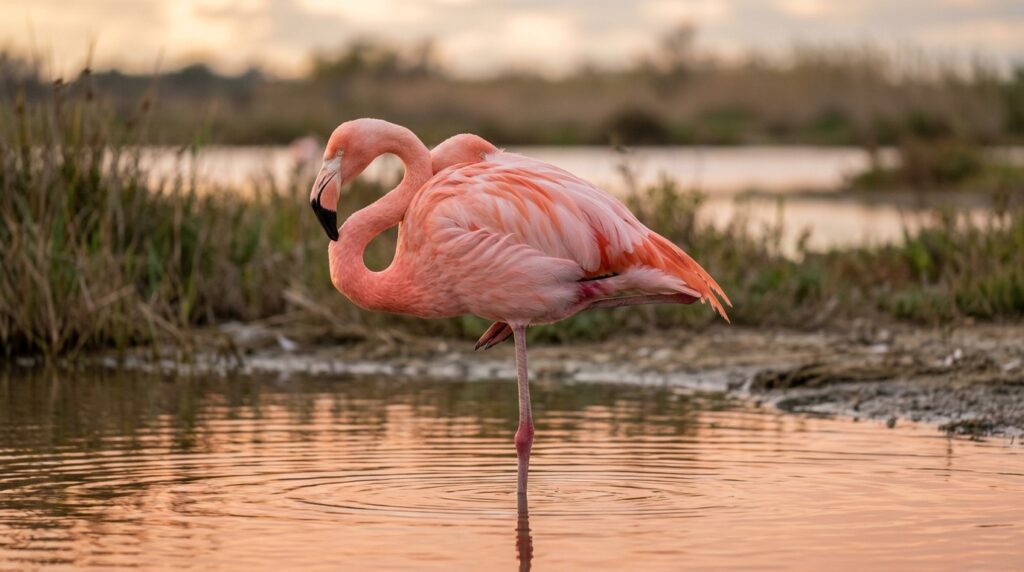
Sleeping on one leg is not only a way to maintain balance but also an ideal mechanism for conserving heat
A neat myth gives way to a richer explanation
The appealing idea that a bird’s foot simply snaps shut like a carabiner has given way to a far more complex — and more impressive — picture. Birds stay on their perches thanks to the coordinated interplay of multiple factors:
- An anatomically convenient foot shape that works as a saddle around the branch;
- Tendon assistance that reduces load but does not replace active muscle control;
- A low, well-centered center of gravity;
- A brain capable of maintaining functional muscle tone even during unconscious states.
A sleeping bird on a branch is not a passive object clipped in place. It is an active living system that continues to finely manage every aspect of its balance — even in deep sleep.