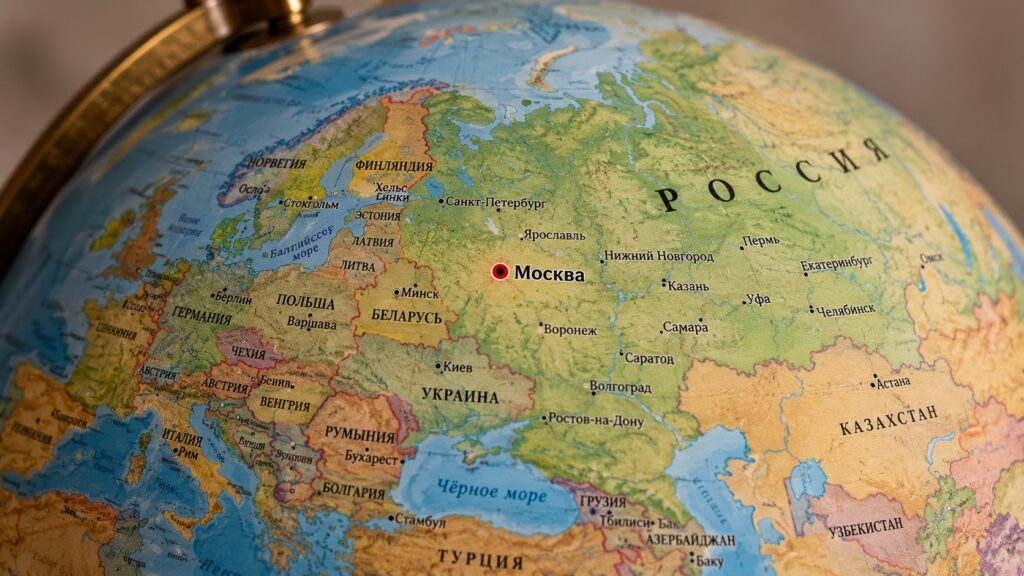
Moscow on a globe
If you could drill a straight hole from Moscow through the center of the Earth, you would come out in the open ocean. Moscow’s antipode is the point exactly opposite it on the globe. It lies in the southern Pacific Ocean, roughly between New Zealand, South America and Antarctica. The spot is about 2,050 kilometers from one of the nearest pieces of land and thousands of kilometers from the nearest people. Here is what that spot is like, why the weather there is so rough, and how to find the antipode of any city yourself.
What you need to know
- Moscow sits at about 55.75° N, 37.62° E. Its antipode is at about 55.75° S, 142.38° W, in the South Pacific.
- One of the nearest pieces of land is tiny, uninhabited Maher Island off Antarctica, about 2,050 km away. One of the nearest settlements is Waitangi in New Zealand’s Chatham Islands, about 2,750 km away.
- The point lies in the “Furious Fifties,” a belt of strong westerly winds between 50° and 60° south.
- A tunnel through the planet would be about 12,700 km long. The shortest route over the surface is about 20,000 km.
Moscow’s antipode lies between New Zealand and Antarctica
Moscow’s coordinates are approximately 55.75° north latitude and 37.62° east longitude. Its antipode is therefore at 55.75° south latitude and 142.38° west longitude. On a map, that is the southern part of the Pacific Ocean, roughly between New Zealand, South America and Antarctica.
There is one subtlety. Many people assume that this close to Antarctica you are already in the Southern Ocean. However, its northern boundary is most often placed at the 60th parallel south. Moscow’s antipode lies slightly north of that line, so formally it is still in the Pacific.
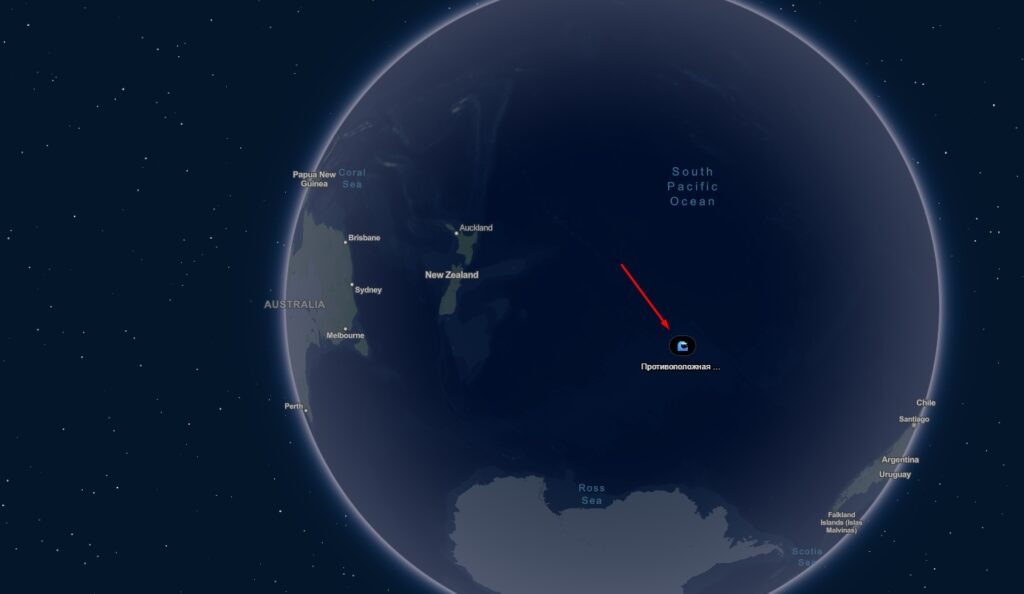
Moscow’s antipode on a map
The nearest land is about 2,050 kilometers away
One of the closest pieces of land is Maher Island, off the coast of Antarctica. It is tiny, uninhabited and horseshoe-shaped, with bare rock visible in places. It lies roughly 2,050 kilometers from Moscow’s antipode.
People are even farther away. One of the nearest settlements is Waitangi, in New Zealand’s Chatham Islands, about 2,750 kilometers away. That is more than the distance from Moscow to many European cities. In other words, on the far side of the planet from one of the world’s largest cities, there is no one for thousands of kilometers around.
The “Furious Fifties”: wind with nothing in its way
Sailors call the belt between 50° and 60° south latitude the “Furious Fifties.” Strong westerly winds blow there almost constantly, and storms whip up enormous waves. Moscow’s antipode falls within this belt.
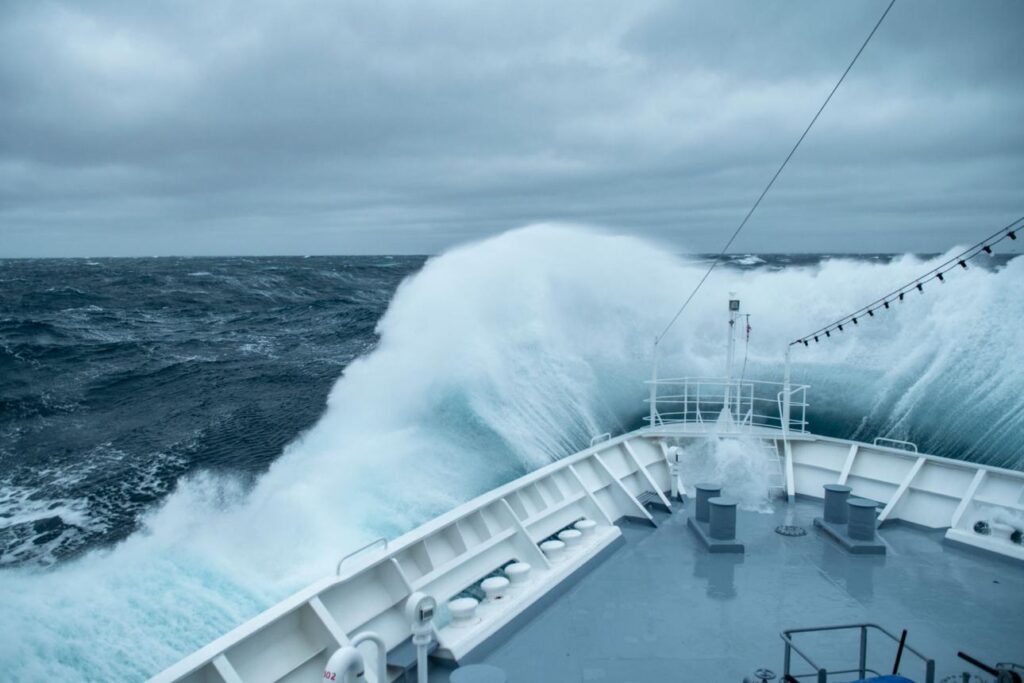
A large wave breaking over the bow of a ship on the open sea
The explanation is simple. At these latitudes there are almost no large continents to block or slow the wind. In the Northern Hemisphere, moving air constantly runs into the mountains and plains of Europe, Asia and the Americas. Here, it travels thousands of kilometers over open water and has room to build up considerable speed.
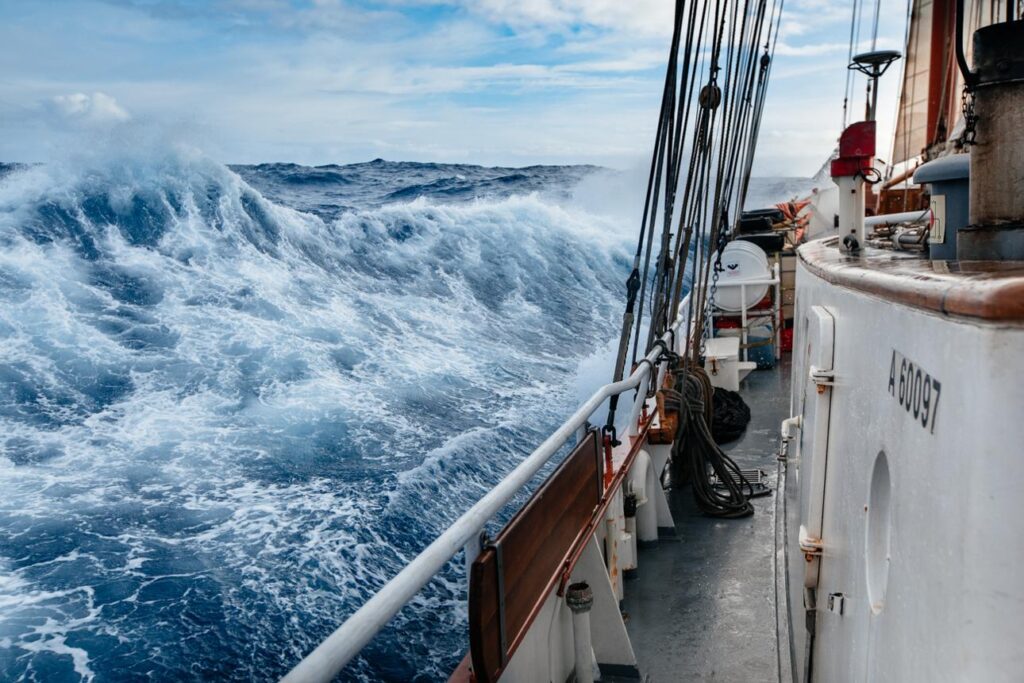
A sailing ship amid high waves on the open sea
That does not mean the storm never stops at this point. Calm weather happens too. Overall, though, the sea here is much colder and harsher than at familiar beach destinations.
Winter when Moscow has summer, midnight when Moscow has noon
The seasons at the antipode are the reverse of Moscow’s. When it is summer in Moscow, it is winter in this part of the ocean, and vice versa. That is because the Northern and Southern Hemispheres receive the most solar heat in different months.
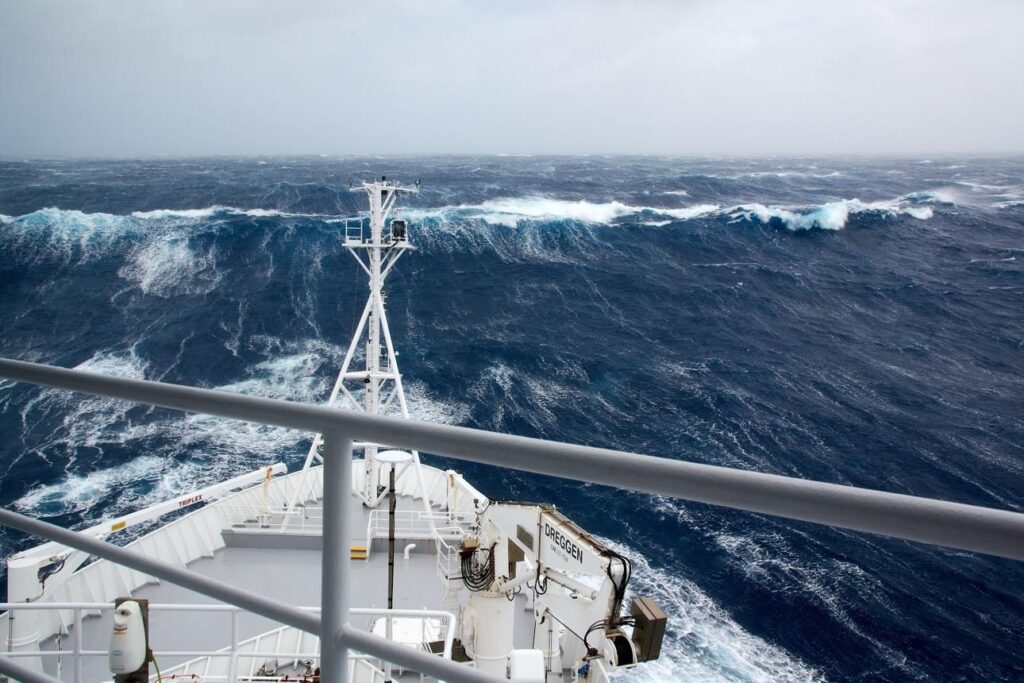
A ship in a stormy sea with high waves and white foam
The same applies to the time of day. Solar time is time based on the Sun’s position rather than on time zones. It differs by roughly 12 hours between two opposite points. When the Sun is at its highest over Moscow, it is approximately solar midnight at the antipode.
Point Nemo is about 1,500 kilometers away
Not far from Moscow’s antipode lies Point Nemo, the place in the ocean farthest from land of any spot on the planet. It is also known as the oceanic pole of inaccessibility. It is named after Captain Nemo from Jules Verne’s novel Twenty Thousand Leagues Under the Sea.
Point Nemo is about 2,688 kilometers from the nearest land, and there are three equally near pieces of it: Ducie Island, the islet of Motu Nui and the same Antarctic Maher Island. The two locations should not be confused, however. Based on their coordinates, Moscow’s antipode and Point Nemo are about 1,500 kilometers apart.
A tunnel through the Earth would be about 12,700 kilometers long
If it were possible to dig a tunnel from Moscow straight down through the center of the planet, it would be roughly 12,700 kilometers long. That is almost the full diameter of the Earth, which averages about 12,742 kilometers.
In reality, such a tunnel cannot be built. The deeper you go, the higher the temperature and pressure. The route would also have to pass through the mantle, the thick, hot layer beneath the crust, and through the core. Scientists still do not know much about the Earth’s core. They study it only indirectly, by observing how seismic waves from earthquakes travel through the planet.
Traveling over the surface instead, the journey would be about 20,000 kilometers. That is the greatest possible distance between two points on a sphere when following the shortest route.
How to find the antipode of any city
You can work out what lies on the opposite side of the Earth from your city in about a minute:
- Look up your city’s latitude and longitude.
- Switch north latitude to south, or south to north, keeping the number of degrees the same.
- Subtract the longitude from 180 degrees, and switch east longitude to west, or west to east.
For Moscow, the calculation looks like this: 180 minus 37.62 equals 142.38. The result is 55.75° south latitude and 142.38° west longitude.
Chances are your city’s antipode will also turn out to be somewhere in the ocean. Water covers most of the planet, so most places on land have antipodes that fall on water as well.