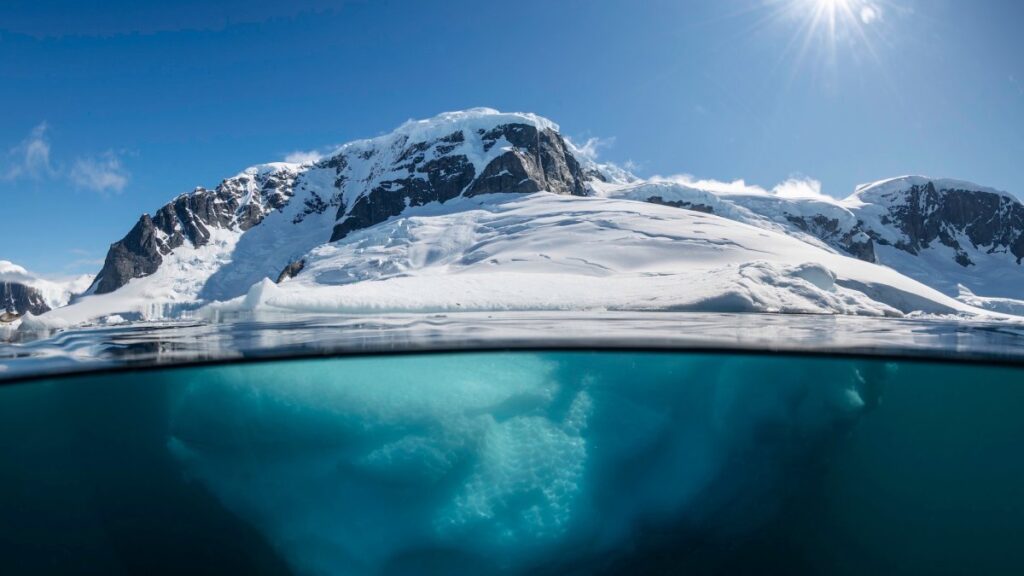
Hot water sources with temperatures of 300 degrees discovered beneath Antarctic ice
Korean scientists have for the first time managed to observe what was previously more of an assumption than a fact. Hydrothermal vents on the Antarctic seafloor at a depth of 1,300 meters, where water temperature exceeds 300°C. While the surface water temperature hovers around minus one degree, streams of superheated fluid saturated with metals and hydrogen sulfide burst from the bottom. And around these streams, life thrives — life that no one had ever seen with their own eyes before. This discovery once again demonstrates how little we know about what lies hidden beneath the ice of our planet.
How Hydrothermal Vents Were Found in Antarctica
The Korea Polar Research Institute (KOPRI) announced the successful completion of an expedition aboard the icebreaking research vessel “Araon.” The team was led by principal investigator Park Seong-hyun. Their target was the Antarctic mid-ocean ridge zone, approximately 1,200 kilometers from Jang Bogo Station on Victoria Land.
This area of open ocean remained one of the most notable “blank spots” on the map of underwater research — too far, too cold, too difficult. No one had previously conducted direct observations of the seafloor here. KOPRI itself called the achievement a world first: for the first time, an unmanned underwater vehicle was sent to Antarctic hydrothermal vents, allowing everything to be examined up close.
Before this expedition, scientists could only study the region indirectly — lowering samplers blindly to the bottom and bringing samples back to the surface. The location, distribution, and ecological structure of the vents remained largely speculative. In 2017, the team confirmed the presence of deep-sea organisms using underwater cameras, and last year they collected approximately 350 kilograms of mineral samples using a dredge (a specialized tool for collecting samples from the bottom of deep bodies of water).
Why Water at 300°C Doesn’t Boil at Depth
Hydrothermal vents are essentially underwater hot geysers. Seawater seeps into cracks in the oceanic crust, is heated by magma at depth, and is expelled back into the ocean. Along the way, it becomes saturated with metals — iron, copper, zinc — as well as hydrogen sulfide and methane, which become fuel for life on the seafloor.
An important point: why doesn’t water at 300°C boil? It’s all about pressure. For every ten meters of depth, pressure increases by one atmosphere. At a depth of 1,300 meters, it is so great that water remains liquid even at temperatures that would have long turned it into steam on the surface.
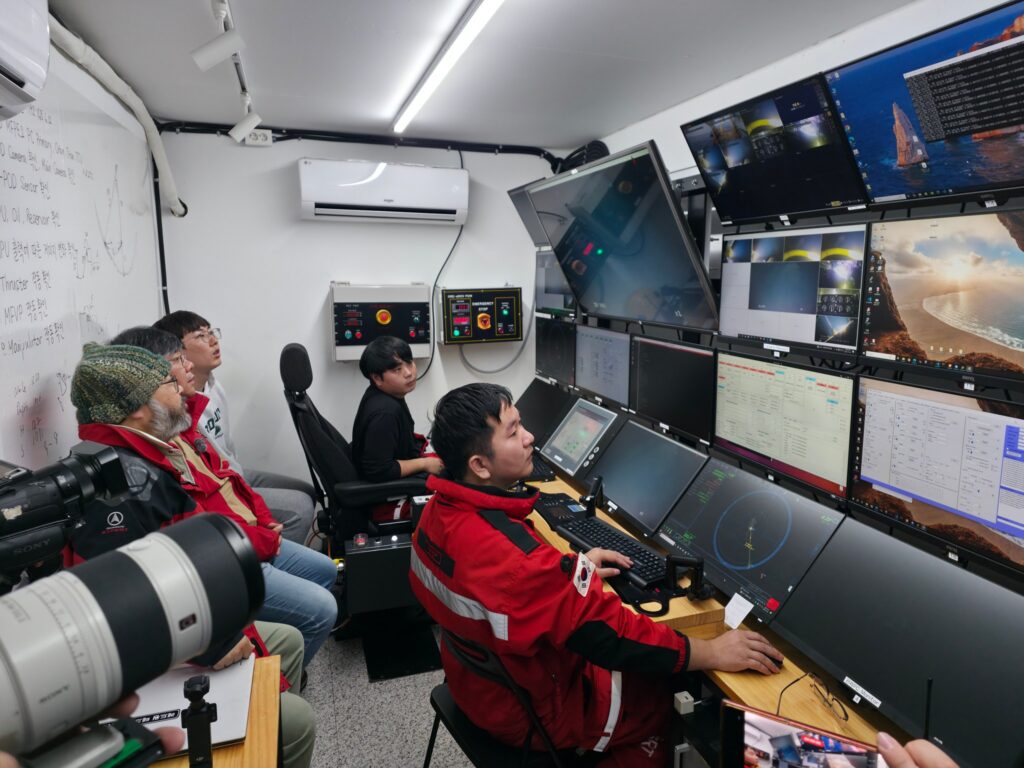
Research team conducting deep-sea exploration using an unmanned underwater vehicle.
At the same time, these vents are unable to noticeably warm the Antarctic ocean. The superheated fluid mixes with the surrounding icy water and cools down literally within a few dozen meters of the discharge point. The temperature of Antarctic waters is still determined by sunlight and global ocean circulation. Hydrothermal vents are localized, pinpoint sources of heat on the ocean floor.
How Organisms Live Without Sunlight in the Ocean
At such depths, sunlight does not penetrate, and photosynthesis is impossible. But life here found another way. Instead of solar energy, local ecosystems use chemical energy — a process called chemosynthesis. Microorganisms break down hydrogen sulfide and methane from hydrothermal emissions and produce organic matter. Essentially, bacteria perform the same role as plants on land, only instead of sunlight they use the chemistry of volcanic vents.
Entire communities are built on this bacterial “foundation.” Some organisms carry symbiotic microbes inside or on the surface of their bodies and receive energy directly from them. In the Pacific and Atlantic Oceans, giant tube worms and mussels typically inhabit areas near hydrothermal vents. But in Antarctic waters, everything is different — here, distinct lineages of crustaceans, mollusks, and echinoderms have evolved.
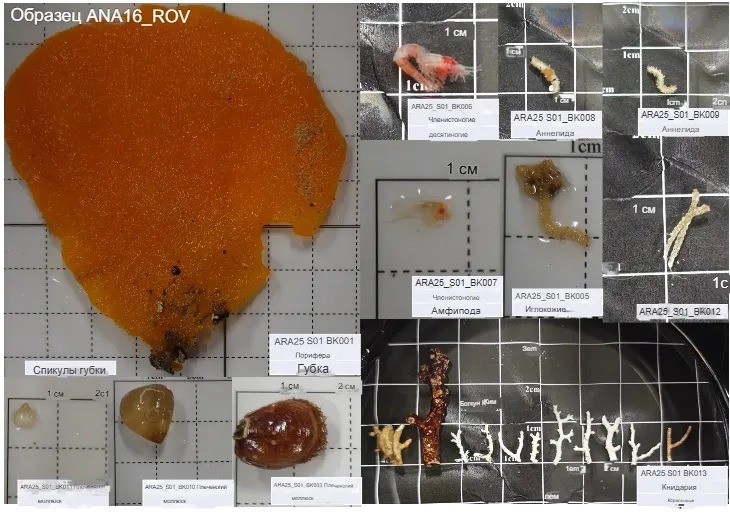
Collected biological samples.
Each such vent is an isolated oasis of life ranging from a few dozen to a few hundred meters in size. Since these oases are separated by kilometers of lifeless seafloor, each one develops its own unique biological community.
Why It’s Difficult to Study Antarctica’s Seafloor
Hydrothermal vents themselves are not new to science. Since the 1970s, they have been discovered in enormous numbers along mid-ocean ridges in the Pacific and Atlantic Oceans. But in Antarctic waters, the situation is different. Although the ridge encircling Antarctica has all the conditions for such vents to exist, detailed on-site research has been extremely rare.
The reasons are mundane but serious. Antarctic waters are located at an enormous distance from inhabited territories. Delivering a team, equipment, and supplies requires weeks or months of sailing. The journey alone consumes colossal resources.
The cost of operating an underwater vehicle is another problem. An unmanned deep-sea vehicle is a complex system requiring the coordinated work of specialists, cables, and a support vessel. When renting equipment, costs multiply: one must pay not only for diving time but also for the entire multi-week voyage, as well as housing for engineers. A typical Antarctic expedition lasts one to two months, but the vehicle can only work underwater for a few days. This ratio makes the financial burden particularly heavy.
A turning point for Antarctic research came with the expedition to the East Scotia Ridge in 2012. At that time, scientists first observed high-temperature hydrothermal emissions at a depth of about 2,500 meters and discovered previously unknown biological communities with new species of “yeti crab,” sea stars, and anemones. This gave grounds to assume that separate ecosystems exist in Antarctic hydrothermal vents. Since then, signs of hydrothermal activity have been detected in several other Antarctic regions, but direct observations of deep-sea ecosystems there remain extremely rare.
How Deep-Sea Drones Work for Research
To overcome the limitations of rented equipment, the KOPRI team decided to take a different approach. Together with a robotics company, they developed their own deep-sea unmanned vehicle called “Ariari.” It is capable of diving to depths of up to 6,000 meters.
“Ariari” fully lived up to expectations in field conditions. Descending to 1,300 meters, it tracked changes in water temperature and chemical composition and recorded an active hydrothermal vent in action. The vehicle filmed “smoking” chimneys — structures ejecting superheated fluid — the surrounding biological communities, and the distribution of minerals. It also selectively collected undamaged samples tailored to the researchers’ specific tasks.
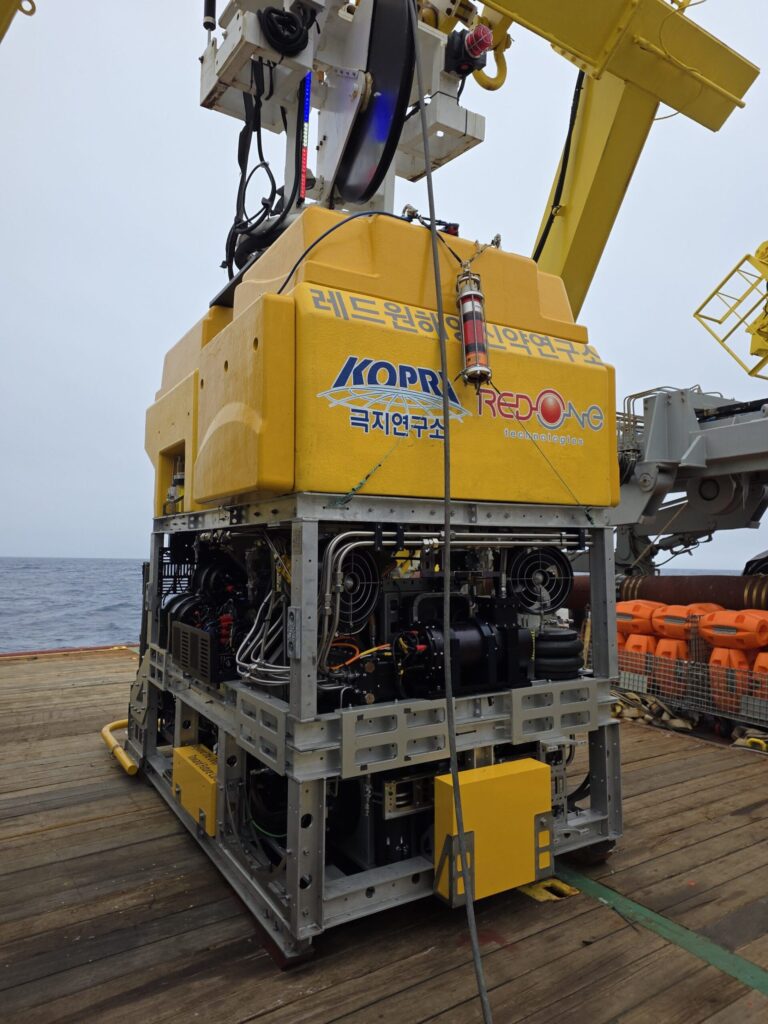
Ariari unmanned deep-sea vehicle.
Using robotic manipulators and suction devices, the team collected 12 deep-sea organisms, including cnidarians, sponges, and echinoderms. Some of these specimens, according to the scientists’ preliminary assessments, may turn out to be previously unknown species. The researchers believe that organisms adapted to such extreme environments could reveal new forms of ecological adaptation.
Beyond biology, the expedition yielded important geological data. The team saw with their own eyes the extensive spatial distribution of sulfide ores rich in copper and zinc around the vents.
“Direct observation of a deep-sea hydrothermal environment on the Antarctic mid-ocean ridge using an unmanned vehicle is a rarity even on a global scale,” noted expedition leader Park Seong-hyun, adding that modern robotics technology enables such research.