If an astronaut became detached from the International Space Station during a spacewalk, the situation would be dire — but not quite the way movies depict it. The astronaut would not plummet toward Earth or hurtle into deep space. Because they share the ISS’s orbital velocity of 7.7 kilometers per second, they would simply drift onto a slightly different orbit around Earth. Even a gentle push of just 10 centimeters per second relative to the station would carry a person six meters away in one minute and tens of meters away within ten minutes. In the vacuum of space, with nothing to create friction, even the slightest momentum becomes relentless. There is a chance of return, but it depends on many factors.
What you need to know
- A detached astronaut would not fall to Earth or fly into deep space — they would enter a slightly different orbit around the planet, drifting away from the ISS gradually.
- American EMU spacesuits carry SAFER, a small emergency jet backpack that lets an astronaut stabilize spin and fly back to the station; Russian Orlan-MKS suits currently lack an equivalent built-in thruster.
- No accidental detachment from a spacecraft has ever occurred in the history of human spaceflight, according to the source’s review of Roscosmos materials and NASA historical records.
- The only untethered spacewalk took place in 1984, when astronaut Bruce McCandless deliberately tested the MMU jet-propulsion unit, traveling up to 100 meters from the Space Shuttle.
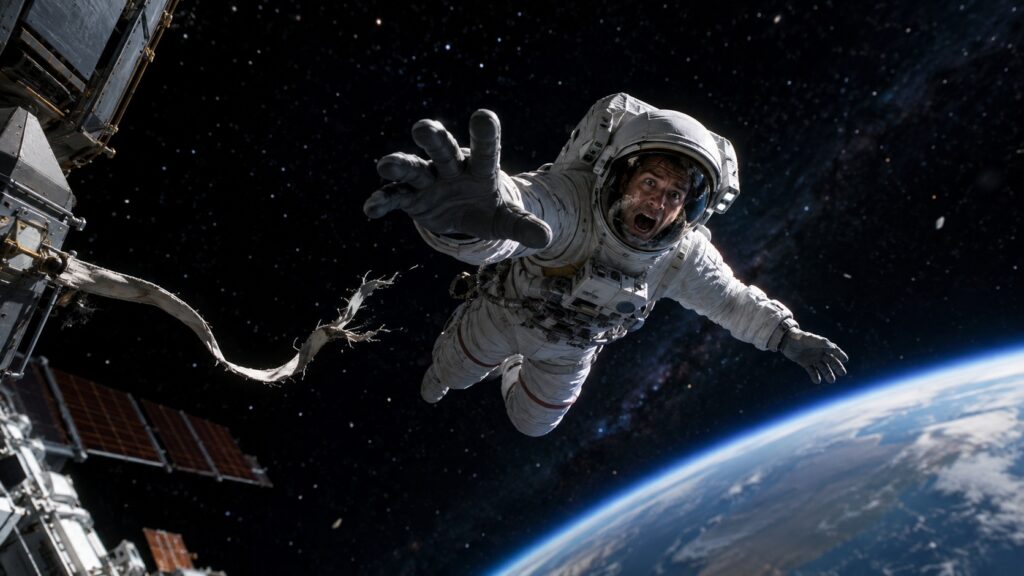
Astronauts could accidentally drift into space, but engineers do everything possible to prevent it
An astronaut won’t fly to the stars — they’ll stay near Earth
The ISS is constantly falling toward Earth, but because of its enormous speed of 7.7 kilometers per second, the planet’s surface constantly “curves away” beneath it, allowing the station to remain in orbit. A person working outside moves around Earth at exactly the same speed.
If an astronaut accidentally lets go of a handrail and loses contact with the station, that enormous velocity doesn’t disappear. They won’t plunge downward — they’ll simply end up on a slightly different near-Earth orbit. The problem lies in the difference in velocities. Even a light push imparting just 10 centimeters per second of relative velocity from the ISS will mean the person is six meters away after one minute, and tens of meters away after ten minutes.
On Earth, friction and air resistance stop us quickly. In vacuum, there is nothing to brake against, so even weak inertia will slowly but relentlessly carry a person away. Moreover, the trajectory will appear strange: due to the laws of orbital mechanics, the astronaut may drift not in a straight line but shift upward, downward, or even along an arc relative to the station.
Why flailing your arms won’t help
A common misconception is that an astronaut could “swim” back by waving their arms and legs. Without air or water to push against, those movements can only change the body’s orientation — they cannot alter its trajectory.
In theory, throwing a heavy tool in the opposite direction could generate a small amount of thrust via conservation of momentum, but in practice it is nearly impossible to aim precisely enough to reach the airlock.
Help from the station itself is also unlikely. The ISS is a massive, unwieldy structure whose maneuvers are carefully pre-calculated; it cannot reverse or turn quickly. Docked spacecraft cannot serve as emergency taxis because undocking requires time and planning. A spacewalk partner could help only in the first few seconds, while the drifting astronaut is still within arm’s reach.
How spacesuits protect against drifting
The survival strategies differ between American and Russian programs because their suits are equipped differently.
The American EMU spacesuit includes a built-in device called SAFER (Simplified Aid for EVA Rescue), a small emergency jet backpack powered by compressed gas. If an astronaut loses contact with the station, they can activate SAFER, stabilize any spin, and use a joystick to propel themselves back toward the ISS. Crews train regularly on simulators for this scenario.
The Russian Orlan-MKS suit does not currently carry a built-in jet backpack. Russian engineers have developed prototypes, but none are integrated into the current suit. Instead, the primary defense is strict tether discipline: cosmonauts follow a two-point restraint rule — two secure carabiners, or one tether plus a firm handhold on the structure — so that at no moment are they without a physical connection to the ISS.
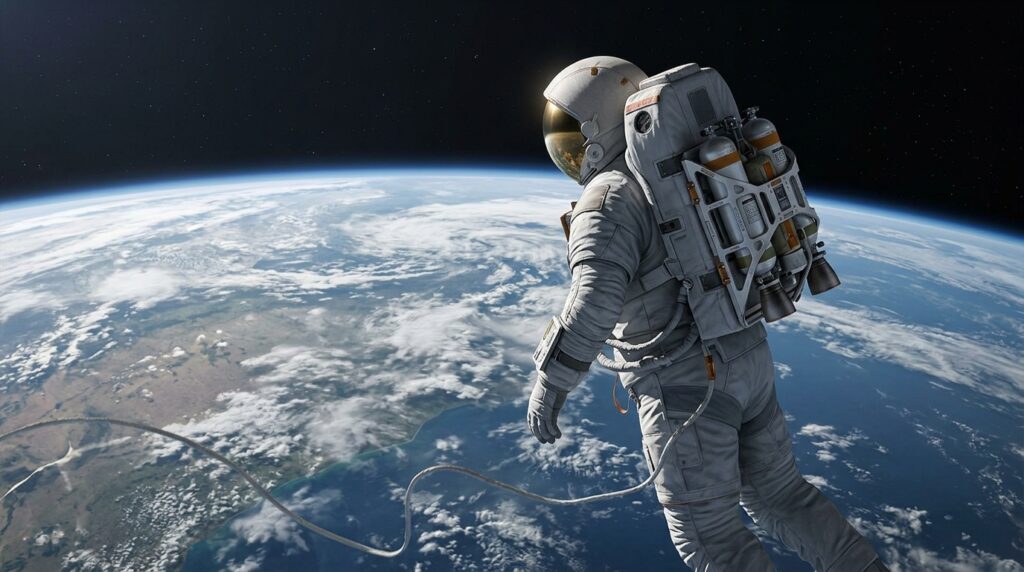
The American SAFER system allows an astronaut to stabilize their body position and return to the airlock
A spacesuit is not a long-term survival vessel
If rescue failed, the astronaut’s greatest threat would not be radiation or the cold of space but the limited resources of the suit’s life-support system. A modern spacesuit is essentially a miniature autonomous spacecraft that maintains pressure, supplies oxygen, and removes carbon dioxide — but its reserves and battery charge last only a limited number of hours. The countdown is measured in hours overall, but effective rescue by a partner would need to happen within the first minutes. When the systems fail, conditions inside the suit become incompatible with life.
The suit itself, however, would continue orbiting Earth for a long time. At the ISS’s altitude there is an extremely thin residual atmosphere whose molecules would gradually slow the object. Only after a prolonged period would the suit descend into denser atmospheric layers and burn up. There would be no dramatic, rapid fall from the sky.
No accidental detachment has ever happened
The famous photograph of a human floating above Earth with no tether shows astronaut Bruce McCandless, who in 1984 deliberately flew up to 100 meters from the Space Shuttle to test the Manned Maneuvering Unit (MMU), a full-sized jet-propulsion backpack. It was not an accident. The MMU was later retired in favor of the compact, emergency-only SAFER system.
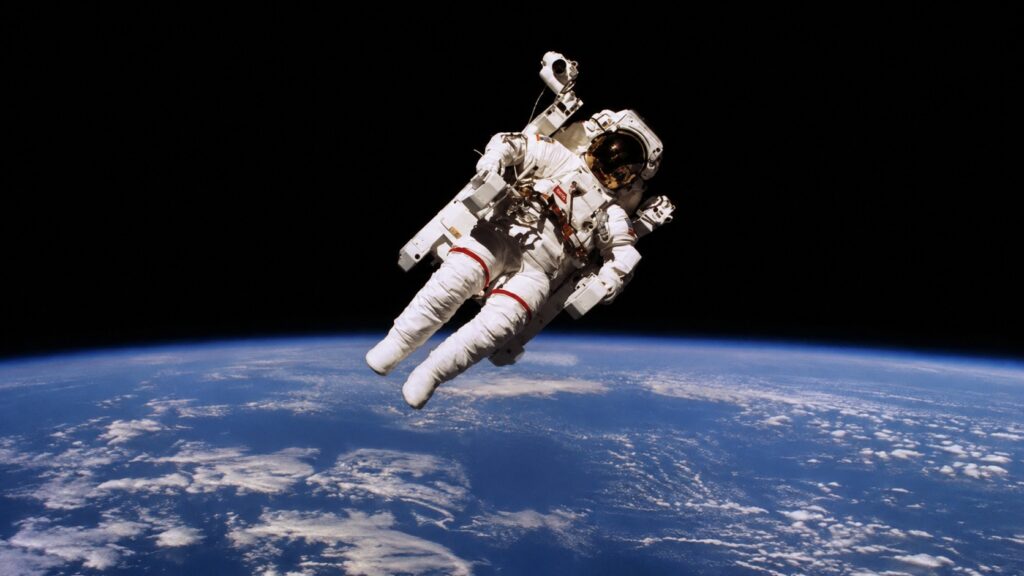
Bruce McCandless during an untethered spacewalk
According to Roscosmos materials and NASA historical records, real spacewalks are protected by multiple overlapping layers of safety designed to completely prevent crew loss:
- Strict use of handrails during every movement;
- Continuous use of two adjustable-length tethers;
- Constant monitoring by a spacewalk partner and Mission Control;
- Tethering of all tools to prevent them from becoming space debris.
Thanks to these rigorous protocols, the cinematic scenario of an astronaut drifting helplessly into the void has remained purely fictional. The physics make it possible, and the consequences would be catastrophic — but engineers and astronauts alike work to ensure the safety tether never fails.