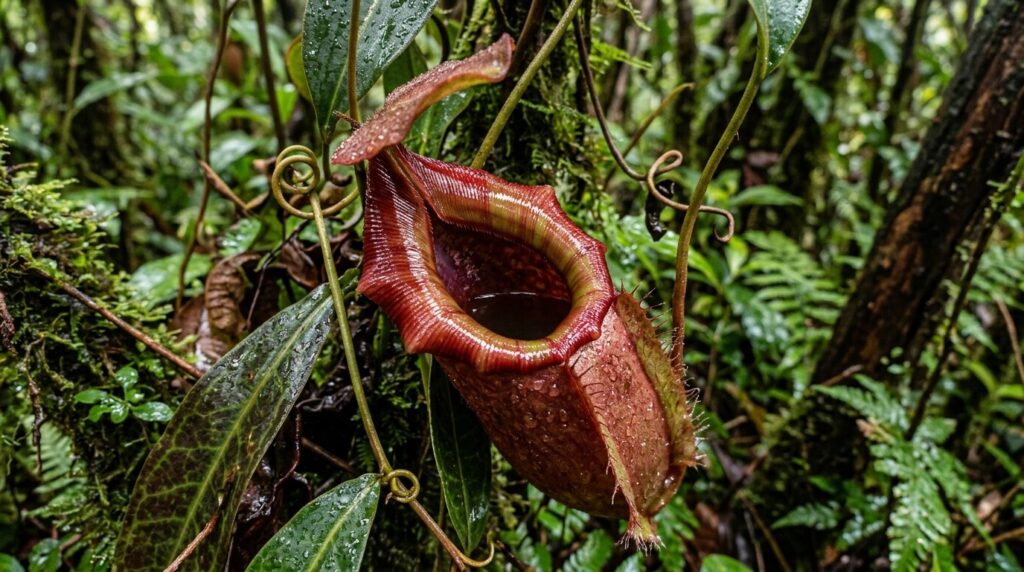
Scientists copied the trap of a carnivorous plant and created the world’s slipperiest material
The world’s slipperiest material is neither ice nor the Teflon once used in frying pans. Scientists have developed a coating inspired by a carnivorous tropical plant. Almost everything slides off such surfaces: water, oil, blood, and even bacteria. The technology is already being tested in industry and medicine, but it’s still a long way from becoming ubiquitous.
How the Nepenthes Trap Works
In the tropical forests of Southeast Asia grows Nepenthes — a carnivorous plant with pitcher-shaped traps. Insects land on the rim of the pitcher, and then something happens that has amazed biologists for decades: the prey instantly loses grip and slides inside. There is no way to climb back out.
The secret is neither glue nor venom. The rim of the Nepenthes trap is covered with microscopic pores that constantly retain the thinnest layer of water. The result is a kind of natural ice rink: the insect’s legs cannot grip a solid surface because there is always a liquid film between them and the wall. It is precisely this principle of a porous material infused with liquid that scientists used as the basis for creating a super-slippery artificial coating.
How SLIPS Material Works
The technology was named SLIPS — Slippery Liquid-Infused Porous Surfaces. The idea, described by scientists in the Journal of Physics Conference Series, is remarkably simple.
The base material has pores measured in microns or nanometers — it can be a specially treated polymer or ceramic. A lubricant is loaded into the pores, and it stays firmly inside thanks to capillary forces. On top, a smooth, stable layer of liquid forms — everything slides along it without ever reaching the solid substrate.
To understand how this works, imagine a wet ice rink. Regular ice is slippery on its own, but if you constantly maintain a thin layer of water on top of it, friction drops even further. In the case of SLIPS, the role of “water” is played by special oils, most often perfluorinated ones — chemically inert and very stable. And the role of “ice” is played by the porous substrate that securely holds the lubricant.
The result is impressive: the friction coefficient of such coatings is tens of times lower than that of Teflon. Almost any liquid flows off them without leaving a trace, and solid contaminants simply cannot take hold.
Why Almost Nothing Sticks to SLIPS Coatings
Conventional non-stick coatings, like Teflon, have a weak point: their surface is still solid. Any micro-scratch or defect creates a point where dirt, bacteria, or a drop of liquid can cling. Over time, the coating wears out and loses its properties.
SLIPS material works on a fundamentally different principle. Since the contact layer is a liquid rather than a solid, there are no scratches on it. Even if the external environment damages part of the surface, the lubricant flows over and restores the film’s integrity.
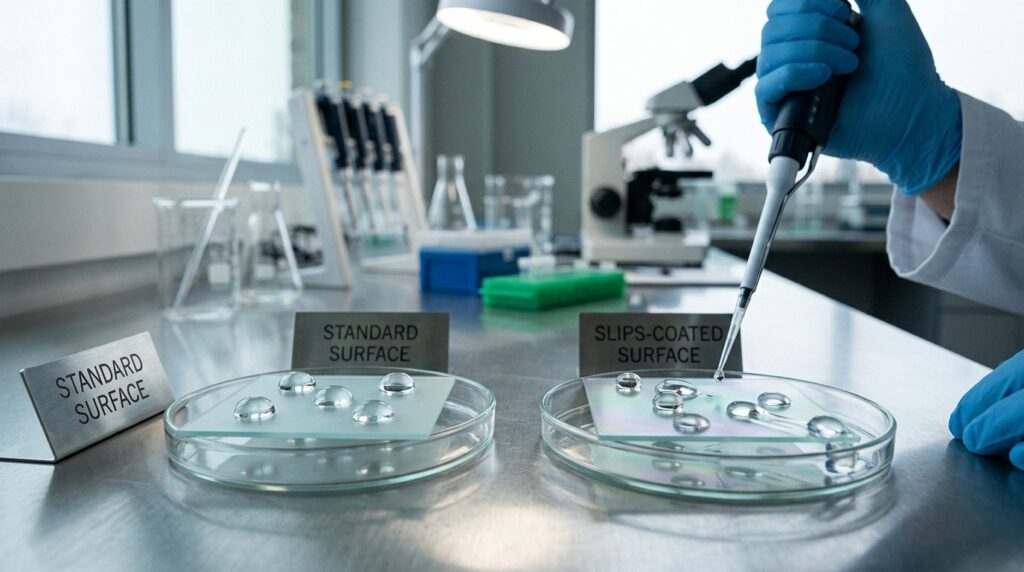
Comparison: a water droplet instantly rolls off a SLIPS coating but lingers on a regular surface
There is another important effect. On a liquid lubricant, bacteria cannot form a biofilm — that dense colony they usually use to firmly cling to solid materials. There is simply nothing to hold on to. That is why medical professionals are looking at SLIPS with particular interest.
Where Super-Slippery Materials Are Used
There are already quite a few application areas for SLIPS coatings, although most projects are still undergoing testing or are being implemented selectively.
The slipperiest material in industry helps solve several serious problems:
- Protecting pipelines and tanks from the buildup of oil, paraffins, and other viscous substances, which reduces cleaning costs and increases throughput;
- Fighting icing — ice on a SLIPS surface holds tens of times more weakly than on ordinary metal. This is critically important for power lines, aviation, wind turbines, and ships operating in cold latitudes;
- Anti-corrosion protection — the lubricant layer physically isolates the metal from water and aggressive environments;
- Self-cleaning surfaces for solar panels, building facades, and optical instruments.
In the search for ideal materials, scientists often chase strength, but sometimes the key property is precisely the absence of adhesion.
In medicine, the potential of slippery materials is even more exciting:
- Coatings for catheters, implants, and surgical instruments that blood and proteins do not stick to. This reduces the risk of thrombosis and infections;
- Surfaces for hospital equipment, door handles, and operating tables that prevent bacteria from establishing themselves — without any antibiotics or antiseptics;
- Containers for storing and transporting blood and biomaterials — where every drop counts.
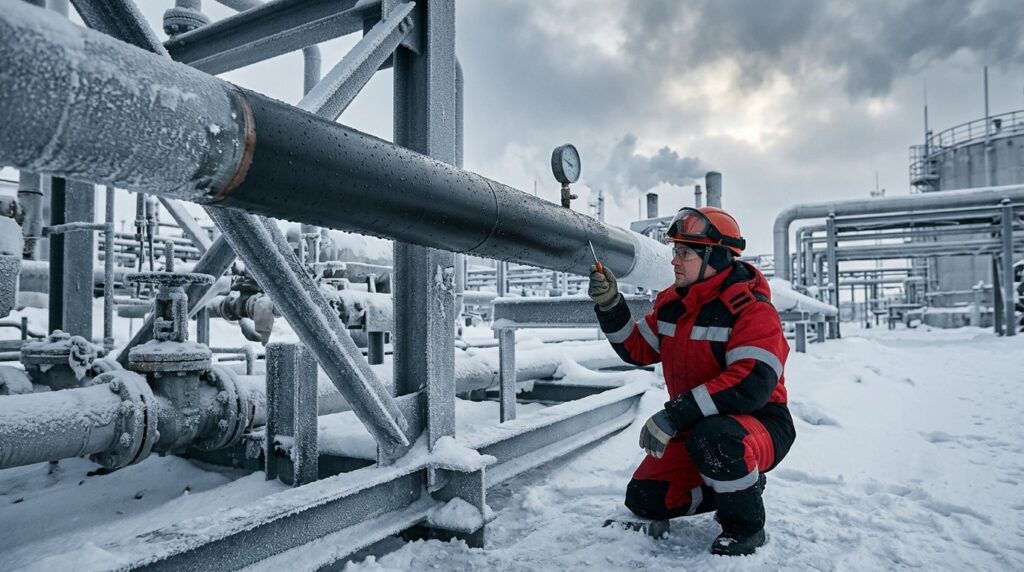
SLIPS coating on a pipeline prevents ice formation even in extreme frost
What Prevents SLIPS Coatings from Reaching Mass Production
If the technology is so great, why isn’t everything coated with it? There are several reasons, and they are quite mundane.
First, the lubricating liquid gradually evaporates or gets washed away. In laboratory conditions, the coating works perfectly, but in real-world environments — under rain, wind, and mechanical loads — its lifespan is limited. Scientists are working on self-replenishing systems where lubricant is supplied from an internal reservoir, but for now this complicates the design and increases the cost.
Second, some lubricants are not compatible with every application. The food industry requires compositions safe for humans, medicine requires biocompatible ones, and the oil industry requires those resistant to aggressive chemicals. There is no universal formula yet.
Third, scaling up production remains expensive. Creating a perfect nanoporous coating on a lab sample the size of a coin is one thing. Coating a kilometer-long pipeline or an airplane wing with it is an entirely different matter.
Finally, perfluorinated liquids most commonly used in SLIPS raise environmental concerns. Some of these compounds belong to forever chemicals (PFAS), which break down extremely slowly in nature. The search for safe alternatives is one of the key research directions.
Nevertheless, progress is noticeable. Over the past decade, the number of publications on SLIPS has grown tens of times, and the first commercial products have appeared — from anti-icing sprays to medical coatings. The technology has clearly moved beyond the purely academic stage.
The remarkable properties of the Nepenthes plant, honed by millions of years of evolution, turned out to be so elegant that we cannot yet reproduce them in full. But each new experiment brings us closer to the moment when the world’s slipperiest material becomes just as commonplace as Teflon once did.