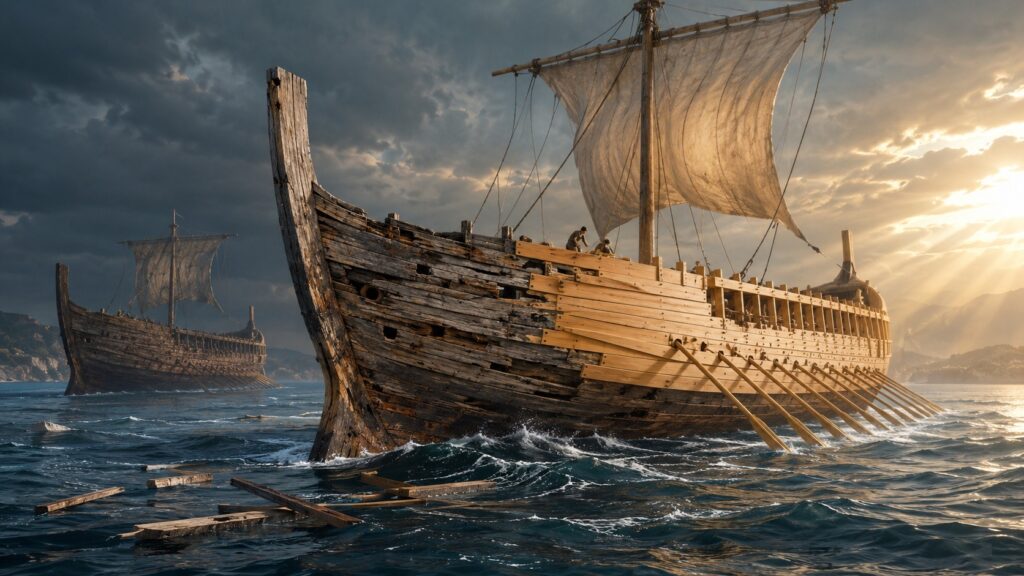
The Ship of Theseus can be considered the most ancient paradox in human history
Attentive readers of our site know that the cells of the human body are renewed every 7–10 years. This means that in ten years, we will be made up of entirely new molecules. But will we still be ourselves? This is not a question of psychology or mysticism, but an old philosophical puzzle called the Ship of Theseus. It was conceived several centuries before our era, yet it still has no definitive answer. And for some reason, it equally troubles a neurobiologist with a tomograph and an ordinary person who simply scratched their head in front of a mirror.
What Is the Ship of Theseus Paradox in Simple Terms
According to Greek myth, the hero Theseus defeated the monster Minotaur and returned to Athens on a ship. The Athenians preserved this ship as a relic and every year sent it on a voyage to the island of Delos in honor of the god Apollo. Over time, the planks rotted and were replaced with new ones. First one, then another, then a third, until not a single original part of the initial ship remained.
And here ancient philosophers asked the question: if all parts of the ship have been replaced, is it still the same Ship of Theseus, or is it an entirely different one? And if it is different, at what exact moment did it stop being “that same” ship? When the first plank was removed? The tenth? The last?
This story was preserved for us by Plutarch in his Life of Theseus. He wrote that the ship became a constant subject of debate among philosophers: some believed the vessel remained the same, others believed it did not. And in over two thousand years, the debate has never been settled.
What Thomas Hobbes Added to the Paradox in the 17th Century
According to the Encyclopedia Britannica, in the 17th century, English philosopher Thomas Hobbes added another twist to the puzzle. Imagine that a certain custodian collected all the old planks removed from the ship and assembled a second ship from them, identical to the original. Now we have two vessels. One is the one standing in the port with all its parts replaced. The other is assembled entirely from original parts.
Which of the two ships is the real Ship of Theseus? The one that preserved its form and continuous history but has not a single original plank? Or the one made of original material but was disassembled and reassembled?
Hobbes showed that the phrase “the same” has at least two meanings — identity of form and identity of matter. And they can contradict each other. If both ships are “real,” then we end up with two identical originals, which sounds absurd.
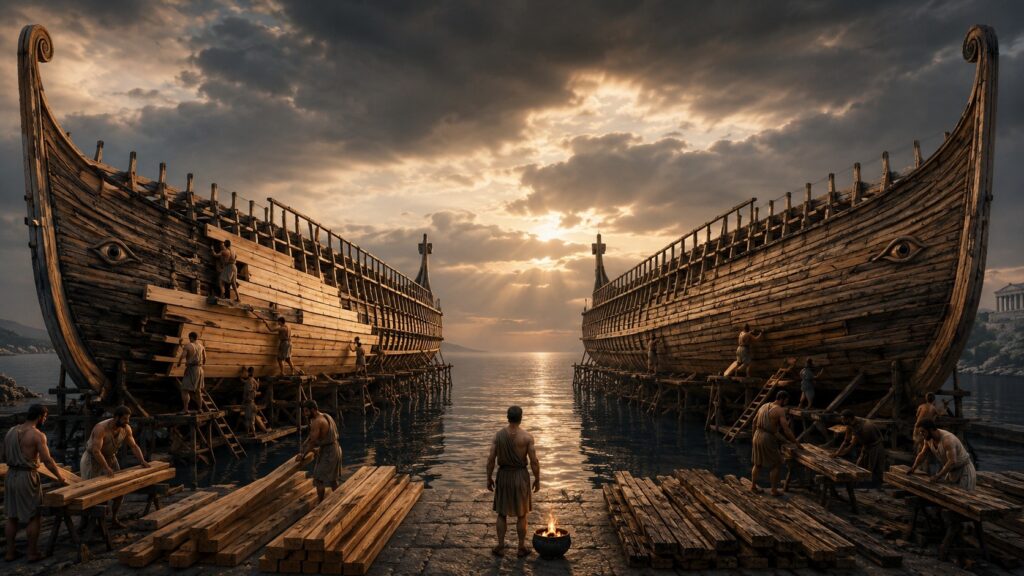
Visualization of the Theseus paradox
Does the Ship of Theseus Remain the Same After Replacing Its Parts
Over the centuries, philosophers have proposed several fundamentally different answers to this question, and none of them has become universally accepted.
The most popular solution, according to the Stanford Encyclopedia of Philosophy, is to recognize that the material from which the ship is made and the ship itself as an object are not the same thing. They simply occupy the same place in space at the same time. It sounds strange, but the logic is this: a ship is not a set of planks, but a certain structure with a certain history.
Another approach was proposed by American philosopher David Lewis. He suggested viewing objects as a series of temporal slices, like frames in a movie. The ship on Monday and the ship on Friday are not one object that changes, but two different slices of one entity stretched across time.
There is also a third point of view — the so-called theory of continuous identity. If changes occur gradually and the object was not completely destroyed in a single moment, it remains the same. A house in which all walls were replaced one by one over ten years is still the same house. But if you demolish it entirely and rebuild it in a day, it is already a different house.
Noam Chomsky and a number of cognitive scientists believe that the paradox arises from peculiarities of our thinking, not from the structure of reality. We are accustomed to believing that our intuitive notions about things accurately reflect the world, but this is far from always the case.
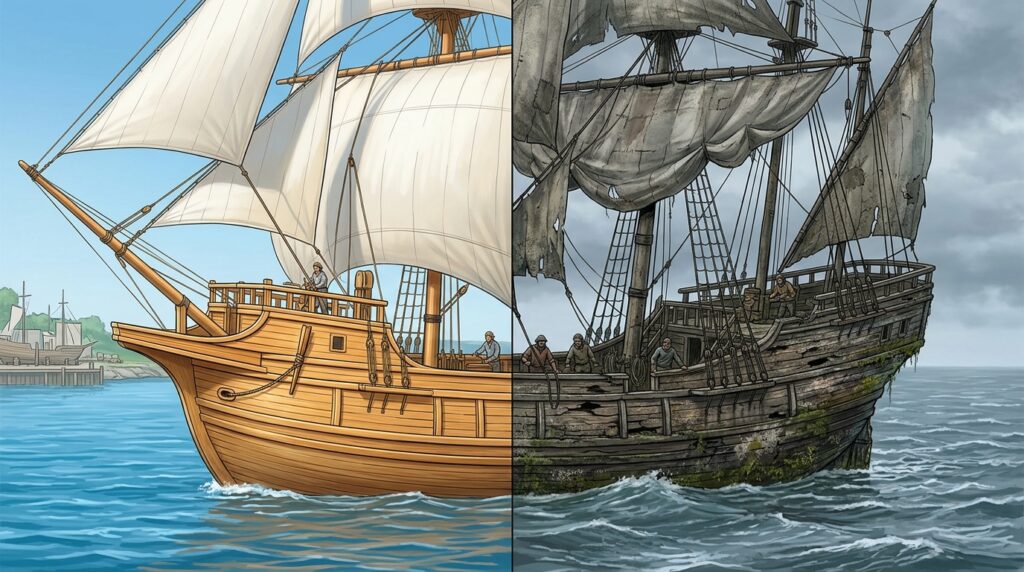
Two ships: one with new planks, the other made from old ones. Which one is real?
How the Ship of Theseus Relates to the Human Body
And now for the most interesting part — you yourself are the Ship of Theseus. About 330 billion cells in your body are replaced every day. Stomach cells are renewed in a couple of days, skin in two to three weeks. The skeleton is completely renewed in about ten years.
A popular myth states that the body is completely renewed every seven years. In reality, research has shown that the average age of a cell in the body is 7 to 10 years, but this is just an average: some cells live only a few days, others last decades. Some brain neurons stay with us throughout our entire lives and are never replaced at all. The same applies to lens cells of the eye — they form during the embryonic period and are preserved until death.
So our body is simultaneously both a “renewed ship” and partially an “original” one. You in ten years are mostly a different set of atoms and cells, but with the same neurons, the same memories, and the same sense of “I.” Where exactly does the boundary lie between the former you and the new you? This is the Ship of Theseus paradox, only applied to a human being.
The Ship of Theseus in the Real World
This paradox is not just a mental exercise. It appears in entirely real situations.
USS Constitution — an American wooden frigate, the oldest commissioned warship afloat, launched in 1797. According to U.S. Navy specialists, only about 8–10 percent of the original material remains. The ship’s museum directly references the Ship of Theseus paradox, yet concludes that while the Constitution contains virtually no original timber, we believe no one would consider it a replica.
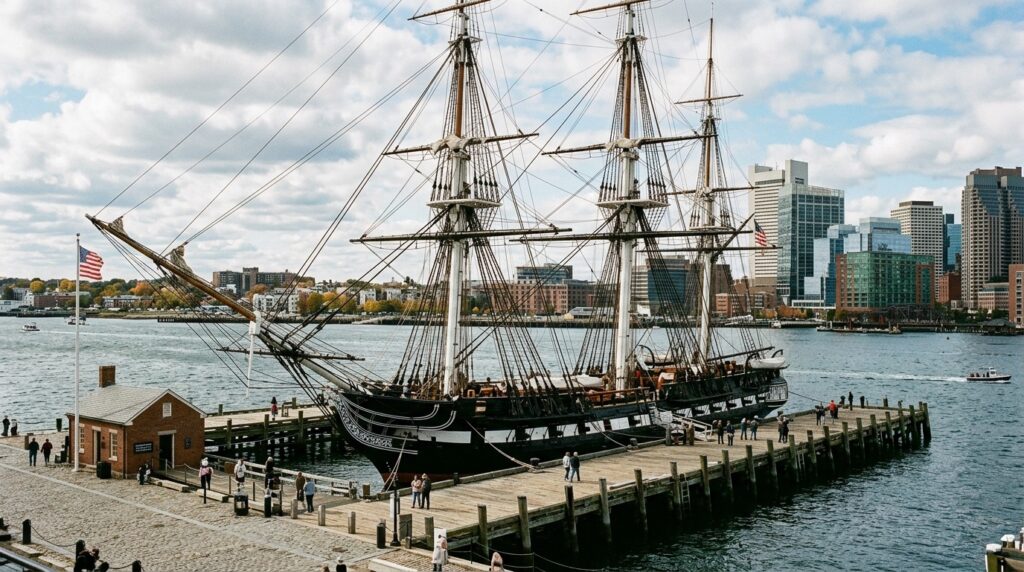
The frigate USS Constitution in Boston Harbor — a real-life Ship of Theseus
Another stunning example is the Ise Grand Shrine in Japan, which since the late 18th century has been completely rebuilt every twenty years on an adjacent site. The current building, erected in 2013, is already the 62nd version, and the 63rd will be completed in 2033. The reconstruction symbolizes the Shinto idea of death and renewal, the impermanence of all things. The Japanese see no contradiction here: the shrine remains the same, simply eternally young.
Why the Ship of Theseus Paradox Has No Answer
The fact is that the Ship of Theseus paradox is not a mathematical problem with a single solution. It is a question about what we actually mean by the words “the same.” And as it turns out, these words have no single universal meaning.
American philosopher Hilary Putnam argued that the very concepts of “object” and “existence” have multiple equally valid meanings, and none of them is the only correct one. This is a position sometimes called the doctrine of quantifier variance. Simply put, the debate is not about the ship, but about language and ways of thinking.
There is also another important perspective that comes from cognitive science. The ship can be viewed not as a “thing” or a set of parts, but as an organizational structure with continuous perception. We consider an object “the same” as long as our brain perceives it as continuous. This tells us more about our brain than about the ship itself.
That is why the paradox has proven so enduring and has survived to the present day. It is not simply about planks and nails — it is about the limits of our thinking, about the nature of identity, about what makes a thing or a person themselves. Every era finds something new in it.