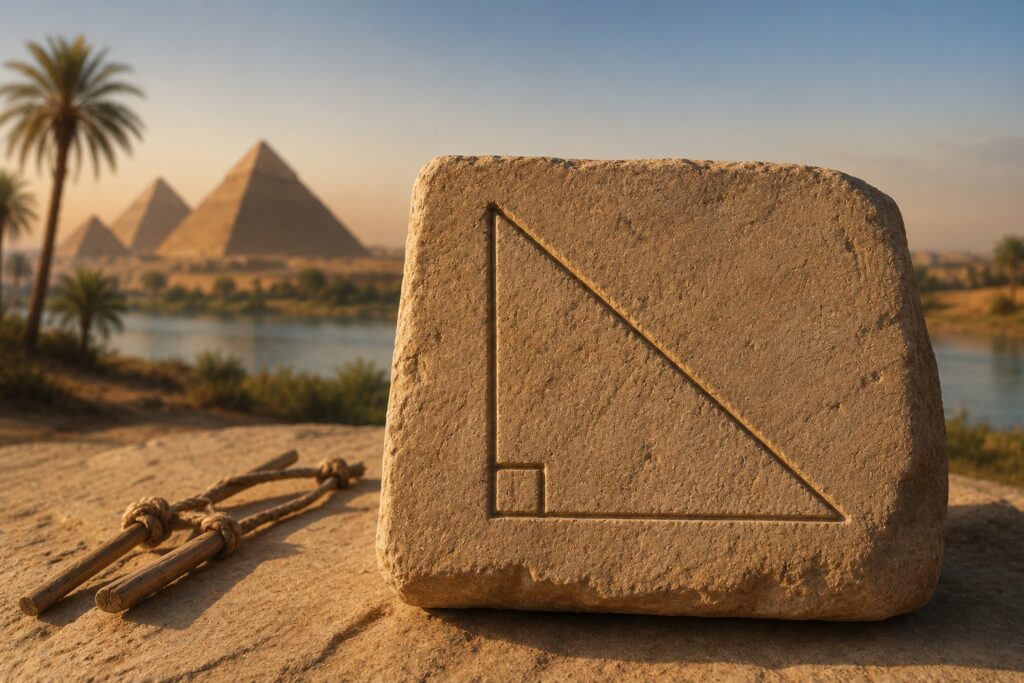
The Pythagorean theorem turned out to be thousands of years older than Pythagoras himself
Everyone who finished school knows the Pythagorean theorem, even if they’ve long forgotten geometry. But when it comes to its author, things aren’t so straightforward. Did Pythagoras actually discover it? Archaeology stubbornly says otherwise: mathematics appeared long before writing, and the Babylonians were already using this relationship over a thousand years before the Greek philosopher was even born. And the only surviving rigorous proof actually belongs to another person — Euclid. Quite the ancient detective story spanning centuries.
What Is the Pythagorean Theorem in Simple Terms
The formulation is familiar to the point of automaticity: in any right triangle, the square of the hypotenuse (the longest side, opposite the right angle) equals the sum of the squares of the other two sides. It’s written as a² + b² = c². The most famous example is a triangle with sides 3, 4, and 5: 3² + 4² = 5², or 9 + 16 = 25.
Behind this simplicity lies enormous practical value. In a world without GPS and laser rangefinders, the theorem allowed surveyors to mark right angles, builders to check the evenness of walls, and astronomers to calculate distances in the sky. If you know two sides of a right triangle, you can find the third. That’s why the relationship between the sides of a right triangle became one of the most useful tools of ancient mathematics.
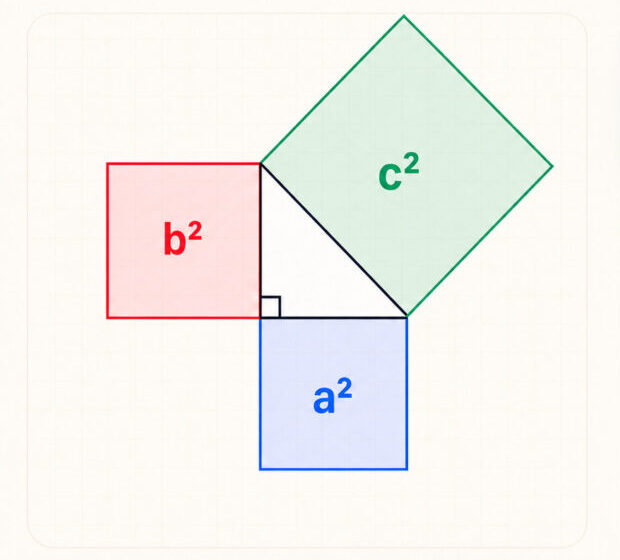
A common way to visualize the Pythagorean theorem.
And here’s the paradox: despite all its fame, the theorem most likely was not Pythagoras’s discovery. Moreover, Pythagoras himself left behind not a single surviving text.
Why the Theorem Was Named After Pythagoras
Pythagoras of Samos lived in the 6th century BCE and founded an unusual philosophical community in Croton (in the south of modern-day Italy). The Pythagoreans practiced communal living, vegetarianism, vows of silence, and believed that numbers were the fundamental basis of the Universe. Pythagoras himself lived in a cave where he conducted private research and occasionally spoke before his students.
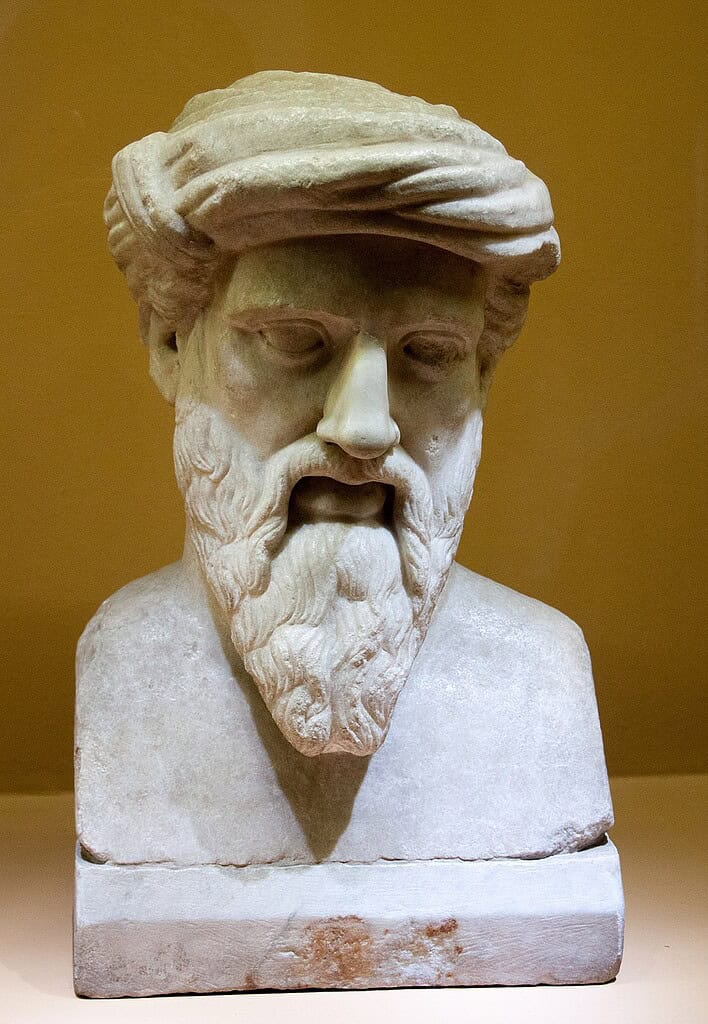
Roman copy of a Greek bust of Pythagoras from the 2nd–1st centuries BCE.
But not a single text personally written by Pythagoras has survived. At least, archaeologists have found nothing. Greek and Roman authors attributed important mathematical discoveries to Pythagoras (or more precisely, to the Pythagoreans, his students). But in none of the earliest sources closest in time, including the works of Plato and Aristotle, is there any mention of Pythagoras’s connection to the theorem.
Perhaps Euclid — the Greek thinker — has more claim to the theorem. He wrote his legendary book Elements around 300 BCE, that is, two to three centuries after Pythagoras. And it was precisely in the Elements, Book I, Proposition 47, that Euclid proved that the square on the side opposite the right angle equals the sum of the squares on the other two sides. Notably, he did not mention Pythagoras at all.
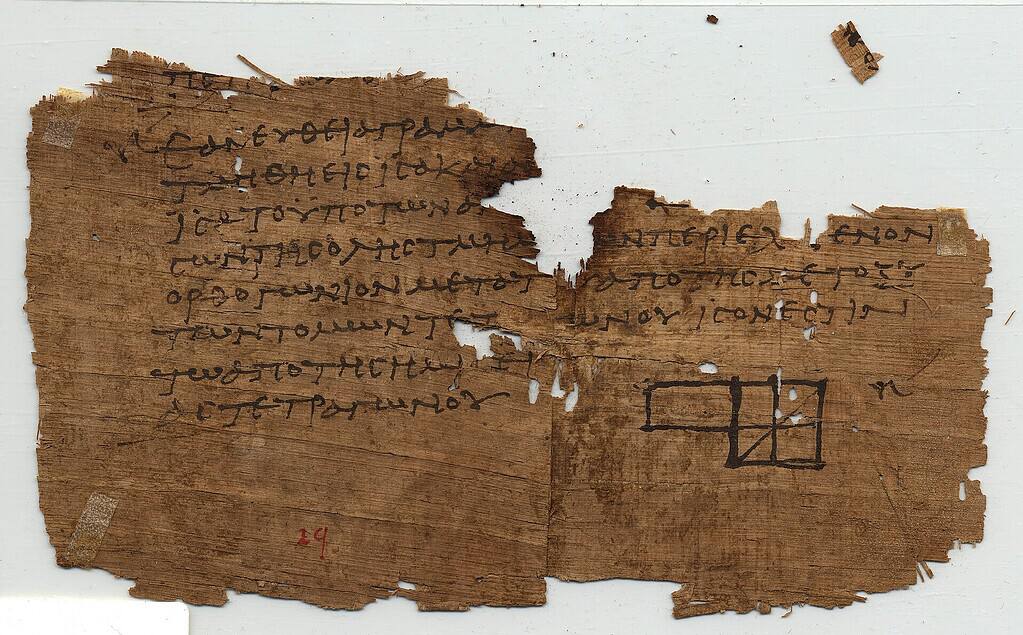
Fragment of a papyrus from the second book of Euclid’s Elements.
The name of Pythagoras was attached to the theorem much later. In the 1st century BCE, this was done by Cicero and Plutarch. Even later, the biographer of Greek philosophers Diogenes Laërtius wrote that Pythagoras allegedly “sacrificed an ox in honor of discovering the theorem.” The 5th-century scholar Proclus mentions the same thing. There is no archaeological confirmation of this, but the point is not even that.
The Babylonians Knew the Pythagorean Theorem Before the Greeks
It’s quite possible that important works by Pythagoras, written by his own hand, simply haven’t survived. But the key point is that other people were using the theorem millennia before him. The most convincing evidence that the theorem was known long before the Greeks came from Mesopotamia.
The clay tablet Plimpton 322, dating to approximately 1800 BCE, contains 15 rows of numbers that represent Pythagorean triples — sets of numbers forming the sides of right triangles. And these aren’t just the simplest examples like 3-4-5: some triples include five-digit numbers, indicating a systematic mathematical method rather than random measurements. In its structure, the tablet resembles a prototype of an ancient trigonometric table.
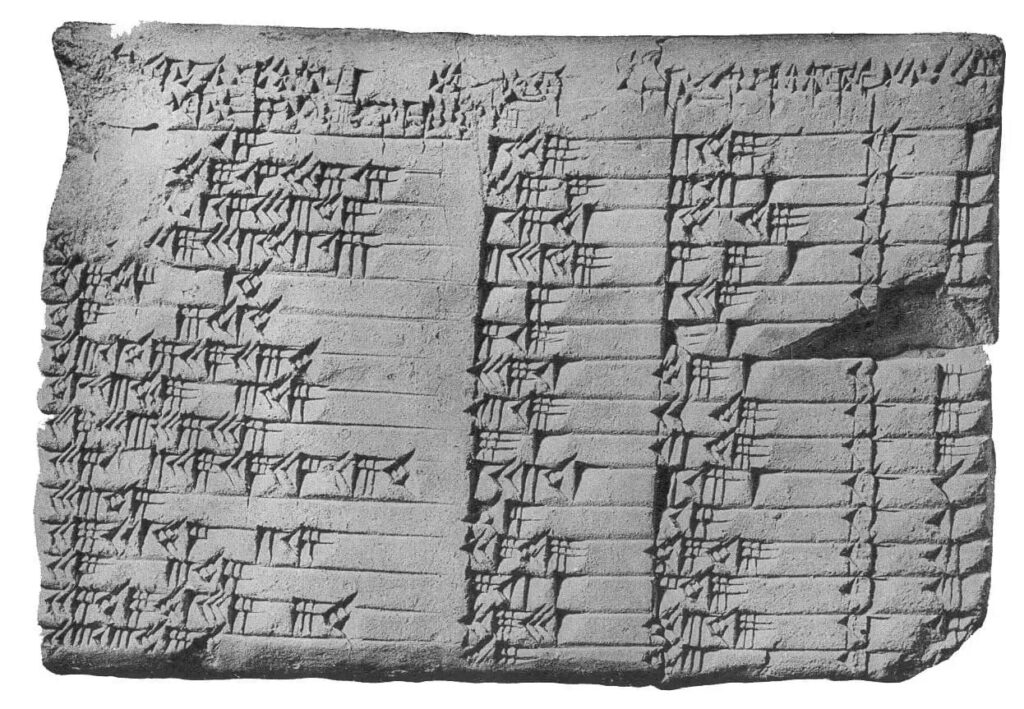
Plimpton 322, a Babylonian tablet with Pythagorean triples.
There is also another tablet — YBC 7289 — a Babylonian tablet from Yale University. It shows a square with diagonals and provides an approximation of √2 accurate to the sixth decimal place: approximately 1.414213. For the 18th–17th centuries BCE, this accuracy is staggering. And the connection to the theorem is direct: the diagonal of a square with side 1 is the hypotenuse of a right triangle with two legs of 1, and by the theorem it equals exactly √2.
In other words, Babylonian scribes didn’t just know about the relationship — they could systematically apply it — over a thousand years before Pythagoras was born.
How the Pythagorean Theorem Was Used in Egypt and China
Meanwhile, Egyptian scribes used mathematics for accounting grain, taxes, and labor, and their knowledge of geometry (including the relationship between areas of squares and right angles) helped in surveying and construction. Egyptian surveyors used cords to measure land plots and draw straight lines. The Greeks later called such surveyors “harpedonaptai,” meaning rope-stretchers. Similar practical logic also applied to major ancient construction projects: there is still debate about how the pyramids were built and how stone blocks were delivered to them.
The Berlin Papyrus 6619, dating to approximately 1800 BCE, contains a problem about two squares whose areas together equal the area of a third square of 100 square cubits. One side of the square is 3/4 of the other. In modern terminology, the problem reads: x² + y² = 100. The solution yields sides of length 6 and 8, forming a 6-8-10 triangle — a scaled-up version of the 3-4-5 triangle. The Egyptians applied this in practice: after the annual Nile floods, field boundaries had to be re-marked, and the geometry of right triangles was a vital necessity for them.
In India, the “Shulba Sutras” (texts from approximately the 8th–2nd centuries BCE) described how to build sacrificial altars. Altars had to be enlarged, reduced, and rebuilt while preserving the sacred area — precise geometry was indispensable. The “Baudhayana Shulba Sutra,” usually dated to the 8th century BCE, provides one of the earliest explicit formulations of the theorem: “The rope stretched along the diagonal of a rectangle produces an area equal to that which the vertical and horizontal sides create together.” In essence — the same Pythagorean theorem, just stated in different words.
In the Chinese tradition, the same relationship was called the “Gougu theorem” (gou and gu being the legs, xian being the hypotenuse). The ancient “Zhoubi Suanjing” already features a triangle.